PIL in Supreme Court Challenges 0.4% MDR on UPI Transactions Above Rs.2,000:
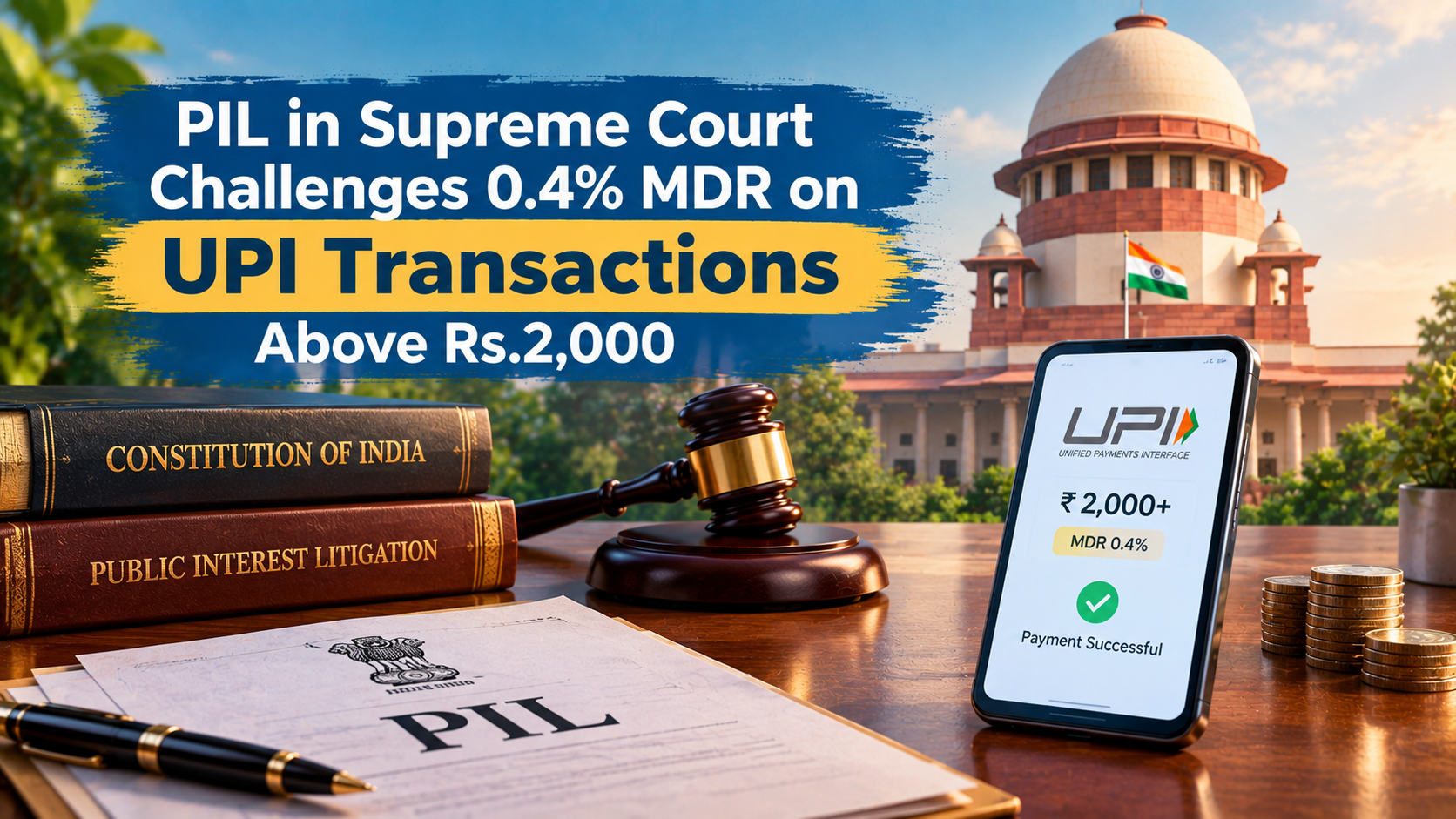
A PIL has been filed before the Supreme Court challenging the Centre’s decision to introduce a Merchant Discount Rate (MDR) on UPI transactions exceeding Rs.2,000.
Plea Seeks Quashing of New UPI Merchant Charges
 Saima
Saima Sep 19, 2026
A Public Interest Litigation has been filed before the Supreme Court by Advocate Anjan Datta challenging the Centre’s recently introduced framework permitting Merchant Discount Rate (MDR) on specified UPI person-to-merchant transactions exceeding Rs.2,000.
The petition challenges the Union Finance Ministry’s September 14, 2026 notification and the MDR framework announced, which is scheduled to come into effect from October 15, 2026. Under the new framework, UPI person-to-person (P2P) transactions would continue to remain free, while specified P2M transactions above Rs.2,000 would attract MDR.

The standard MDR has been announced at 0.4%, subject to a maximum charge of Rs.300 for transactions of Rs.75,000 or more. Certain specified sectors would attract a flat Rs.5 MDR, while capital-market transactions would carry a lower rate. Small merchants receiving up to Rs.1 lakh per month through UPI QR codes would continue to receive zero-MDR treatment.
The petitioner has questioned the Rs.2,000 transaction threshold and Rs.1 lakh monthly-receipt ceiling, arguing that the basis and supporting data for these classifications have not been disclosed. The plea alleges that the differential treatment may result in unequal treatment of similarly situated merchants and raises issues under Article 14 of the Constitution. The plea questions whether such a nationwide financial burden can be created through press releases, FAQs and directions without adequate statutory standards and safeguards.

The petition has also challenged the constitutional validity of the amended Section 10A of the Payment and Settlement Systems Act, 2007, alleging that the provision does not provide sufficient standards for determining MDR rates and related classifications.
The PIL has been filed before the Supreme Court and no final adjudication on the constitutional validity of the MDR framework has been reported as of September 16, 2026. The Centre is yet to respond to the challenge, and the Supreme Court has not expressed any view on the merits of the petition. The framework is presently scheduled to take effect from October 15, 2026, subject to any subsequent judicial or governmental intervention.
About Author


Saima
Content Writer
 StudyCafe
 Delhi, Delhi, India
 529
529My Recent Articles
- ITAT Dismisses Duplicate Appeal as Withdrawn After Assessee Confirms Earlier Filing
- ITAT Remands Reassessment Case for Fresh Adjudication
- ITAT Remands Ex-Parte Appeal for Fresh Adjudication
- ITAT Condones 115-Day Delay in Appeal To Provide Substantive Justice
- ITAT Deletes Disallowances on Foreign Currency Loan Interest and Forex Loss in American Express Bank Case
Loading suggestions…


Recent Posts
All Posts


Recent Posts
All Posts