Supreme Court Stays Punjab & Haryana High Court Ruling Declaring Income-Tax Section 147A Unconstitutional:
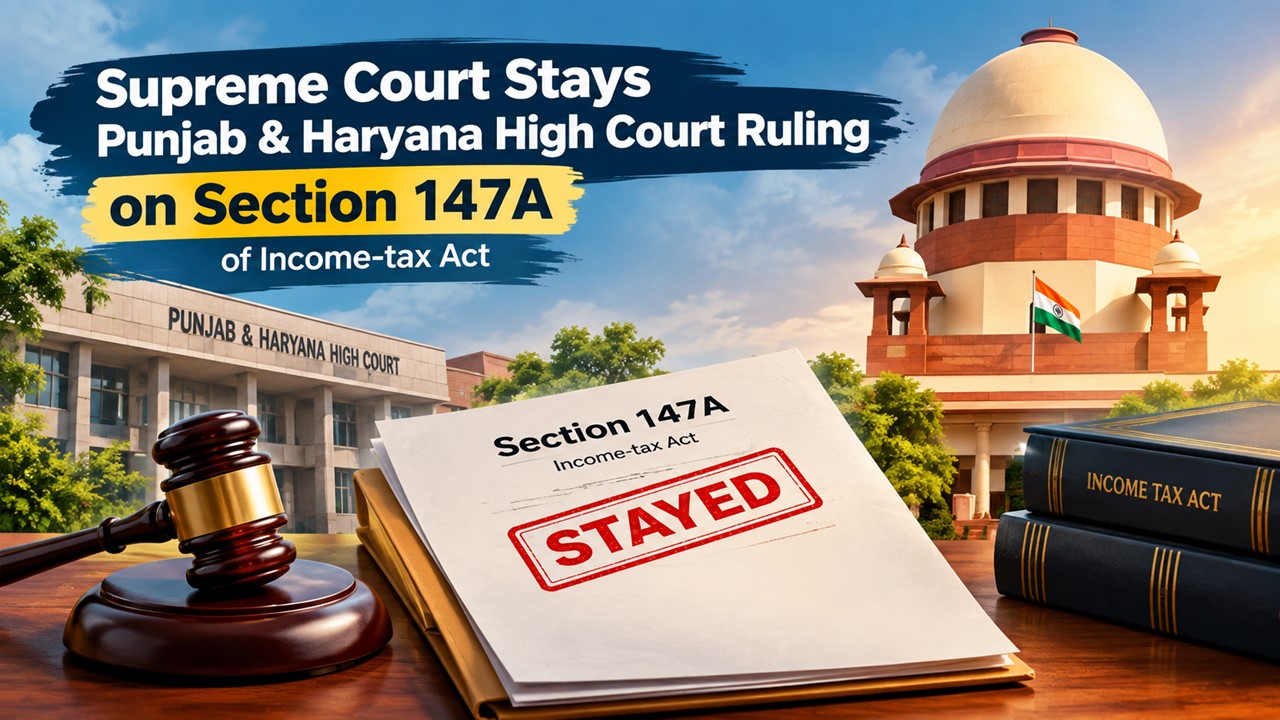
The Supreme Court has stayed the Punjab and Haryana High Court judgment striking down Section 147A of the Income-tax Act, pending final hearing on December 3.
Final Hearing Schedule for December 3
 Saloni Kumari
 Sep 19, 2026
The Supreme Court has put a stay on a judgement delivered by the Punjab and Haryana High Court's judgement, wherein Section 147A of the Income-tax Act, 1961, was declared unconstitutional.
The apex court has passed the interim order while hearing the Centre’s challenge against the High Court judgement in a case titled Union of India and Others v. Bharat Industrial Enterprises Private Limited. The Supreme Court has directed that the High Court ruling would remain stayed and that the related assessment and reassessment proceedings should not proceed until the case is finally decided.

The dispute concerns the issuance of notices under Section 148 of the Income-tax Act for reopening assessments. The key issue is whether such notices can be issued directly by the taxpayer’s Jurisdictional Assessing Officer (JAO) or whether they must be issued through the faceless assessment mechanism.
The issue arose in the context of Section 151A and the e-Assessment of Income Escaping Assessment Scheme notified on March 29, 2022. The scheme provided for automated allocation and a faceless process for issuing reassessment notices. Several taxpayers later challenged notices issued directly by their respective JAOs.

Parliament subsequently introduced Section 147A through the Finance Act, 2026, with retrospective effect from April 1, 2021. The provision stated that, for specified reassessment proceedings, the term “Assessing Officer” would refer to an officer other than the National Faceless Assessment Centre (NFAC) or its assessment units.
However, on September 10, the Punjab and Haryana High Court struck down Section 147A. The High Court held that Parliament could change the legal position created by a court ruling only by addressing the underlying legal basis of that ruling, rather than simply declaring through legislation that the earlier judicial position would not apply.
The High Court also held that Section 151A and the 2022 scheme still required reassessment notices to be issued through an automated and faceless process. It said that the introduction of Section 147A, even with its overriding effect, did not change the earlier interpretation or remove the conflict between the provisions.
The Centre challenged the High Court decision before the Supreme Court. The apex court has stayed the ruling, and the final hearing is scheduled for December 3.
About Author


Saloni Kumari
Content Writer
 StudyCafe
 Delhi, Delhi, India
 2886
2886My Recent Articles
- Dreamfolks Services Faces Rs 1.58 Crore IGST Demand Over ITC Availment on Invoices Issued by GST-Cancelled Supplier
- ITAT Restores Taxpayer's Appeal In Interest of Natural Justice After CIT(A)'s Failure to Decide Appeal on Merits
- ITAT Restores Income Tax Appeal to CIT(A) After Condoning 115-Day Delay Due to COVID-19 Genuine Hardship
- ITAT Quashes Reassessment Order Against Geecee Ventures Over Lack of Section 151 Approval From Specified Authority
- ITAT Sets Aside Rs 3.47 Crore Addition, Reopening Beyond 4 Years Without PCIT Approval Is Legally Invalid
Loading suggestions…


Recent Posts
All Posts
Recent Posts
All Posts