Police investigation into alleged GST offence cannot be ordered after taking cognizance under the Cr.P.C
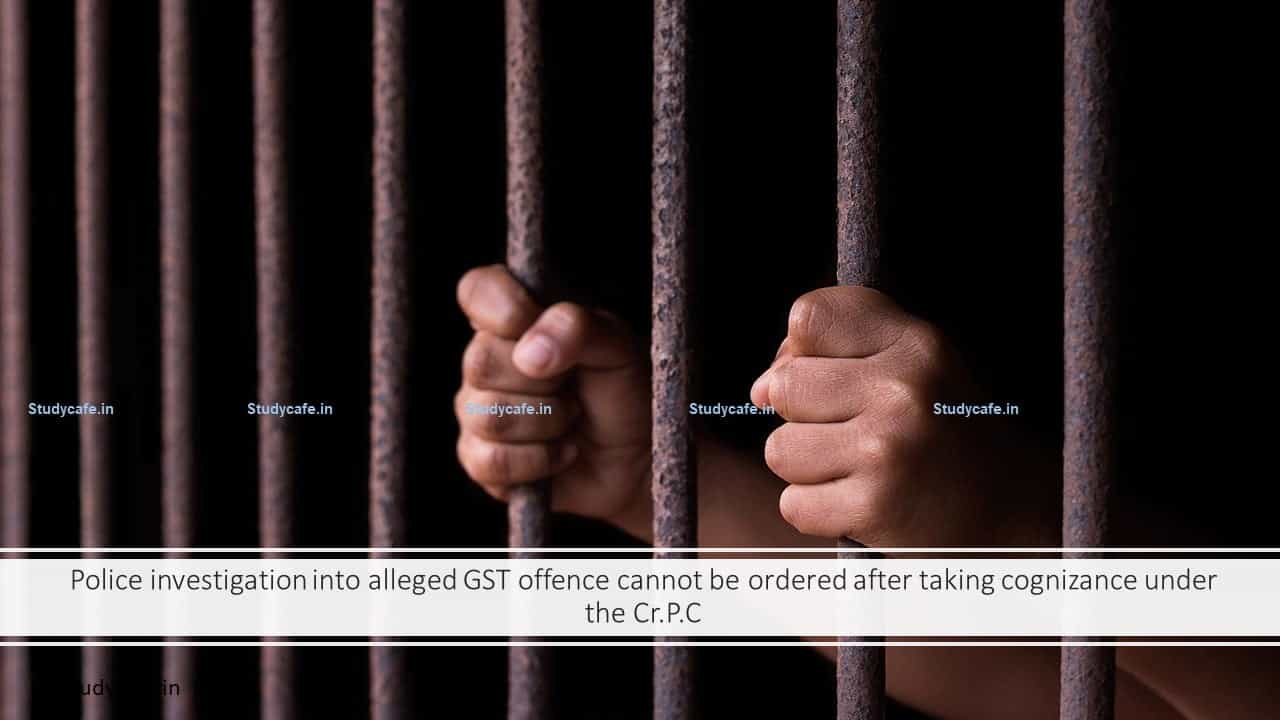
Police investigation into alleged GST offence cannot be ordered after taking cognizance under the Cr.P.C. The Hon’ble Tripura High Court in Shri Sent…
 A2ZBimal Jain
 Jul 13, 2021
Police investigation into alleged GST offence cannot be ordered after taking cognizance under the Cr.P.C.
The Hon’ble Tripura High Court in Shri Sentu Dey v. State of Tripura [Criminal Petition No. 14/2021 dated May 28, 2021] quashed the order passed for police investigation by the Judicial Magistrate in a matter of alleged GST offence. Held that, once the cognizance of offences alleged in the complaint has been taken by the Magistrate, it was thereafter not open to change the course and revert back to the initial option of requiring police investigation and calling for police report.
Facts:
This petition has been filed by Shri Sentu Dey (“the Petitioner”) a sole proprietor of M/S. Sentu Dey, against the order dated January 2, 2021 (“impugned order”) passed by the Judicial Magistrate, on a complaint by Superintendent of State Taxes, Bishalgarh (“the Respondent”) to the Sub-Divisional Magistrate, Bishalgarh (“SDM”), alleging that the Petitioner had under declared the outward taxable turnover and accordingly, against the demand of Rs 19.74 crores (approx.) raised for the period starting from August, 2017 onwards, paid only Rs. 1.18 crores (approx.) and when notices were issued to purchasing dealers, it was informed that the taxes had been already paid to the Petitioner. Further, it was alleged that the Petitioner though had collected the taxes from the purchasing dealers, had not deposited the same in the Government revenue, thus punishable under Section 132 of the Central Goods and Services Tax Act, 2017 (“CGST Act”).
The SDM directed to register a criminal case and transfer to the Judicial Magistrate. Accordingly, on November 27, 2020, a complaint was registered and was placed before the Judicial Magistrate and an order was passed for fixing the examination at later date.
Subsequently, the Judicial Magistrate afterwards passed the impugned order directing the investigation by Police before taking the cognizance, under Section 156(3) of the CrPC Act after registering a complaint as a First Information Report (“FIR”) and called for a report.
The Petitioner has contended that once the complaint was placed before the Judicial Magistrate, and had taken cognizance thereon. It was thereafter not open to call for investigation.
Issue:
- Whether is it reasonable for calling police investigation by the Magistrate whereupon cognizance of complaint has already been taken by the Magistrate for an offence punishable under Section 132 of the CGST Act?
- Analysed that, the powers of the High Court under Section 482 of the Criminal Procedure Code, 1973 (“Cr.P.C.”) read with Articles 226 and 227 of the Constitution of India are sufficiently wide and would not preclude from examining the legality and correctness of an order passed by the Judicial Magistrate, which adversely affects the Petitioner.
- Noted that, the Judicial Magistrate had taken cognizance of the offences disclosed in the complaint and the action of perusal of the case record which led to its decision to examine the witnesses at a later date clearly establishes application of mind on its part on the allegations made in the complaint and which led requirement of carrying out examination. The Judicial Magistrate perused the case records and was of the opinion that before deciding to take cognizance of the offence it was necessary to call for the police investigation, and it was open to do so.
- Observed that, after perusal of the case record, Judicial Magistrate was persuaded that there is a requirement of examination, would establish that the cognizance of the offence was already taken and the stage of examination of witness would not arise before taking cognizance by the Judicial Magistrate. Thus, these facts would leave no manner of doubt that the Judicial Magistrate had taken cognizance of the offences on November 27, 2020. It was thereafter not open for Judicial Magistrate to change the course and revert back to the initial option of requiring police investigation and calling for police report.
- Further observed that, the provisions of Section 190(1)(a) of the Cr.P.C. doesn’t require that the complaint is lodged before the concerned Magistrate, attempt must be first made to file a FIR before the police and only when the police authorities fail to register the FIR, the complainant can approach the Magistrate.
- Held that, in the impugned order, the Judicial Magistrate was of the opinion that before taking cognizance, the matter may be investigated by the police. In the process, the Judicial Magistrate lost sight of the fact that the stage of taking cognizance had already been crossed on November 27, 2020 itself.
- Quashed the impugned order passed by the Judicial Magistrate
- Directed the Judicial Magistrate to proceed further in accordance with the law from the stage of taking cognizance of the offence disclosed.
- (1)Whoever commits, or causes to commit and retain the benefits arising out of, any of the following offences, namely:-
- supplies any goods or services or both without issue of any invoice, in violation of the provisions of this Act or the rules made thereunder, with the intention to evade tax;
- issues any invoice or bill without supply of goods or services or both in violation of the provisions of this Act, or the rules made thereunder leading to wrongful availment or utilisation of input tax credit or refund of tax;
- avails input tax credit using the invoice or bill referred to in clause (b) or fraudulently avails input tax credit without any invoice or bill;
- collects any amount as tax but fails to pay the same to the Government beyond a period of three months from the date on which such payment becomes due;
- evades tax or fraudulently obtains refund and where such offence is not covered under clauses (a) to (d);
- falsifies or substitutes financial records or produces fake accounts or documents or furnishes any false information with an intention to evade payment of tax due under this Act;
- obstructs or prevents any officer in the discharge of his duties under this Act;
- acquires possession of, or in any way concerns himself in transporting, removing, depositing, keeping, concealing, supplying, or purchasing or in any other manner deals with, any goods which he knows or has reasons to believe are liable to confiscation under this Act or the rules made thereunder;
- receives or is in any way concerned with the supply of, or in any other manner deals with any supply of services which he knows or has reasons to believe are in contravention of any provisions of this Act or the rules made thereunder;
- tampers with or destroys any material evidence or documents;
- fails to supply any information which he is required to supply under this Act or the rules made thereunder or (unless with a reasonable belief, the burden of proving which shall be upon him, that the information supplied by him is true) supplies false information; or
- attempts to commit, or abets the commission of any of the offences mentioned in clauses (a) to (k) of this section,
About Author


A2ZBimal Jain
Chartered Accountant
CA Bimal Jain is a Member of Institute of Chartered Accountants of India since May 1994 and Member of Institute of Company Secretaries of India since December 2006 along with a Bachelors degree in Law. Also, he is a Qualified SAP - FI/CO Consultant and has more than 21 years of experience in Indirect Taxation and specializes in all aspects of Service Tax, Value Added Tax (VAT)/ Central Sales Tax (CST), Central Excise, Customs, Foreign Trade Policy (FTP), Special Economic Zone (SEZ), Export Oriented Unit (EOU), Export-Import Laws and well acquainted with the concept and impact of way forward Goods and Services tax (GST).
CA Bimal Jain is a Member of Institute of Chartered Accountants of India since May 1994 and Member of Institute of Company Secretaries of India since December 2006 along with a Bachelors degree in Law. Also, he is a Qualified SAP - FI/CO Consultant and has more than 21 years of experience in Indirect Taxation and specializes in all aspects of Service Tax, Value Added Tax (VAT)/ Central Sales Tax (CST), Central Excise, Customs, Foreign Trade Policy (FTP), Special Economic Zone (SEZ), Export Oriented Unit (EOU), Export-Import Laws and well acquainted with the concept and impact of way forward Goods and Services tax (GST).
 A2Z Taxcorp LLP
 Delhi, Delhi, India
 468
468My Recent Articles
- Actions taken by the department during enquiry need not necessarily be termed as harassment
- Who are liable to generate e-invoice w.e.f October 1, 2022
- Personal penalty cannot be imposed on the Chairman of the Company for failure in ensuring proper accounting of the goods
- Stayed the order of cancellation of GST Registration of the assessee for continuing the trading activities
- Can CA be arrested- Section 69 vs Section 132 of the CGST Act
Up Next
Loading suggestions…


Recent Posts
All Posts

Recent Posts
All Posts