Rajasthan Commercial Taxes Department Issues New Guidelines for GST Return Scrutiny Under Section 61 of RGST Act, 2017:
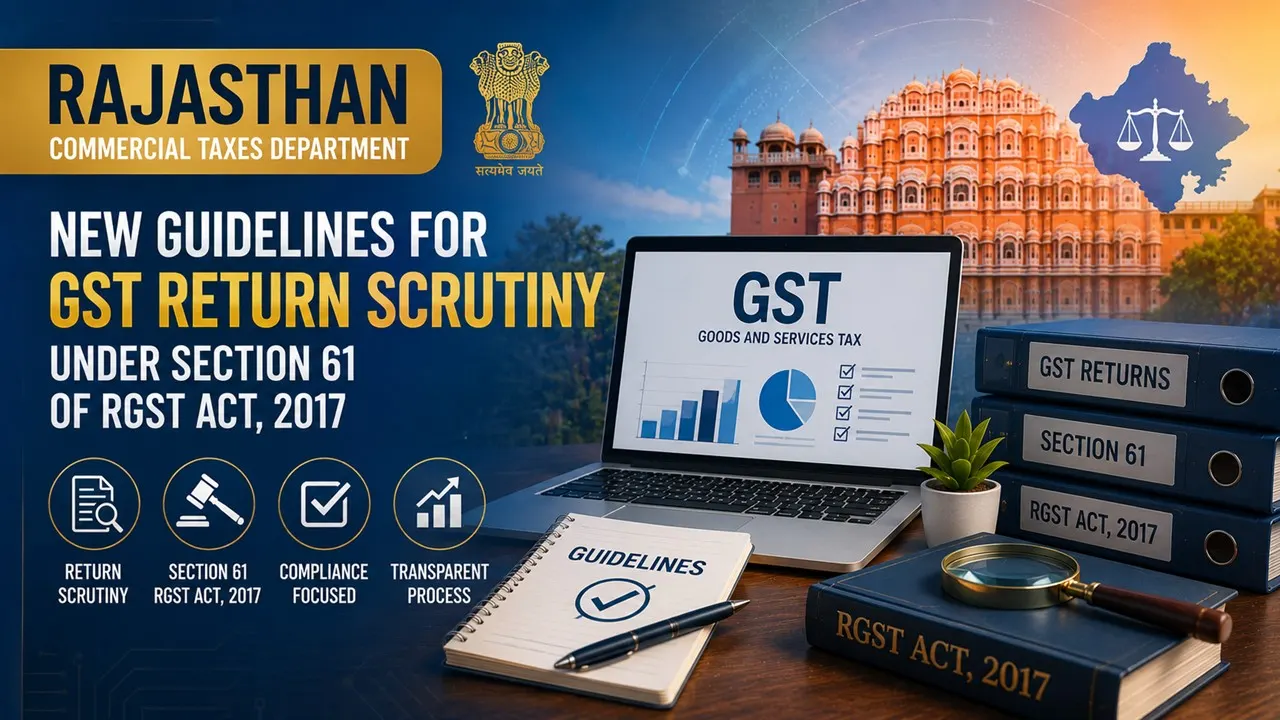
The Rajasthan Commercial Taxes Department has issued revised guidelines for scrutiny of returns under Section 61 of the RGST Act, 2017.
Faceless Scrutiny and Action Under Sections 73, 74 & 74A Standardised
 Saima
Saima Jul 21, 2026
The Commercial Taxes Department, Rajasthan, has issued fresh guidelines for scrutiny of returns under Section 61 of the RGST Act, 2017, replacing the earlier guidelines issued on January 7, 2022. The revised process aims to ensure uniformity in scrutiny proceedings and action under Sections 73, 74 and 74A of the RGST Act, 2017.
Under the guidelines, the Business Intelligence Unit (BIU) will analyse data available on the GSTN Portal for selecting registered taxpayers for scrutiny. The provided parameters include excess outward tax in GSTR-1 compared to GSTR-9 or GSTR-3B, turnover mismatches with GSTR-7 and GSTR-8, excess outward liability in e-way bills, excess ITC claimed in GSTR-3B or GSTR-9, ITC claimed from non-filing or cancelled suppliers and ITC claimed beyond the period provided under Section 16(4) of the RGST Act.

The Department has mandated scrutiny for cases selected on the basis of excess outward tax in GSTR-1 compared to GSTR-9 or GSTR-3B, excess outward liability in e-way bills compared to GSTR-3B and ITC claimed from suppliers whose registration certificates have been cancelled. There will be other parameters for preparation of the scrutiny list.
The list of taxpayers will be prepared by the Special Commissioner (BIU), approved by the Chief Commissioner, State Tax, and allocated through the Integrated Tax Management System (ITMS) for faceless scrutiny or to Proper Officers according to jurisdiction. The list will also be cross-checked with audit cases to avoid duplication.

The proper officer shall issue Form GST ASMT-10 under Section 61(1) of the RGST Act read with Rule 99(1) of the RGST Rules, clearly providing all corrections or mistakes noticed during scrutiny. The registered taxpayer may furnish an explanation in ASMT-11 within thirty days or such further period as permitted by the Proper Officer. Where the explanation is accepted, or the taxpayer accepts the mistake and pays the tax, interest and other applicable amounts through DRC-03, the proceedings shall be dropped and the taxpayer informed through ASMT-12. However, where no satisfactory explanation is given or corrective measures are not taken despite acceptance of the mistake, the matter shall be transferred to the Proper Officer. The Proper Officer shall then initiate appropriate proceedings for determination of tax and other dues under Sections 73, 74 or 74A of the RGST Act.
The Department further directed that where the detected tax not paid, short paid or ITC wrongly availed or utilised exceeds Rs 5 crore, adjudication proceedings shall be initiated only after prior approval of the Additional Commissioner (Administration) of State Tax.
The guidelines also provide for scrutiny by officers across jurisdictions through the newly assigned Scrutiny Officer role, while maintaining the existing process for issuance of ASMT-10, filing of ASMT-11 and acceptance of replies through ASMT-12.
About Author


Saima
Content Writer
 StudyCafe
 Delhi, Delhi, India
 555
555My Recent Articles
- High Court Quashes GST Demand Against Amul Over Non-Cross-Charging of Common Expenses
- High Court Quashes Income Tax Demand Against Contractual Worker Over Misuse of PAN
- ITAT Deletes Rs 2.06 Crore Addition Under Section 68 for Unsecured Loans
- ITAT Holds Section 263 Revision Invalid on Taxability of Interest Under Section 28 of Land Acquisition Act
- ITAT Upholds Section 68 Addition for Bogus Loans But Restricts Estimated Profit to 2% of Sales
Loading suggestions…


Recent Posts

All Posts
Recent Posts
All Posts