Section 69A Cannot Be Applied When Money or Valuable Items Are Properly Recorded in Books of Account, Says ITAT:
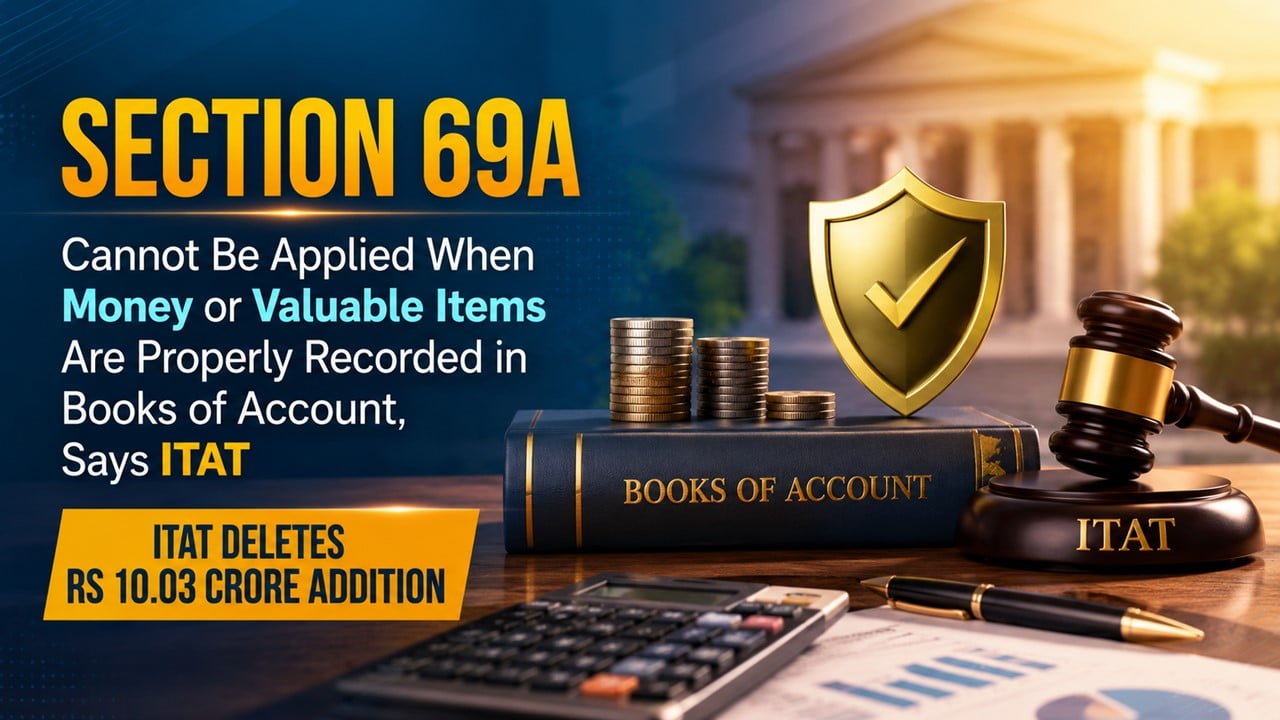
The ITAT deletes the Rs 10.03 crore unexplained money addition, holding that Section 69A can only be applied when money or valuable items are not recorded in the assessee’s books of account.
ITAT Deletes Rs 10.03 Crore Addition, Criticises Tax Authorities For Not Conducting Independent Inquiry
 Saloni Kumari
 Jun 25, 2026
Section 69A Cannot Be Applied When Money or Valuable Items Are Properly Recorded in Books of Account, Says ITAT
The ITAT Ahmedabad, in a significant case titled ITO Vs Bharatbhai Bhagwandas Soni, has clarified that the tax authorities can only pursue provisions of Section 69A in a case where money or valuable items are not recorded in the assessee’s books of account. However, in the present, the said condition was not met; hence, the Rs 10.03 crore unexplained money addition was deleted.
Bharatbhai Bhagwandas Soni's case was reopened under Section 147 of the Income Tax Act through a notice dated April 28, 2021. During the reassessment proceedings, the Assessing Officer (AO) noted that an amount of Rs 10.03 crore was credited to the assessee's bank account during the Assessment Year (AY) 2015-16 (year under consideration), using NEFT/RTGS transactions, and the assessee had not reflected the same in its income tax return (ITR).
Consequently, the assessee was called to explain the source of these credits. In response, the assessee submitted all relevant documents such as bank statements, sales registers, sample sale invoices, ledger accounts, VAT returns and others. However, the AO did not find the assessee's submissions sufficient and treated the entire amount of Rs 10.03 crore as unexplained money under Section 69A of the Income Tax Act. Thereafter, the entire Rs 10.03 crore credit was made as an addition to the assessee's taxable income on grounds of a lack of sufficient evidence/documents.
The aggrieved assessee filed an appeal before the lower appellate authority, i.e., the Commissioner of Income Tax (Appeals) [CIT(A)], challenging the Rs 10.03 crore addition, wherein the assessee asserted that "the receipts reflected in the bank account represented business turnover duly recorded in the books of account and, therefore, provisions of section 69A of the Act were not applicable." The CIT(A) found the assessee's submissions relevant and accordingly deleted the impugned addition of Rs 10.03 crore made by the AO under Section 69A of the Income Tax Act.
Now, the tax authorities, being dissatisfied with the CIT(A)'s order, filed the present appeal before the ITAT Ahmedabad. When the tribunal examined the case, it noted that the assessee had furnished all the relevant documents proving the source of the Rs 10.03 crore credits in question; however, the concerned tax authorities, without conducting any independent enquiry or bringing any adverse material on record, held the evidence insufficient and treated the entire credit as unexplained money under Section 69A of the Act merely on the ground that certain further details were not furnished. Such a behaviour is unsustainable under the law.
It was further highlighted by the tribunal that the provisions of Section 69A can only be applied to a case when money or valuable items are not recorded in the assessee’s books of account. However, in the present, the assessee had explicitly recorded the credits in the books and shown them as business receipts. Based on the aforementioned findings, the tribunal quashed the impugned Rs 10.03 crore and sustained the CIT(A)'s ruling. The appeal is dismissed.
About Author


Saloni Kumari
Content Writer
Saloni is a Content Writer with 2+ years of experience at studycafe.in. She writes legal, taxation, and finance related content including GST, Income Tax etc. Skilled in translating complex judicial pronouncements and regulatory developments into clear, and reader-friendly articles. Experienced in covering judgements of ITAT, High Court, GSTAT, and news related to Income Tax, GST, and corporate law. She can be reached at [email protected].
Saloni is a Content Writer with 2+ years of experience at studycafe.in. She writes legal, taxation, and finance related content including GST, Income Tax etc. Skilled in translating complex judicial pronouncements and regulatory developments into clear, and reader-friendly articles. Experienced in covering judgements of ITAT, High Court, GSTAT, and news related to Income Tax, GST, and corporate law. She can be reached at [email protected].
 StudyCafe
 Delhi, Delhi, India
 2889
2889My Recent Articles
- ITAT Sets Aside Rejection of Charitable Trust’s Section 12AB Registration Application, Remands Case to CIT(E) for Fresh Consideration
- Can Same-Sex Partners Claim Tax Exemption on Gifts as Spouses? Karnataka High Court to Examine
- ITAT Remits Section 80G Renewal Application to CIT(E) for Fresh Consideration in Light of CBDT Circular
- Dreamfolks Services Faces Rs 1.58 Crore IGST Demand Over ITC Availment on Invoices Issued by GST-Cancelled Supplier
- ITAT Restores Taxpayer's Appeal In Interest of Natural Justice After CIT(A)'s Failure to Decide Appeal on Merits
Up Next
Loading suggestions…


Recent Posts
All Posts
Recent Posts
All Posts