Steps taken by Government to regulate large scale Ponzi Scams:
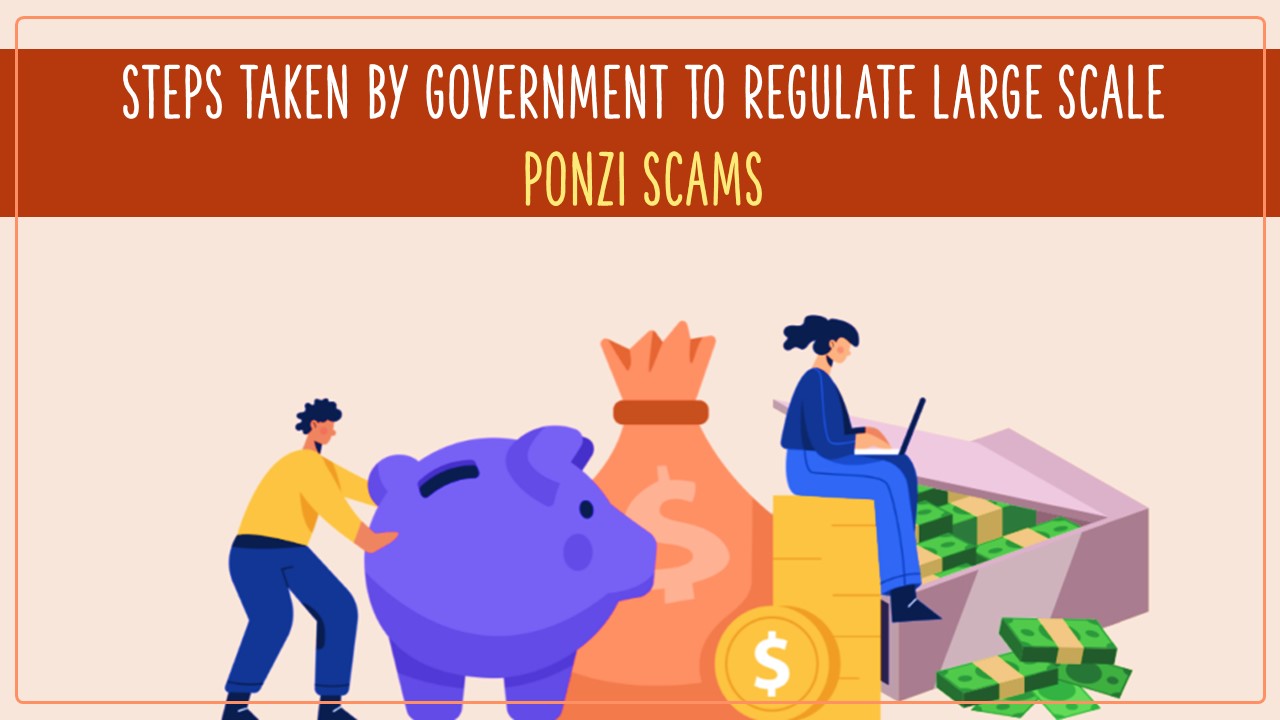
The Minister of State Dr. Bhagwat Karad in a written reply to a question in Lok Sabha said that Steps taken by Government to regulate large scale Ponzi Scams.
Large scale Ponzi Scams
 Reetu
Reetu Dec 25, 2023
Table of Contents

Steps taken by Government to regulate large scale Ponzi Scams
The Minister of State Dr. Bhagwat Karad in the Ministry of Finance in a written reply to a question in Lok Sabha said that Steps taken by Government to regulate large scale Ponzi Scams.
Shri Sujeet Kumar raised the following questions:
Will the Minister of FINANCE be pleased to state - (a) Whether the Government is aware of the proliferation of Ponzi apps and their unfettered promotion by financial influencers on social media platforms; (b) if so, the details of the action plan devised by the Government to regulate these applications; and (c) if not, the reasons therefor?Replied by Minister of State Dr. Bhagwat Karad:
(a) to (c): To control fraudulent loan apps and unregulated deposit taking, following steps have been taken:- The Central Government has passed the Unregulated Deposit Schemes Act of 2019. The Act contains extensive prohibitions that make it illegal to promote, operate, issue ads for, or accept deposits in any Unregulated Deposit Scheme.
- The public is warned against fraudulent schemes/entities via the Reserve Bank of India's (RBI) internet platform SACHET. Members of the public can use the portal to obtain information about entities that are permitted to accept deposits, whether the entity is registered with any regulator, file complaints, and share information about financial frauds and illegal deposit acceptance by unscrupulous entities.
- In terms of digital lending apps, the RBI established regulatory guidelines based on the suggestions of the Working Group on Digital Lending. This intends to strengthen the legal environment for digital lending while also improving customer safety and making the digital lending ecosystem more secure.
- The Indian Cybercrime Coordination Centre (I4C) of the Ministry of Home Affairs (MHA) conducts proactive analysis of digital lending apps. Based on its analysis and complaints made on the National Cybercrime Reporting Portal, the I4C team examines Apps on several parameters and reports those found suspicious to the Ministry of Electronics and Information Technology (MeitY) for blocking.
- The RBI provides electronic banking awareness and training (e-BAAT), which focuses on fraud prevention and risk mitigation.
- The Reserve Bank of India (RBI) holds Financial Literacy Week (FLW), and banks are encouraged to hold special camps through Financial Literacy Centres (FLCs) and rural branches.
- Dissemination of cybercrime messaging via short message service (SMS), radio advertising, public awareness of cybercrime prevention and cyber safety tips via the I4C's social media profiles.
About Author


Reetu
Content Manager
Reetu is a Content Writer with 4+ years of experience in GST, Income Tax, Finance, Company Law, Education and Career Related Content. She is a B.COM (Honrs.) Graduate.
Reetu is a Content Writer with 4+ years of experience in GST, Income Tax, Finance, Company Law, Education and Career Related Content. She is a B.COM (Honrs.) Graduate.
 Studycafe
 Delhi, Delhi, India
 8071
8071My Recent Articles
- Income Tax Guide for Indian Defence Personnel for Tax Filing, Taxable Allowances and Other Benefits
- Income Tax Return Breaking: ITR Forms released for AY 25-26
- Ex-DRT Officials Sentenced to 5 Years Rigorous Imprisonment by Madras High Court along with Rs.27 Lakh Fine
- GSTN issued Advisory on Case Sensitivity in IRN Generation
- RBI to issue Notes of Rs.10 and Rs.500 bearing Signature of Guv Malhotra
Up Next
Loading suggestions…


Recent Posts
All Posts


Recent Posts
All Posts