Supreme Court Sets Aside Delhi HC's Order, Holds No Disallowance of Expenses Never Claimed as Deduction Under Income Tax Act:
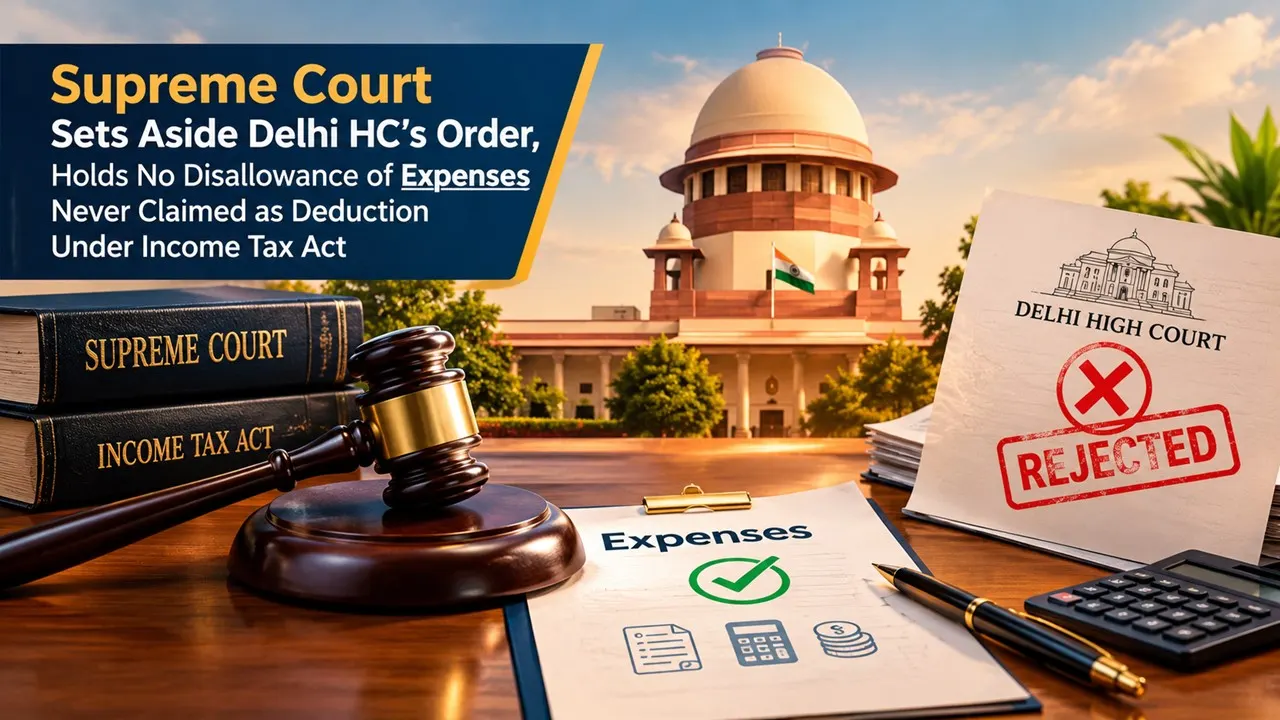
The Supreme Court set aside the Delhi HC's ruling, holding that an AO cannot disallow an amount never claimed as a deduction without establishing its impact on taxable income.
SC Quashes Rs 69.92 Lakh Excise Duty Addition
 Saloni Kumari
 Oct 29, 2026

The Supreme Court bench comprising Justice S.V.N. Bhatti and Justice N.V. Anjaria, in a recent significant ruling, set aside a judgement passed by the Delhi High Court, holding that an Assessing Officer (AO) is not permitted to disallow an amount that was never claimed as a deduction under the Income Tax Act, 1961.
The dispute in the present case had arisen when the Assessing Officer (AO) had made an addition of Rs 69.92 lakh under Sections 43B and 145A of the Income Tax Act towards unpaid excise duty to the taxable income of Lakshmi Sugar Mills for the Assessment Year 2005-06.

The assessee, being aggrieved by the aforementioned addition, challenged the same before the first appellate authority, i.e., the CIT(A), contending that the goods remained in its bonded warehouse. It was further claimed by the assessee that it had not claimed any deduction for the unpaid duty. The CIT(A), after analysing the facts of the case, deleted the impugned addition.
Thereafter, the tax authorities, being dissatisfied with the CIT(A)'s order, approached the Income Tax Appellate Tribunal (ITAT), which sustained the CIT(A)'s decision. Subsequently, the tax authorities filed a writ petition before the Delhi High Court. The High Court passed a reverse judgement by sustaining the impugned addition made by the AO, thereby ruling in favour of the tax authorities.

Then, the assessee approached the Supreme Court of India, which noted that the Delhi High Court had mistakenly assumed that the goods had been removed from the warehouse, which was incorrect. The records demonstrated that the stock on which excise duty was not paid was still kept in the assessee's warehouse.
It was further observed by the court that the AO could not establish how the disputed amount had been accounted for in the company's books. Nor had the officer explained how the entry had affected its taxable income. The amount had neither been paid nor treated as payable in the company's accounts, apart from a remark in the tax audit report.
Consequently, the court allowed the assessee's appeal and restored the CIT(A) and ITAT's decision, holding that "disallowing an amount not treated as an allowance by the Assessee is impermissible under the Act, 1961. The negative impact on the taxable income stated by the Assessee should have been taken into account; i.e., by factoring in this entry, the income has come down, and therefore the tax has come down."
About Author


Saloni Kumari
Content Writer
 StudyCafe
 Delhi, Delhi, India
 3071
My Recent Articles
- ITAT Remands Rs 1.90 Crore Unexplained Income Case for De Novo Assessment After Admitting Additional Evidence Under Rule 29
- Dating App Match Turns Into Rs 1.57 Crore Fake Trading Scam for Kochi Doctor
- CBI Arrests Assistant Sub-Inspector (ASI), Delhi Police for Demanding Rs 2 Lakh Bribe to Prevent Family’s Arrest
- Supreme Court Quashes GST Demand of Rs 59.14 Crore and Equal Penalty Against Sterling and Wilson Renewable Energy
- GSTN Issues Advisory on e-Invoicing for RCM Domestic Supplies and Import of Services Effective January 1, 2027
Loading suggestions…


Recent Posts

All Posts

Recent Posts
All Posts