June 30 is the final date for issuing income tax scrutiny notices for FY 2025-26 returns. Taxpayers should review their filings and watch for any notices.
Jasmine | Jun 25, 2026 |
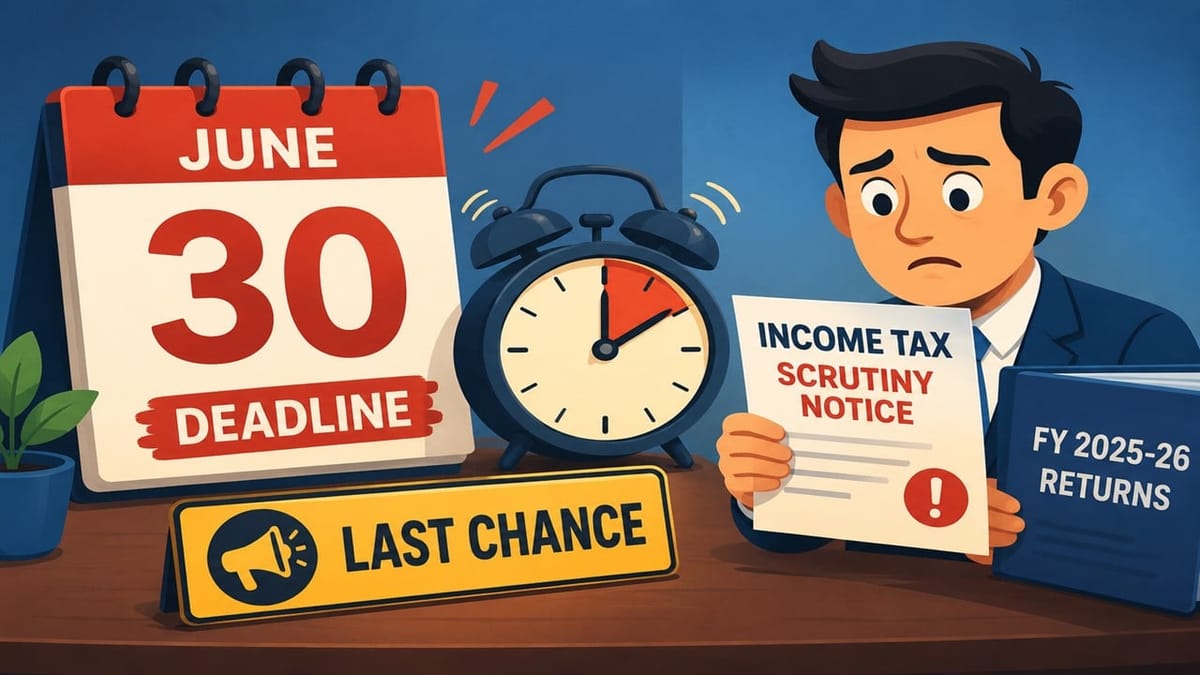

June 30 Deadline: Last Chance for Income Tax Scrutiny Notices on FY 2025-26 Returns
While most taxpayers are focused on the upcoming income tax return (ITR) filing deadline, there’s another date that shouldn’t be overlooked – June 30. It may not be important for everyone, but it could be crucial for those who have already filed their returns and may come under the Income Tax Department’s scrutiny process.
A tax notice may make one anxious, but that does not necessarily imply that there has been an error in filing. At times, tax notices are issued by the Income Tax Department in order to confirm details stated in the tax returns. Having knowledge of the cause and proper response to the notice makes everything easier.

Significance of June 30 to Taxpayers
June 30 is a significant date for taxpayers because it is the last day by which a scrutiny notice can be issued by the Income Tax Department under Section 143(2) in respect of income tax returns that have been filed in FY 2025-26. Post June 30, no scrutiny notice can be issued in respect of the relevant income tax returns.

Scrutiny assessment comes into being when there is a need on the part of the Income Tax Department to confirm certain information given in the tax return of the taxpayer.
Such information may include income statements, deductions, payments of tax and some other financial transactions. The purpose is to confirm the accuracy of the information given.
Who is More Likely to be Issued a Scrutiny Notice?
In case there are some inconsistencies found in the return by the Income Tax Department, the taxpayer may get issued a scrutiny notice. The most likely reason for this can be that there is an inconsistency between the income declared in the return and what was reflected in the Form 26AS or AIS.
Another common cause of being scrutinized could be an inconsistency between the turnover declared in the GST accounts and the turnover declared on the income tax returns. In the same way, any taxpayer who claims excessive deductions or exemptions in proportion to their income is likely to be scrutinized by the department.
The Income Tax Department could also ask for an explanation about large transactions that have been recorded in its records but are not reflected in the income tax return. Similarly, property sale transactions that have been recorded with the authorities but are not mentioned in the income tax return could invite questions.
Since technology has increasingly been utilized, there is now an abundance of financial and transaction data available for the department. Through the use of data analytics and artificial intelligence, the department can detect discrepancies and return cases that require further scrutiny.
Mistakes may be made at the time of filing income tax returns. But the fact that mistakes have been made after filing your ITR is not a reason for your ITR being selected for scrutiny.
There are some mistakes that can be rectified by filing an ITR-U, depending on certain conditions.
It is common practice for tax professionals to recommend that taxpayers make corrections for their errors voluntarily without waiting for the Income Tax Department to discover them.
What Should Your Response Be to a Notice?
The scrutiny notice will normally be sent to the registered email address of the taxpayer and can also be posted to the taxpayer at the registered postal address. Additionally, taxpayers can log into the income tax online filing system for notices.
Following this process, the notification will then be accessed within the e-proceedings tab. The taxpayer will get the chance to go through all the details, have a clear understanding of what is required of them and respond accordingly using the platform provided. This is after having uploaded relevant documents in cases where the matter requires that they do so.
If the response is successfully submitted through the portal, then the system will generate a transaction number. This transaction number will be your proof of submission.
What if You Do Not Follow the Notice?
The tax advisors from B S Sridhar & Co., Chartered Accountants, warn that the failure to respond to such a notice as per Section 133(6) would be highly risky for any individual. According to the Income-tax Act, the department is entitled to impose penalties on an individual in case he does not provide the information or documents as demanded in the notice.
Section 272A(2)(c) of the Income-tax Act states that individuals who do not comply with the notice issued to them for any valid reason shall be liable to pay a fine of up to Rs 10,000.
Where the Notice has been given during an examination or assessment, the Assessing Officer (AO) can make a Best Judgement Assessment if there is no response from the taxpayer. Here, the AO can assess the matter based on the existing facts available on record, which might lead to a higher tax assessment.
However, this should not be taken as an alarming situation since, in most instances, it is just the Income Tax Department demanding more clarifications or documents on the information stated on the tax return. It should be easy to comply with their requirements since taxpayers will always have the required documentation.
As June 30th approaches fast, taxpayers need to take time and go through their returns and make sure that all disclosures have been made. This will be beneficial to them since any problems can be sorted out before a notice is issued.

In case of any Doubt regarding Membership you can mail us at [email protected]
Join Studycafe's WhatsApp Group or Telegram Channel for Latest Updates on Government Job, Sarkari Naukri, Private Jobs, Income Tax, GST, Companies Act, Judgements and CA, CS, ICWA, and MUCH MORE!"