A complete guide on taxability of bonus shares in India covering allotment rules, cost of acquisition, holding period, and capital gains on sale.
Khush Dharmeshkumar Trivedi | Jun 27, 2026 |
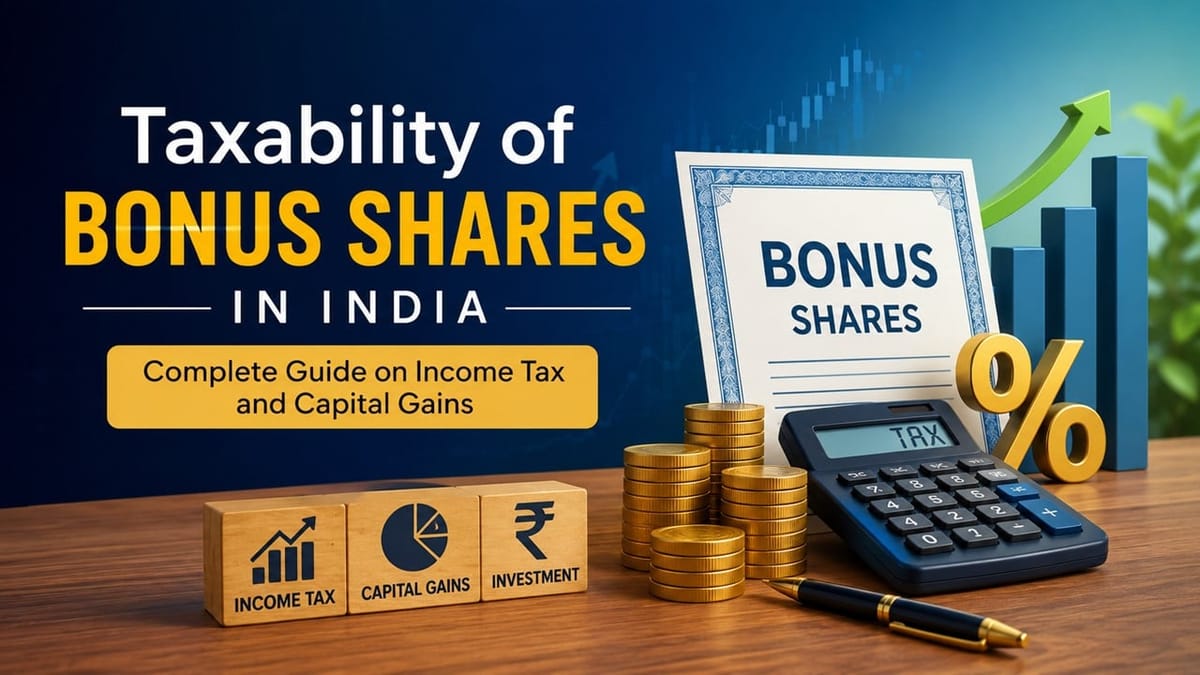

Taxability of Bonus Shares in India: Complete Guide on Income Tax and Capital Gains
Have you guys ever received any Bonus shares? & don’t know the tax treatment, then this article is for you.
Bonus shares are the shares that are given to the existing shareholders free of cost in proportion to their holdings issued by the company. The company issued bonus shares from its free reserve and retained earnings, with no requirement for additional cash or new capital. This is the popular method for a company to reward shareholders. Therefore, every investor must know the tax treatment of bonus shares.

In this article, we will know under which head the bonus shares are taxed and the treatment of capital gain on the sale of bonus shares.
Taxability on Receipt of Bonus Shares

Are Bonus Shares Taxable at the Time of Allotment?
No. There is no tax liability at the time of allotment because the company is doing capital restructuring by issuing bonus shares, not distributing income.
As nothing goes out from the company’s profits and nothing comes in shareholders’ pockets so issue of bonus shares cannot be taxed as a dividend, as well as a deemed dividend on receipt.
The Section 56(2) controversy
Tax authorities have tried to tax the issue of bonus shares under the head of Income from other sources.
Assessing officers argue that tax bonus shares that shareholders receive benefit and try to cover under section 56 of the Income Tax Act, 1961, which covers property received without consideration.
However, courts have continually rejected this view. The reasoning behind this is that the value of a shareholder’s holding after bonus shares are added remains the same as before, so there is no real benefit that can be taxed.
In the landmark Sudhir Menon HUF vs. CIT (ITAT Mumbai, 2014) case, the Tribunal held that issuing bonus shares is simply a capitalisation of the company’s profits that does not increase or decrease a shareholder’s wealth or shareholding percentage and therefore cannot attract tax under Section 56.
When Does Tax Actually Apply?
Tax is payable only when the bonus shares are sold or transferred, not when it receive. So profit from this sale or transfer is taxed as capital gain.
Cost of acquisition: treated as a zero
Income tax treated the cost of acquisition of bonus shares = zero, so the profit = selling or transferred price.
However, if received before
01/04/2001: FMV as on 01/04/2001 can be taken as cost
Note: In the case of long-term, when it’s taxed under section 112A & allotted before 01/02/18, the benefit of FMV as on 31/1/2018 can be taken.
Holding Period:
The holding period for bonus shares is considered from the date of allotment, not from the date of original shares purchased, so the gain from this is bifurcated under short-term and long-term.
| Types of shares | Short-term Gain (STCG) | Long-term Gain (LTCG) |
| Listed Shares | Held ≤ 12 months | Held > 12 months |
| Unlisted Shares | Held ≤ 24 months | Held > 24 months |
Listed Bonus Shares (where Securities Transaction Tax applies):
Unlisted Bonus Shares:
Suppose an investor receives 100 bonus shares of a listed company and sells them after holding them for 18 months at ₹200 per share.
Some shareholders have tried to use bonus shares as a tax avoidance tool. Buying the shares just before allotment of bonus shares and selling the original shares (prices are falling) and booking an artificial loss. To curb this practice, the Income Tax Act includes anti-bonus-stripping provisions (Section 94(8)).
Under this provision, any loss arising from the sale of original shares within a specified period of the bonus issue is disallowed and is instead added to the cost of the bonus shares retained, which prevents investors from creating an artificial loss.

In case of any Doubt regarding Membership you can mail us at [email protected]
Join Studycafe's WhatsApp Group or Telegram Channel for Latest Updates on Government Job, Sarkari Naukri, Private Jobs, Income Tax, GST, Companies Act, Judgements and CA, CS, ICWA, and MUCH MORE!"