Beware! 10 Key Financial Transactions That May Trigger Income Tax Scrutiny:
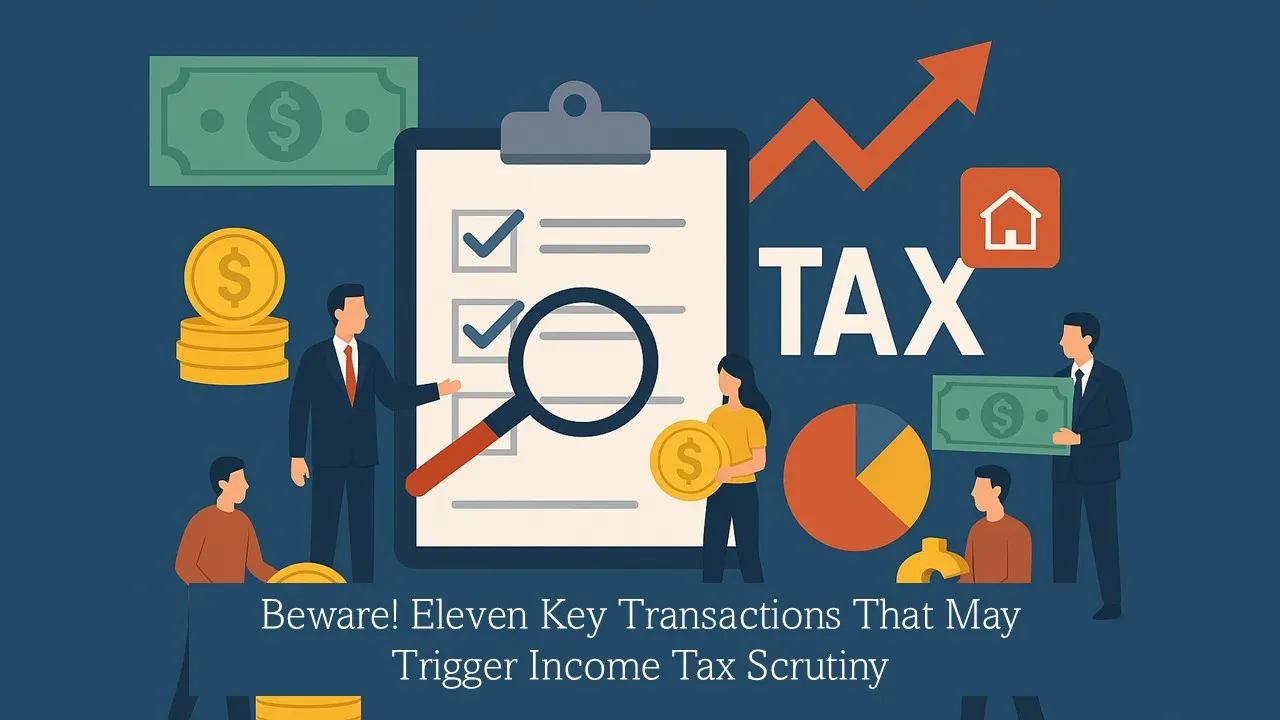
Here's a comprehensive guide of even high-value financial transactions that are closely monitored by the Income Tax Department and can trigger scrutiny if they exceed specified limits.
11 Key Transactions Can Put You on the IT Dept’s Radar
 Saloni Kumari
 Nov 11, 2025
Beware! 10 Key Financial Transactions That May Trigger Income Tax Scrutiny
Numerous individuals are not even aware that the Income Tax Department keeps a close eye on certain high-value transactions in order to curb cases related to tax evasion and ensure transparency in the system. If you perform any of the following transactions, then you may get reported to the department and can attract scrutiny.
Below are the types of transactions, their value limits, and who reports them to the tax authorities:
1. Large Cash Transactions in Banks
If any individual performs any of the following large-value cash transactions in a bank, then a banking company or a cooperative bank reports the information to the Income Tax Department:
- If an individual makes a payment of an aggregate of Rs. 10 lakh or more in a financial year for the purpose of purchasing bank drafts or pay orders, or banker's cheques.
- If an individual makes a payment of an aggregate of Rs. 10 lakh or more during a financial year for pre-paying instruments issued by the Reserve Bank of India (RBI).
- If an individual makes a payment of an aggregate of Rs. 50 lakh or more in a financial year in or from one or more current accounts of a person for the purpose of depositing or withdrawing cash, including through a bearer's cheque.
- If cash deposits are made of an aggregate of Rs. 10 lakh or more in a financial year in one or more accounts (other than a current account and time deposit) of a person.
- If cash deposits of aggregate Rs. 10 lakh or more are made in a financial year in one or more accounts (other than a current account and time deposit) of a person.
- If payment of an aggregate of Rs. 1 lakh or more in cash or Rs. 10 lakh or more by any other mode is made against bills raised in respect of one or more credit cards issued to that person in a financial year.
- If Payment is made of an aggregate of Rs. 10 lakh or more in a financial year to purchase bonds or debentures issued by the company or institution (other than the amount received on account of renewal of the bond or debenture issued by that company).
- If Payment is made of an aggregate of Rs. 10 lakh or more in a financial year to purchase shares (including share application money) issued by the company.

- If the buyback of shares from any person (other than the shares bought in the open market) is made of an aggregate of Rs. 10 lakh or more in a financial year.
- If an investment of an aggregate of Rs. 10 lakh or more in a financial year is made to acquire units of one or more schemes of a Mutual Fund (other than the amount received on account of transfer from one scheme to another scheme of that Mutual Fund).
- If a person buys or spends Rs. 10 lakh or more worth of foreign currency in a financial year for the sale of foreign currency, including any credit of such currency to a foreign exchange card or expense in such currency through a debit or credit card or through the issue of a traveller's cheque or draft or any other instrument.
- If a person buys or sells property valued at Rs. 30 lakh or more, or if the stamp duty valuation of the property is Rs. 30 lakh or more, the registration authority will report it.
About Author


Saloni Kumari
Content Writer
Saloni is a Content Writer with 2+ years of experience at studycafe.in. She writes legal, taxation, and finance related content including GST, Income Tax etc. Skilled in translating complex judicial pronouncements and regulatory developments into clear, and reader-friendly articles. Experienced in covering judgements of ITAT, High Court, GSTAT, and news related to Income Tax, GST, and corporate law. She can be reached at [email protected].
Saloni is a Content Writer with 2+ years of experience at studycafe.in. She writes legal, taxation, and finance related content including GST, Income Tax etc. Skilled in translating complex judicial pronouncements and regulatory developments into clear, and reader-friendly articles. Experienced in covering judgements of ITAT, High Court, GSTAT, and news related to Income Tax, GST, and corporate law. She can be reached at [email protected].
 StudyCafe
 Delhi, Delhi, India
 2945
2945My Recent Articles
- ICAI Opens Application Window for Empanelment of Members to Act as Observer at CA January 2027 Exams
- ICAI CA Inter Sept 2026 Result OUT at caresults.icai.org, Check Steps to Download
- Section 148 Notice Without Manual or Digital Signature Invalidates Entire Reassessment Proceedings, Holds ITAT
- ITAT Holds Failure to Issue Draft Assessment Order Under Section 144B Invalidates Assessment Procedure
- TRACES to Soon Permit Cross-Year Challan Corrections Amid New Income Tax Act Transition
Up Next
Loading suggestions…


Recent Posts
All Posts

Tags
Recent Posts
All Posts