Budget 2026: How India’s Union Budget Is Prepared; Inside the Process and What to Expect:
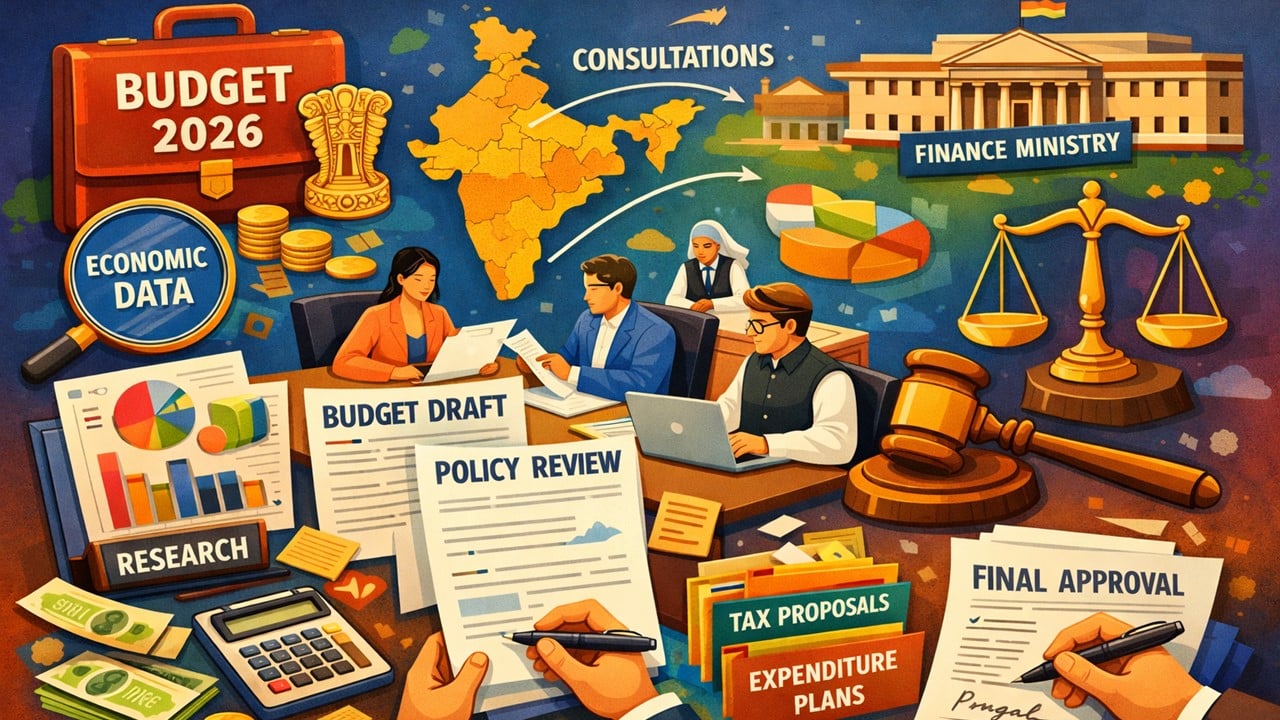
From closed-door deliberations to policy expectations, here’s how the Union Budget 2026 takes shape
Budget 2026: How India’s Union Budget Is Made and What to Expect
 Meetu Kumari
 Jan 6, 2026
Budget 2026: How India’s Union Budget Is Prepared; Inside the Process and What to Expect
Every year, as February approaches, the Union Budget takes centre stage in India’s public conversation. It influences everything from how much tax you pay to how much the government spends on infrastructure, welfare, and development. Yet, while the Budget speech lasts barely a couple of hours, the work behind it stretches across several months and involves intense planning, secrecy, and coordination at the highest levels of government.
When the Finance Minister rises in Parliament on February 1, 2026, to present Budget 2026, the document will represent the outcome of countless meetings, calculations, and policy debates that begin long before most citizens start thinking about it.
Where the Budget Process Begins
Contrary to popular belief, the Budget is not put together in the weeks leading up to February. The process usually starts around August or September of the previous year. At this stage, the Department of Economic Affairs (DEA), which functions under the Ministry of Finance, sends formal communications to all central ministries, state governments, and Union Territories.
These circulars ask departments to submit estimates of the funds they will need in the coming financial year. Ministries outline their spending requirements, ongoing commitments, and new proposals. This early exercise lays the foundation for expenditure planning and helps the government assess how resources should be allocated.
Who Shapes the Budget?
The responsibility for drafting the Union Budget rests with the Department of Economic Affairs, but the exercise is far from a one-department affair. A core decision-making group led by the Finance Minister steers the process. This team typically includes the Finance Secretary, Revenue Secretary, and Expenditure Secretary.
Alongside them, officials from the Central Board of Direct Taxes (CBDT), Central Board of Indirect Taxes and Customs (CBIC), and policy experts from NITI Aayog contribute data, projections, and sector-specific inputs. Their role is to evaluate revenue trends, economic growth assumptions, and the likely impact of policy choices.
The Ritual of Secrecy
One of the most distinctive aspects of Budget preparation is the emphasis on confidentiality. As the Budget nears completion, the Finance Ministry observes the traditional Halwa Ceremony. This marks the start of the final printing phase of Budget documents.
Once the ceremony concludes, officials and staff involved in the Budget are effectively cut off from the outside world. They remain confined to the North Block basement, with phones and internet access suspended. This practice, followed for decades, is intended to prevent leaks and ensure that sensitive financial information remains secure until the Budget is presented in Parliament.
The Mysterious ‘Blue Sheet’
Among all Budget documents, the so-called “Blue Sheet” holds special significance. It contains the revenue estimates, expenditure figures, and fiscal calculations that define the Budget. Access to this document is tightly restricted, and it is not permitted to leave the Finance Ministry. Even senior officials, including the Finance Minister, can consult it only under strict controls.
Why February 1 Matters
The Union Budget is presented in Parliament at 11 a.m. on February 1. This date was advanced from the end of February in 2017 to give the government enough time to implement Budget proposals before the new financial year begins on April 1. The change allows ministries to roll out schemes, revise tax rules, and adjust spending plans without delay.
What to Expect from Budget 2026
As Budget 2026 approaches, expectations are evolving. With tax collections remaining strong and direct taxes now accounting for a significant share of government revenue, the focus is shifting from aggressive revenue mobilisation to stability and predictability.
Tax professionals and policy experts are calling for clearer rules, reduced litigation, and better administrative discipline, especially as the Income-tax Act, 2025 is set to come into force from April 1, 2026. There is also growing emphasis on rationalizing criminal provisions under tax laws, limiting prosecution to cases involving deliberate evasion or fraud, and making compounding procedures less punitive.
Another area of concern is dispute resolution. With a large backlog of pending tax appeals, there is pressure on the government to improve appellate efficiency, introduce enforceable timelines, and ensure consistency in legal interpretation.
Why the Budget Matters to You
The Union Budget has a direct impact on everyday life and determines how much tax you pay, whether essential goods become cheaper or more expensive, and how much the government invests in sectors like infrastructure, railways, healthcare, and education.
Thus, the Budget is not just a financial statement, but it is a reflection of the government’s priorities and its vision for the economy. As Budget 2026 draws closer, understanding how it is made helps explain why its announcements carry such weight for households, businesses, and the broader economy.
About Author


Meetu Kumari
Content Manager
Meetu Kumari is an Experienced Advocate and Content Writer with 4+ years of demonstrated history of working in the law practice industry. Skilled in Developing Content, Researching, and Drafting. Strong professional with a Bachelor of Science (B.Sc.) focused on Law from Gujarat National Law University.
Meetu Kumari is an Experienced Advocate and Content Writer with 4+ years of demonstrated history of working in the law practice industry. Skilled in Developing Content, Researching, and Drafting. Strong professional with a Bachelor of Science (B.Sc.) focused on Law from Gujarat National Law University.
 Studycafe
 Jodhpur, Rajasthan, India
 2264
2264My Recent Articles
- ITAT Condones 302-Day Delay, Restores Salary Assessment for Fresh VerificationPremium
- ITAT Condones Delay After Tax Consultant's Death, Restores Appeals for Fresh HearingPremium
- ITAT Remands Salary Addition, Says Taxability Depends on Salary Becoming Due, Not Mere ReceiptPremium
- ITAT Deletes TP Royalty Adjustment, Orders Fresh Review of Commission BenchmarkingPremium
- ITAT Quashes Reassessment Over Unsigned Section 148 Notice Issued to AssesseePremium
Up Next
Loading suggestions…


Recent Posts

All Posts


Recent Posts
All Posts