CAAS Suggests Changes to Supreme Court's Draft AI Regulations By Seeking Practical Framework for Courts and Tribunals:
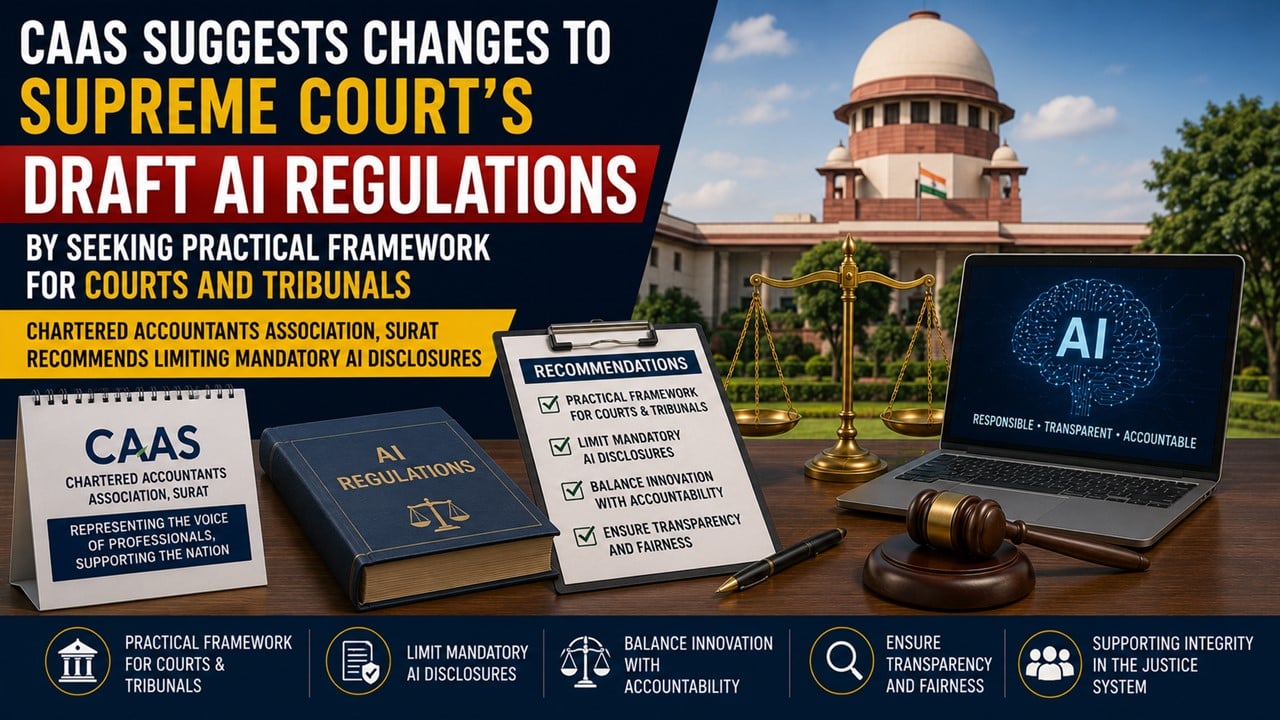
The Chartered Accountants Association, Surat (CAAS) has submitted a detailed representation to the Artificial Intelligence Committee of the Supreme Court of India on the draft "Regulations for Use of Artificial Intelligence in Courts, 2026".
Chartered Accountants Association, Surat recommends limiting mandatory AI disclosures
 Saima
Saima Jun 15, 2026
CAAS Suggests Changes to Supreme Court's Draft AI Regulations By Seeking Practical Framework for Courts and Tribunals
The Chartered Accountants Association, Surat (CAAS), has submitted its suggestions to the Artificial Intelligence Committee of the Supreme Court regarding the draft "Regulations for Use of Artificial Intelligence in Courts, 2026". At the outset, CAAS appreciated several features of the draft framework and praised Regulations 16 and 17 also, which favour responsible AI adoption and promote innovation.
The Association also praised the prohibitions contained in Regulation 20 against risk scoring, behavioural profiling and machine-decided outcomes and supported Regulation 46 which preserves public ownership over judicial data. With regard to the constitution of AI Committees under Regulation 33, CAAS suggested that recognised Bar Associations and professional bodies should be granted permanent status. It further recommended making stakeholder consultation under Regulation 33(6) mandatory annually and publishing its outcome through the Annual Transparency Report under Regulation 45.
The Association addressed Regulation 43(3), which mandates disclosure whenever AI assists in preparing documents, pleadings or evidence, the Association cautioned that the provision, if interpreted literally, would make virtually every filing in India "AI-assisted". It proposed that disclosure should be required only when AI generates a larger part of the content, while normal assistance such as grammar correction, formatting, search, transcription and translation should remain exempt.
On the issue of audits under Regulation 38(2), CAAS opposed the proposal for exclusively in-house audits of Court AI systems and suggested the appointment of independent technical auditors operating under strict confidentiality and carrying out audits entirely within court premises. The representation also recommended extending the scope of Regulation 52 to all AI incidents defined under Regulation 3(e), along with time-bound disposal and mandatory recording of such incidents in the AI Incident Database. It suggested that litigant-facing tools, chatbots and accessibility services should be made available in regional languages and inclusivity should be ensured so that they reach smaller tribunals and district centres.
Finally, CAAS recommended a ninety-day outer limit for disposal of applications relating to AI tools, recording of reasons for extensions and publication of pendency figures through the Annual Transparency Report.

About Author


Saima
Content Writer
Saima is a Law graduate with a passion for research and content writing. She writes for Finance, Taxation and Legal Updates at Studycafe.in, simplifying complex legal decisions by the ITAT, High Court, AAR and GSTAT into uncomplicated and clear explanations.
Saima is a Law graduate with a passion for research and content writing. She writes for Finance, Taxation and Legal Updates at Studycafe.in, simplifying complex legal decisions by the ITAT, High Court, AAR and GSTAT into uncomplicated and clear explanations.
 StudyCafe
 Delhi, Delhi, India
 528
528My Recent Articles
- ITAT Remands Reassessment Case for Fresh Adjudication
- ITAT Remands Ex-Parte Appeal for Fresh Adjudication
- ITAT Condones 115-Day Delay in Appeal To Provide Substantive Justice
- ITAT Deletes Disallowances on Foreign Currency Loan Interest and Forex Loss in American Express Bank Case
- ITAT Allows 115BAB Tax Benefit Claim And Remands Eligibility Verification to AO
Up Next
Loading suggestions…


Recent Posts

All Posts


Tags
Recent Posts
All Posts