CLAUSE BY CLAUSE ANALYSIS OF PART A OF GSTR 9C
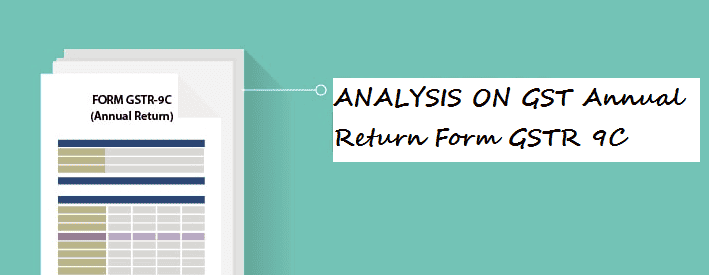
CLAUSE BY CLAUSE ANALYSIS OF PART A OF GSTR 9C CLAUSE BY CLAUSE ANALYSIS OF PART A OF GSTR 9C FROM MY POINT OF VIEW: In Gst audit u/s 35(5),
 Mridul
 Jul 22, 2019
CLAUSE BY CLAUSE ANALYSIS OF PART A OF GSTR 9C
CLAUSE BY CLAUSE ANALYSIS OF PART A OF GSTR 9C FROM MY POINT OF VIEW:
In Gst audit u/s 35(5), there is no specific report have to be given by the GST auditor. GST auditor has to certify the prescribed Reconciliation Statement from GSTR 9C. Auditor have to fill Part B portion (as per requirement) of GSTR 9C with proper observations / comments / discrepancies / disclosers and certify true and correctness of GSTR 9Cs reconciliation after giving proper recommendation in part A. Then the auditor signs the form by using his DSC and creates the JESON file and sends the file to auditee for upload in GST portal. According to Section 42(2), Registered person (auditee) have to file the digitally signed (signed by the auditor) GSTR 9C and scan copy of audited financial statements in GST portal by using EVC or own DSC (DS mandatorily needed in applicable cases). When GST books, records, data audit is conducted by the auditor who already conducted the audit of books of accounts under any law (same auditor for audit GAAP books of accounts and GST data with GSTR 9C certification), has to certify GSTR 9C by using first option of Part B of the certification section and when the GST books and records auditor did not conduct the audit of GAAP books and accounts (audit of books and accounts of GAAP purpose was done by another auditor) has to certify GSTR 9C by using the second option of Part B of the certification section.
In that write-up, I am trying to make lawful discussion about every clauses of GSTR 9C with clarification from my personal point of view. We know that filing of annual return in the form of GSTR 9 by the registered person (for composite scheme holder, GSTR 9A) other than TDS detector, TCS collector, casual taxable person and non-resident taxable person is mandatory according to section 44(1) of CGST act but when the aggregate turnover according to section 2(6) of that registered person (PAN basis) exceeds Rs.2 crore in a financial year, he has to get his accounts audited by a C.A. or C.M.A according to section 35(5) read with rule 80(3) and also have to submit a copy of the audited annual accounts along with certified (certified by C.A. or C.M.A.) reconciliation statement in the form of GSTR 9C according to section 44(2).
Now we have to know that audit applicability depends on limit (touching Rs. 2 Crore) of Aggregate Turnover according to Rule 80(3) and Aggregate Turnover is aggregate value of all taxable supplies (excluding the value of inward supplies on which tax is payable by a person on reverse charge basis), exempt supplies, exports of goods or services or both and inter-State supplies of persons having the same Permanent Account Number, to be computed on all India basis but excludes central tax, State tax, Union territory tax, integrated tax and cess. So audit liability goes to entity level (PAN). We can clearly say when any entity (PAN) has more than one GSTIN (distinct person), for compliance, has to file GSTR 9C for every GSTIN irrespective of individual turnover of GSTIN level. (Example: A, the Company have two GSTIN and one GSTIN has turnover of Rs. 1 Crore and 80 lac when another GSTIN has turnover of Rs. 30 lac. Now audit is applicable for A, the company (I mean both GSTIN are liable for audit) and every GSTIN have to file GSTR 9C separately. It is not mandatory to certify both GSTINs and GSTR 9C by same auditor.
The Form, GSTR 9C has two parts. Part A and Part B. Part A is for calculation and reconciliation and recommendation (Recommendation of auditor) and part B is for certification of GST auditor. Now Part A is divided by five points (pt) and every point have some tables where tables are divided into some sub tables.
Point I (Pt.I) : That point is basically for the basic information. Table 1 to 4 are given in that point.
Table 1 : Financial Year : You have to put the FY for which that GSTR 9C is filing (I am discussing about financial year 2017-18 in that writeup)
Table 2 : GSTIN : You have to put the GSTIN for which that GSTR 9C is prepared.
Table 3A : Legal Name : You have to put the name of the person (entity) as per PAN data.
Table 3B : Trade Name (if any) : You have to put the trade name in that table as per GST Registration Certificate.
Table 4 : Are you liable to audit under any Act : If the entity is liable for audit under any act like Income Tax Act, Co operative Society Act, Companies Act, you have to put those name of acts on which the entity is liable for audit.
Data requirement : The main factor of GSTR 9C is GSTIN wise data (when any entity have more than one GSTIN) of financials audited accounts. As per section 35(1), read with rule 56, GSTIN wise (if any GSTIN have more than one declared business place then GST records should maintain separately for each business place) GST books and records have to be maintained but books of accounts as per accounting process may be maintained for entity level in place of GSTIN level. Maintenance of accounting entries also in accounting books in GSTIN wise separately is alleyways helpful but generally audited financial records (Final Accounts) are prepared for entity level so the management of the entity have to prepare some sheets by which the financial audited data is divided into data of GSTIN wise as per requirement and certify from the auditor who conducted the audit of financial books (when GST auditor and Financial Books Auditor are different) and provide the sheet to GST auditor. Here detailed Trial Balances may be used. Detail process are described in my previous writeup on GST audit u/s 35(5). Not only F.Y.-17-18, you have to watch (management certified) Trial balances or financial statements for 18-19 also for some adjustment for GST matters.
Point II (Pt. II) : Reconciliation of turnover declared in audited Annual Financial Statement with turnover declared in Annual Return (GSTR9)
You have to reconcile the turnover declared in audited financial records for the GSTIN for which that GSTR 9C is prepared, to reach the gross turnover declared in annual return, I mean GSTR 9 of the GSTIN. And if any un reconcile amount is found, have to put the reason. After reconciling the gross turnover, you have to reconcile the taxable turnover and again compare the reconcile data of financial records of taxable turnover with taxable turnover declared in GSTR 9 and have to give reasons, if any un reconcile amount was found. Main table No.5, 6,7 and 8 are given in that point. Completeness of gross turnover and taxable turnover is the main aim for that part. From my point of view, 5P is the table where the exact gross turnover of that GSTIN as per gst law should be reflected (including of revenue generated from Schedule III of CGST act) and 7E is the table where the exact taxable turnover of that GSTIN should be reflected as per gst law. When you compare table 5P with respective data of GSTR 9 and table 7E with respective data of GSTR 9, we can find whether any under declare or over declare turnovers were done up to the filing of GSTR 9 or not (though its depends on GSTR 9 in some cases as we have to compare with GSTR 9 in place of every comply for the FY).
Table No. 5A : Turnover (including exports) as per audited financial statements for the State / UT (For multi-GSTIN units under same PAN the turnover shall be derived from the audited Annual Financial Statement) :
You have to put the turnover of audited financial statement in that table. I mean turnover for that GSTIN including export turnover for applicable cases (watch the above discussed point, Data Requirement for those cases where the entity has more than one GSTIN). You may take the trial balance of that GSTIN and consider those ledgers, which are taken for formation of turnover in audited financials. Please watch my previous write up regarding GST audit u/s 35(5) for details procedure of making various segregated data sheet for malty GSTIN cases. We know some ledgers balances are reflected in credit side of Trading and Profit and Loss account but all ledgers balances in credit side of Trading and Profit and Loss account are not treated as Financial Turnover. From my point of view, you can take the ledgers balances which are considered as financial turnover of financial final accounts, in table 5A and you have to keep in mind that other ledgers balances which are reflected in credit side of Trading and Profit and Loss account should considered in required tables if those ledgers balances are subject to GST supply and auditor should give the discloser regarding that point of GSTR 9C.
Some of my very close view : GSTR 9C is a reconciliation statement which will be certified by the auditor. Finding out the proper aggregate turnover as per GST law by using the financial audited statements and compare with annual return is the first work of GSTR 9C. If the entity have more than one GSTIN, then the portion of aggregate turnover which is generated from that GSTIN, is the turnover which has to be disclosed properly in GSTR 9C for that GSTIN as per GST law. Mainly all outward Supply (including export cases) and Deemed supply of that GSTIN have to consider as GST turnover of that GSTIN. As applicable schedule III items have were disclosed as No supply in GSTIN 9 so that parts are also automatically included in table 5P of GSTR 9C. You start from table 5A by putting up turnover of financial statements. Now you have to find the places from where GST supply (Outward, Deemed) may triggered to GST. Generally you can make four parts of final accounts i.e. Income/Profit side, Expenses/Loss side, Assets Side and Liability Side. Outward supply/deemed supply can make its effect from any place of those four sides. Outward Supply/Deemed Supply may be established without touching the net financials. Some time sale/service rendered value as per financial records are not the same value as declared in GST supply matters. So you have many points to watch and reconcile the accounting data with GST data in GSTR 9C. I think auditors should disclose the policies (for every table/sub table) which he/she is taking for filling GSTR 9C.
To reach GST turnover from accounting turnover, we have to add some amount with accounting turnover (table 5A) through applicable sub tables and also have to deduct some amount from accounting turnover (Table 5A) through applicable tables.
Table 5B : (Add) Unbilled revenue at the beginning of Financial Year :
Firstly we have to know the concept of unbilled revenue. When accrual basis of accounting is going on, some time some revenue was recognized as per implemented accounting slandered (like AS 9) but invoice for the same was not issued at that time of revenue recognization, that revenue is called as unbilled revenue on that date. In GST, supply is established when the clauses of section 12,13, 14 (as per requirement) of CGST act are fluffed and invoice have to be raised according to section 31 of CGST act. You have to add the figure of unbilled revenue as on 31.03.2017 through table 5B.
My close view regarding Table 5B,5H and 5G
By GSTR 9C you have to calculate that type of GST supply matter after adjusting opening and closing figure from accounting figure. Suppose unbilled revenue as on 31.03.2017 was Rs. 2000/- and unbilled revenue as on 31.03.2018 was Rs. 1500/- and Financial Turnover was Rs. 4000/- for FY 17-18. So the understanding is Rs. 2000/- have to add with Rs.4000/- (Rs. 2000/- not included in Rs.4000 as Rs. 2000/- was a part of turnover for the FY 16-17) through table 5B as there is a chance of attracting GST supply for Rs. 2000/- within FY 17-18. Now if Rs. 1500/- still unaffected by section 12 and 13 and unbilled as on 31.03.2018 after considering revenue of Rs. 1500/- in financials within FY 17-18, we have to deduct Rs. 1500/- from Rs.4000/- by using table 5H for reaching GST turnover of FY 17-18 as Rs. 4000/- is already included with Rs. 1500/- in financials. Now when the unbilled revenue of Rs. 2000/- as on 31.03.2017 was billed within 01.04.2017 to 30.06.2017 and already added in table 5B, you have to deduct the amount again (as the billing of unbilled revenue is not considered in GST period) by table 5G. Auditors shall disclose the policies of reconciliation for those tables and also disclose the name of ledgers for revenue for which those provisions are applied. That disclosers will also help next years GSTR 9C reconciliation.
Table 5C : (Add) Unadjusted advances at the end of the Financial Year :
The provision of time of supply of goods at the advance consideration point was withdrawn by government for the regd. persons having turnover less than 1.5 crore during last financial year from 13.10.17. Again time of supply of goods at advance consideration point was withdrawn by government from 15.11.17 for those registered persons whose turnover during last financial year crosses 1.5 crore. But no relaxation was given for time of supply at advance receipt point for services. So advance received for supply of services in any time is considered as time of supply. As per financial records, advances are not considered as turnover. Advances are situated in the liability side of Balance Sheet but in GST law, (as per applicable cases, after considering the above relaxation) advances received established time of supply. So (applicable cases according to above discussion) advances are considered as GST turnover. As we start from Accounting Turnover in table 5A, we have to add those advances as on 31.3.2018 which are considerable as turnover in GST. So You have to watch the balance of advances as on 31.3.2018 very closely and within that amount, if any part is considered as time of supply attract on advance received time within FY 17-18 (as per applicable cases of the above discussion), you have to add those part only in table 5C. For supply of services, no calculation needed, straight way it should attract GST supply.
Table 5D : (Add) Deemed Supply under Schedule I :
I think Schedule I of CGST acts transactions/activities are not unknown to anybody. It talks about some kind of activities to be treated as supply even there is no considerations. Supply made to related persons and distinct persons are not depending on consideration.
You have to know that if the schedule I supplies are already considered with Table 5A, then no need to declare those transactions in table 5D, only the difference amount for valuation of GST supply (difference between accounting Sale / Services ledgers amount and value of supply as per valuation on which tax is chargeable) have to add or less in table 5M.
- Supply made to distinct person : If any entity have more than one GSTIN and you are filling up the GSTR 9C for a GSTIN who supplied goods or services to another GSTIN of that entity then firstly you have to watch whether that GSTINs financial turnover is included that sale/ service rendered or not. If not included (not included in table 5A also), then you have to add those amount to reach the GST turnover. Now the question is what value you have to add. As the supply transacted between two distinct person then those kinds of GST turnover depends on Valuation Rule, (Rule 28 may attract) so you have to put the value according to valuation in that table [if the turnover of GST also covered in financial turnover of that GSTIN then you have to watch the Sale / Service rendered ledgers accounting amount and value of supply (for charge ability of GST). If both the amount are not same then you have to declare the balance (when 5A included that kind of sale / service rendered ledgers figure) amount in Table 5M (as per requirement, have to add or subtract)]
- Supply made to related person without consideration : When any goods or services or both supplied to any related person (related persons are described in section 15 of CGST act) without any consideration, then it may treated as business gift in books so it may reflect its effect in debit side of P/L account so it is not included in Financial Turnover (table 5A) so you have to add the amount (as it is related party supply so valuation rule applicable) through that Table according to value of supply (For gift to employee, have relaxation from that provision for per employee per year upto Rs. 50,000/-).
- Permanent Transfer or disposal of Business Assets (for which ITC was taken) without any consideration : When any goods (being business assets) for which ITC was taken earlier, is given permanently without any consideration then deemed supply is attracted. Some time we may pass those accounting book entries as business promotional expenses. Then that mater is not attracting as turnover in financials so not included in table 5A so you have to add according to the value determined as per gst law through table 5D but Some time some goods are given with another goods for promote sale then it may attract mixed sales in GST for combo pack system according to situations (if all conditions are fulfilled) and in Financial books it is also appeared as sale for a consulted consideration so no need to declare those amounts in table 5D as table 5A already includes those sale.
- Transactions with agents : In applicable cases, if the applicable for re conciliation, you have to declare those transactions here and obviously value shall declare as per valuation Rule 29.
About Author


Mridul
na
 na, Delhi, India
 6
6Up Next
Loading suggestions…


Recent Posts
All Posts
Tags
No tags yet.
Recent Posts
All Posts
Tags
No tags yet.