Corporate Governance : Importance and Role of Corporate Governance

CORPORATE GOVERNANCE INTRODUCTION What is corporate governance : Corporate governance has a broad scope. It includes both social and institu
 Editor
 Dec 6, 2018
CORPORATE GOVERNANCE INTRODUCTION
What is corporate governance : Corporate governance has a broad scope. It includes both social and institutional aspects. Corporate governance is the system by which companies are directed and managed. It influences how the objectives of the company are set and achieved, how risk is monitored & assessed, & how performance is optimized.
Corporate governance is the system of principles, policies, procedures, and clearly defined responsibilities and accountabilities used by stakeholders to overcome the conflicts of interest inherent in the corporate form.
Corporate governance is the interaction between various participants (Shareholder, Board of Director and Company Management) in shaping corporation's performance and the way it is proceeding towards. Corporate governance deals with determining ways to take effective strategic decisions and developed added value to the stakeholder.
Corporate governance ensures transparency which ensures strong and balance economic development. This is also ensures that the interest of all shareholders (Majority as well as minority shareholder) are safeguard.
Corporate governance affects the operational risk and, hence, sustainability of a corporation.
The quality of a corporation's corporate governance affects the risks and value of the corporation.
Effective, strong corporate governance is essential for the efficient functioning of markets.
[caption id="attachment_44936" align="aligncenter" width="359"]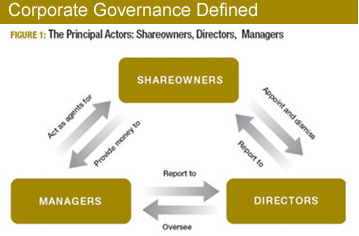 Corporate Governance[/caption]
WHY GOOD CORPORATE GOVERNANCE IS IMPORTANT
Corporate Governance is intended to increase the accountability of your company and avoid massive disasters before they occur. Failed energy giant Enron, and its bankrupt employees and shareholders, is a prime argument for the importance of solid Corporate Governance. Well- executed Corporate Governance should be similar to a police department's internal affairs unit, weeding out and eliminating problems with extreme prejudice. The Need, Significance or Importance of Corporate Governance is listed below.
Changing Ownership Structure:-
In recent years, the ownership structure of companies has changed a lot. Public financial institutions, mutual funds, etc. are the single largest shareholder in most of the large companies. So, they have effective control on the management of the companies. They force the management to use corporate governance. That is, they put pressure on the management to become more efficient, transparent, accountable, etc. They also ask the management to make consumer-friendly policies, to protect all social groups and to protect the environment. So, the changing ownership structure has resulted in corporate governance.
Importance of Social Responsibility
Today, social responsibility is given a lot of importance. The Board of Directors has to protect the rights of the customers, employees, shareholders, suppliers, local communities, etc. This is possible only if they use corporate governance
Growing Number of Scams
In recent years, many scams, frauds and corrupt practices have taken place. Misuse and misappropriation of public money are happening everyday in India and worldwide. It is happening in the stock market, banks, financial institutions, companies and government offices. In order to avoid these scams and financial irregularities, many companies have started corporate governance.
Indifference on the part of Shareholders
In general, shareholders are inactive in the management of their companies. They only attend the Annual general meeting. Postal ballot is still absent in India. Proxies are not allowed to speak in the meetings. Shareholders associations are not strong. Therefore, directors misuse their power for their own benefits. So, there is a need for corporate governance to protect all the stakeholders of the company.
Globalization
Today most big companies are selling their goods in the global market. So, they have to attract foreign investor and foreign customers. They also have to follow foreign rules and regulations. All this requires corporate governance. Without Corporate governance, it is impossible to enter, survive and succeed the global market.
Takeovers and Mergers
Today, there are many takeovers and mergers in the business world. Corporate governance is required to protect the interest of all the parties during takeovers and mergers.
SEBI
SEBI has made corporate governance compulsory for certain companies. This is done to protect the interest of the investors and other stakeholders.
NEED OF CORPORATE GOVERNANCE
Corporate Governance is needed to create a corporate culture of transparency, accountability and disclosure.
Corporate Performance: Improved governance structures and processes ensure quality decision-making, encourage effective succession planning for senior management and enhance the long-term prosperity of companies, independent of the type of company and its sources of finance. This can be linked with improved corporate performance- either in terms of share price or profitability.
Enhanced Investor Trust: Investors consider corporate governance as important as financial performance when evaluating companies for investment. Investors who are provided with high levels of disclosure and transparency are likely to invest openly in those companies. The consulting firm McKinsey surveyed and determined that global institutional investors are prepared to pay a premium of up to 40 percent for shares in companies with superior corporate governance practices.Better Access to Global Market: Good corporate governance systems attract investment from global investors, which subsequently leads to greater efficiencies in the financial sector.
Combating Corruption: Companies that are transparent, and have sound system that provide full disclosure of accounting and auditing procedures, allow transparency in all business transactions, provide environment where corruption would certainly fade out. Corporate Governance enables a corporation to compete more efficiently and prevent fraud and malpractices within the organization.
Easy Finance from Institutions: Several structural changes like increased role of financial intermediaries and institutional investors, size of the enterprises, investment choices available to investors, increased competition, and increased risk exposure have made monitoring the use of capital more complex thereby increasing the need of Good Corporate Governance. Evidences indicate that well-governed companies receive higher market valuations. The credit worthiness of a company can be trusted on the basis of corporate governance practiced in the company.
Enhancing Enterprise Valuation: Improved management accountability and operational transparency fulfill investors expectations and confidence on management and corporations, and in return, increase the value of corporations.
Reduced Risk of Corporate Crisis and Scandals: Effective Corporate Governance ensures efficient risk mitigation system in place. A transparent and accountable system makes the Board of a company aware of the majority of the mask risks involved in a particular strategy, thereby, placing various control systems in place to facilitate the monitoring of the related issues.
Accountability: Investor relations are essential part of good corporate governance. Investors directly/ indirectly entrust management of the company to create enhanced value for their investment. The company is hence obliged to make timely disclosures on regular basis to all its shareholders in Corporate Governance is integral to the existence of the company. Lesson 3 Conceptual framework of Corporate Governance 47 order to maintain good investor's relation. Good Corporate Governance practices create the environment whereby Boards cannot ignore their accountability to these stakeholders.
CORPORATE GOVERNANCE PRINCIPLES
Corporate governance refers to all laws, regulations, codes and practices, which defines how institution is administrated and inspected, determines rights and responsibilities of different partners, attracts human and financial capital, makes institution work efficiently, provides economic value to stack holders in the long turn while respecting the values of the community it belong. For corporate governance, the management approach should be in accordance with the following principles.
Principal 1 : Governance structure:
All Organizations should be headed by an effective Board. responsibilities and accountabilities within the organization should be clearly identified.
Principal2 : The structure of the board and its committees :
The board should comprise independent minded directors. It should include an appropriate combination of executive directors, independent directors and non-independent non-executive directors to prevent one individual or a small group of individuals from dominating the board's decision taking. The board should be of a size and level of diversity commensurate with the sophistication and scale of the organization. Appropriate board committees may be formed to assist the board in the effective performance of its duties.
Principal 3 : Director appointment procedure:
There should be a formal, rigorous and transparent process for the appointment, election, induction and re-election of directors. The search for board candidates should be conducted, and appointments made, on merit, against objective criteria (to include skills, knowledge, experience, and independence and with due regard for the benefits of diversity on the board, including gender). The board should ensure that a formal, rigorous and transparent procedure be in place for planning the succession of all key officeholders.
Principal 4 : Directors duties, remuneration and performance:
Directors should be aware of their legal duties. Directors should observe and foster high ethical standards and a strong ethical culture in their organization. Each director must be able to allocate sufficient time to discharge his or her duties effectively. Conflicts of interest should be disclosed and managed. The board is responsible for the governance of the organization's information, information technology and information security. The board, committees and individual directors should be supplied with information in a timely manner and in an appropriate form and quality in order to perform to required standards. The board, committees and individual directors should have their performance evaluated and be held accountable to appropriate stakeholders. The board should be transparent, fair and consistent in determining the remuneration policy for directors and senior executives.
Principal5 : Risk governance and internal control:
The board should be responsible for risk governance and should ensure that the organization develops and executes a comprehensive and robust system of risk management. The board should ensure the maintenance of a sound internal control system
Principal6 : Reporting and integrity:
The board should present a fair, balanced and understandable assessment of the organization's financial, environmental, social and governance position, performance and outlook in its annual report and on its website.
Principal 7 : Audit:
Organizations should consider having an effective and independent internal audit function that has the respect, confidence and cooperation of both the board and the management. The board should establish formal and transparent arrangements to appoint and maintain an appropriate relationship with the organization's auditors.
Principal8 : Relations with share holders and other key shareholder:
The board should be responsible for ensuring that an appropriate dialogue takes place among the organization, its shareholders and other key stakeholders. The board should respect the interests of its shareholders and other key stakeholders within the context of its fundamental purpose.
BENEFITS OF CORPORATE GOVERNANCE
The Benefits to Shareholders
Corporate Governance[/caption]
WHY GOOD CORPORATE GOVERNANCE IS IMPORTANT
Corporate Governance is intended to increase the accountability of your company and avoid massive disasters before they occur. Failed energy giant Enron, and its bankrupt employees and shareholders, is a prime argument for the importance of solid Corporate Governance. Well- executed Corporate Governance should be similar to a police department's internal affairs unit, weeding out and eliminating problems with extreme prejudice. The Need, Significance or Importance of Corporate Governance is listed below.
Changing Ownership Structure:-
In recent years, the ownership structure of companies has changed a lot. Public financial institutions, mutual funds, etc. are the single largest shareholder in most of the large companies. So, they have effective control on the management of the companies. They force the management to use corporate governance. That is, they put pressure on the management to become more efficient, transparent, accountable, etc. They also ask the management to make consumer-friendly policies, to protect all social groups and to protect the environment. So, the changing ownership structure has resulted in corporate governance.
Importance of Social Responsibility
Today, social responsibility is given a lot of importance. The Board of Directors has to protect the rights of the customers, employees, shareholders, suppliers, local communities, etc. This is possible only if they use corporate governance
Growing Number of Scams
In recent years, many scams, frauds and corrupt practices have taken place. Misuse and misappropriation of public money are happening everyday in India and worldwide. It is happening in the stock market, banks, financial institutions, companies and government offices. In order to avoid these scams and financial irregularities, many companies have started corporate governance.
Indifference on the part of Shareholders
In general, shareholders are inactive in the management of their companies. They only attend the Annual general meeting. Postal ballot is still absent in India. Proxies are not allowed to speak in the meetings. Shareholders associations are not strong. Therefore, directors misuse their power for their own benefits. So, there is a need for corporate governance to protect all the stakeholders of the company.
Globalization
Today most big companies are selling their goods in the global market. So, they have to attract foreign investor and foreign customers. They also have to follow foreign rules and regulations. All this requires corporate governance. Without Corporate governance, it is impossible to enter, survive and succeed the global market.
Takeovers and Mergers
Today, there are many takeovers and mergers in the business world. Corporate governance is required to protect the interest of all the parties during takeovers and mergers.
SEBI
SEBI has made corporate governance compulsory for certain companies. This is done to protect the interest of the investors and other stakeholders.
NEED OF CORPORATE GOVERNANCE
Corporate Governance is needed to create a corporate culture of transparency, accountability and disclosure.
Corporate Performance: Improved governance structures and processes ensure quality decision-making, encourage effective succession planning for senior management and enhance the long-term prosperity of companies, independent of the type of company and its sources of finance. This can be linked with improved corporate performance- either in terms of share price or profitability.
Enhanced Investor Trust: Investors consider corporate governance as important as financial performance when evaluating companies for investment. Investors who are provided with high levels of disclosure and transparency are likely to invest openly in those companies. The consulting firm McKinsey surveyed and determined that global institutional investors are prepared to pay a premium of up to 40 percent for shares in companies with superior corporate governance practices.Better Access to Global Market: Good corporate governance systems attract investment from global investors, which subsequently leads to greater efficiencies in the financial sector.
Combating Corruption: Companies that are transparent, and have sound system that provide full disclosure of accounting and auditing procedures, allow transparency in all business transactions, provide environment where corruption would certainly fade out. Corporate Governance enables a corporation to compete more efficiently and prevent fraud and malpractices within the organization.
Easy Finance from Institutions: Several structural changes like increased role of financial intermediaries and institutional investors, size of the enterprises, investment choices available to investors, increased competition, and increased risk exposure have made monitoring the use of capital more complex thereby increasing the need of Good Corporate Governance. Evidences indicate that well-governed companies receive higher market valuations. The credit worthiness of a company can be trusted on the basis of corporate governance practiced in the company.
Enhancing Enterprise Valuation: Improved management accountability and operational transparency fulfill investors expectations and confidence on management and corporations, and in return, increase the value of corporations.
Reduced Risk of Corporate Crisis and Scandals: Effective Corporate Governance ensures efficient risk mitigation system in place. A transparent and accountable system makes the Board of a company aware of the majority of the mask risks involved in a particular strategy, thereby, placing various control systems in place to facilitate the monitoring of the related issues.
Accountability: Investor relations are essential part of good corporate governance. Investors directly/ indirectly entrust management of the company to create enhanced value for their investment. The company is hence obliged to make timely disclosures on regular basis to all its shareholders in Corporate Governance is integral to the existence of the company. Lesson 3 Conceptual framework of Corporate Governance 47 order to maintain good investor's relation. Good Corporate Governance practices create the environment whereby Boards cannot ignore their accountability to these stakeholders.
CORPORATE GOVERNANCE PRINCIPLES
Corporate governance refers to all laws, regulations, codes and practices, which defines how institution is administrated and inspected, determines rights and responsibilities of different partners, attracts human and financial capital, makes institution work efficiently, provides economic value to stack holders in the long turn while respecting the values of the community it belong. For corporate governance, the management approach should be in accordance with the following principles.
Principal 1 : Governance structure:
All Organizations should be headed by an effective Board. responsibilities and accountabilities within the organization should be clearly identified.
Principal2 : The structure of the board and its committees :
The board should comprise independent minded directors. It should include an appropriate combination of executive directors, independent directors and non-independent non-executive directors to prevent one individual or a small group of individuals from dominating the board's decision taking. The board should be of a size and level of diversity commensurate with the sophistication and scale of the organization. Appropriate board committees may be formed to assist the board in the effective performance of its duties.
Principal 3 : Director appointment procedure:
There should be a formal, rigorous and transparent process for the appointment, election, induction and re-election of directors. The search for board candidates should be conducted, and appointments made, on merit, against objective criteria (to include skills, knowledge, experience, and independence and with due regard for the benefits of diversity on the board, including gender). The board should ensure that a formal, rigorous and transparent procedure be in place for planning the succession of all key officeholders.
Principal 4 : Directors duties, remuneration and performance:
Directors should be aware of their legal duties. Directors should observe and foster high ethical standards and a strong ethical culture in their organization. Each director must be able to allocate sufficient time to discharge his or her duties effectively. Conflicts of interest should be disclosed and managed. The board is responsible for the governance of the organization's information, information technology and information security. The board, committees and individual directors should be supplied with information in a timely manner and in an appropriate form and quality in order to perform to required standards. The board, committees and individual directors should have their performance evaluated and be held accountable to appropriate stakeholders. The board should be transparent, fair and consistent in determining the remuneration policy for directors and senior executives.
Principal5 : Risk governance and internal control:
The board should be responsible for risk governance and should ensure that the organization develops and executes a comprehensive and robust system of risk management. The board should ensure the maintenance of a sound internal control system
Principal6 : Reporting and integrity:
The board should present a fair, balanced and understandable assessment of the organization's financial, environmental, social and governance position, performance and outlook in its annual report and on its website.
Principal 7 : Audit:
Organizations should consider having an effective and independent internal audit function that has the respect, confidence and cooperation of both the board and the management. The board should establish formal and transparent arrangements to appoint and maintain an appropriate relationship with the organization's auditors.
Principal8 : Relations with share holders and other key shareholder:
The board should be responsible for ensuring that an appropriate dialogue takes place among the organization, its shareholders and other key stakeholders. The board should respect the interests of its shareholders and other key stakeholders within the context of its fundamental purpose.
BENEFITS OF CORPORATE GOVERNANCE
The Benefits to Shareholders
Corporate Governance[/caption]
WHY GOOD CORPORATE GOVERNANCE IS IMPORTANT
Corporate Governance is intended to increase the accountability of your company and avoid massive disasters before they occur. Failed energy giant Enron, and its bankrupt employees and shareholders, is a prime argument for the importance of solid Corporate Governance. Well- executed Corporate Governance should be similar to a police department's internal affairs unit, weeding out and eliminating problems with extreme prejudice. The Need, Significance or Importance of Corporate Governance is listed below.
Changing Ownership Structure:-
In recent years, the ownership structure of companies has changed a lot. Public financial institutions, mutual funds, etc. are the single largest shareholder in most of the large companies. So, they have effective control on the management of the companies. They force the management to use corporate governance. That is, they put pressure on the management to become more efficient, transparent, accountable, etc. They also ask the management to make consumer-friendly policies, to protect all social groups and to protect the environment. So, the changing ownership structure has resulted in corporate governance.
Importance of Social Responsibility
Today, social responsibility is given a lot of importance. The Board of Directors has to protect the rights of the customers, employees, shareholders, suppliers, local communities, etc. This is possible only if they use corporate governance
Growing Number of Scams
In recent years, many scams, frauds and corrupt practices have taken place. Misuse and misappropriation of public money are happening everyday in India and worldwide. It is happening in the stock market, banks, financial institutions, companies and government offices. In order to avoid these scams and financial irregularities, many companies have started corporate governance.
Indifference on the part of Shareholders
In general, shareholders are inactive in the management of their companies. They only attend the Annual general meeting. Postal ballot is still absent in India. Proxies are not allowed to speak in the meetings. Shareholders associations are not strong. Therefore, directors misuse their power for their own benefits. So, there is a need for corporate governance to protect all the stakeholders of the company.
Globalization
Today most big companies are selling their goods in the global market. So, they have to attract foreign investor and foreign customers. They also have to follow foreign rules and regulations. All this requires corporate governance. Without Corporate governance, it is impossible to enter, survive and succeed the global market.
Takeovers and Mergers
Today, there are many takeovers and mergers in the business world. Corporate governance is required to protect the interest of all the parties during takeovers and mergers.
SEBI
SEBI has made corporate governance compulsory for certain companies. This is done to protect the interest of the investors and other stakeholders.
NEED OF CORPORATE GOVERNANCE
Corporate Governance is needed to create a corporate culture of transparency, accountability and disclosure.
Corporate Performance: Improved governance structures and processes ensure quality decision-making, encourage effective succession planning for senior management and enhance the long-term prosperity of companies, independent of the type of company and its sources of finance. This can be linked with improved corporate performance- either in terms of share price or profitability.
Enhanced Investor Trust: Investors consider corporate governance as important as financial performance when evaluating companies for investment. Investors who are provided with high levels of disclosure and transparency are likely to invest openly in those companies. The consulting firm McKinsey surveyed and determined that global institutional investors are prepared to pay a premium of up to 40 percent for shares in companies with superior corporate governance practices.Better Access to Global Market: Good corporate governance systems attract investment from global investors, which subsequently leads to greater efficiencies in the financial sector.
Combating Corruption: Companies that are transparent, and have sound system that provide full disclosure of accounting and auditing procedures, allow transparency in all business transactions, provide environment where corruption would certainly fade out. Corporate Governance enables a corporation to compete more efficiently and prevent fraud and malpractices within the organization.
Easy Finance from Institutions: Several structural changes like increased role of financial intermediaries and institutional investors, size of the enterprises, investment choices available to investors, increased competition, and increased risk exposure have made monitoring the use of capital more complex thereby increasing the need of Good Corporate Governance. Evidences indicate that well-governed companies receive higher market valuations. The credit worthiness of a company can be trusted on the basis of corporate governance practiced in the company.
Enhancing Enterprise Valuation: Improved management accountability and operational transparency fulfill investors expectations and confidence on management and corporations, and in return, increase the value of corporations.
Reduced Risk of Corporate Crisis and Scandals: Effective Corporate Governance ensures efficient risk mitigation system in place. A transparent and accountable system makes the Board of a company aware of the majority of the mask risks involved in a particular strategy, thereby, placing various control systems in place to facilitate the monitoring of the related issues.
Accountability: Investor relations are essential part of good corporate governance. Investors directly/ indirectly entrust management of the company to create enhanced value for their investment. The company is hence obliged to make timely disclosures on regular basis to all its shareholders in Corporate Governance is integral to the existence of the company. Lesson 3 Conceptual framework of Corporate Governance 47 order to maintain good investor's relation. Good Corporate Governance practices create the environment whereby Boards cannot ignore their accountability to these stakeholders.
CORPORATE GOVERNANCE PRINCIPLES
Corporate governance refers to all laws, regulations, codes and practices, which defines how institution is administrated and inspected, determines rights and responsibilities of different partners, attracts human and financial capital, makes institution work efficiently, provides economic value to stack holders in the long turn while respecting the values of the community it belong. For corporate governance, the management approach should be in accordance with the following principles.
Principal 1 : Governance structure:
All Organizations should be headed by an effective Board. responsibilities and accountabilities within the organization should be clearly identified.
Principal2 : The structure of the board and its committees :
The board should comprise independent minded directors. It should include an appropriate combination of executive directors, independent directors and non-independent non-executive directors to prevent one individual or a small group of individuals from dominating the board's decision taking. The board should be of a size and level of diversity commensurate with the sophistication and scale of the organization. Appropriate board committees may be formed to assist the board in the effective performance of its duties.
Principal 3 : Director appointment procedure:
There should be a formal, rigorous and transparent process for the appointment, election, induction and re-election of directors. The search for board candidates should be conducted, and appointments made, on merit, against objective criteria (to include skills, knowledge, experience, and independence and with due regard for the benefits of diversity on the board, including gender). The board should ensure that a formal, rigorous and transparent procedure be in place for planning the succession of all key officeholders.
Principal 4 : Directors duties, remuneration and performance:
Directors should be aware of their legal duties. Directors should observe and foster high ethical standards and a strong ethical culture in their organization. Each director must be able to allocate sufficient time to discharge his or her duties effectively. Conflicts of interest should be disclosed and managed. The board is responsible for the governance of the organization's information, information technology and information security. The board, committees and individual directors should be supplied with information in a timely manner and in an appropriate form and quality in order to perform to required standards. The board, committees and individual directors should have their performance evaluated and be held accountable to appropriate stakeholders. The board should be transparent, fair and consistent in determining the remuneration policy for directors and senior executives.
Principal5 : Risk governance and internal control:
The board should be responsible for risk governance and should ensure that the organization develops and executes a comprehensive and robust system of risk management. The board should ensure the maintenance of a sound internal control system
Principal6 : Reporting and integrity:
The board should present a fair, balanced and understandable assessment of the organization's financial, environmental, social and governance position, performance and outlook in its annual report and on its website.
Principal 7 : Audit:
Organizations should consider having an effective and independent internal audit function that has the respect, confidence and cooperation of both the board and the management. The board should establish formal and transparent arrangements to appoint and maintain an appropriate relationship with the organization's auditors.
Principal8 : Relations with share holders and other key shareholder:
The board should be responsible for ensuring that an appropriate dialogue takes place among the organization, its shareholders and other key stakeholders. The board should respect the interests of its shareholders and other key stakeholders within the context of its fundamental purpose.
BENEFITS OF CORPORATE GOVERNANCE
The Benefits to Shareholders
- Good CORPORATE GOVERNANCE can provide the proper incentives for the board and management to pursue objectives that are in the interest of the company and shareholders, as well as facilitate effective monitoring.
- Better CORPORATE GOVERNANCE can also provide Shareholders with greater security on their investment.
- Better CORPORATE GOVERNANCE also ensures that shareholders are sufficiently informed on decisions concerning fundamental issues like amendments of statutes or articles of incorporation, sale of assets, etc.
- Empirical evidence and research conducted in recent years supports the proposition that it pays to have good CORPORATE GOVERNANCE. It was found out that more than 84% of the global institutional investors are willing to pay a premium for the shares of a well-governed company over one considered poorly governed but with a comparable financial record.
- The adoption of CORPORATE GOVERNANCE principles - as good CORPORATE GOVERNANCE practice has already shown in other markets - can also play a role in increasing the corporate value of companies.
- High performance Boards of Directors;
- Accountable management and strong internal controls;
- Increased shareholder engagement;
- Better managed risk; and
- Effectively monitored and measured performance.
- Establish corporate values and governance structures for the company;
- Ensure that all legal and regulatory requirements are met and complied with fully and in a timely fashion;
- Establish long-term strategic objectives for the company;
- Establish clear lines of responsibility and a strong system of accountability and performance measurement;
- Hire the chief executive officer, determine the compensation package, and periodically evaluate the officer's performance;
- Ensure that management has supplied the board with sufficient information for it to be fully informed and prepared to make the decisions that are its responsibility, and to be able to adequately monitor and oversee the company's management;
- Meet regularly to perform its duties;
- Acquire adequate training.
- Ethics: Clearly ethical practices applied to the business
- Align Business Goals: appropriate goals, arrived at through the creation of a suitable stakeholder participation in decision making model
- Strategic management: an effective strategy process which incorporates stakeholder value
- Organisation: an organisation suitably structured to give effect to the good corporate governance
- Reporting: reporting systems structured to provide transparency and accountability.
- having a clear and achievable goal
- having a feasible strategy to achieve it
- creating an organization appropriate to deliver
- having in place a reporting system to guide progress.
-
- Aside from stopping the next illegal moneymaking scheme, transparency also builds a good reputation of the company in question. When shareholders feel they can trust a company, they are willing to invest more, and this greatly helps in lowering cost of capital.
- Transparency is a critical component of corporate governance because it ensures that all of a company's actions can be checked at any given time by an outside observer. This makes its processes and transactions verifiable, so if a question does come up about a step, the company can provide a clear answer.
- Ensure timely, accurate disclosure on all material matters, including the financial situation, performance, ownership and corporate governance.
- How transparent is your corporate board
- Are directors actions readily verifiable by internal and external audit
- Is their leadership visible from the top to all the way down
- Is transparency applicable to everyone't
- hareholders are deeply interested in who will take the blame when something goes wrong in one of a companys many processes. And even when everything goes smoothly as expected, knowing that someone will be held accountable for future mishaps increases shareholders confidence, which in turn increases their desire to invest more.
- Accountability is more than that. It's about having ownership over one's actions whether the consequences of those actions are good or bad. Thus, accountability covers not only failings, but also accomplishments.
- When the idea of accountability is approached with this positive outlook, people will be more open to it as a means to improve their performance. This applies from the staff all the way up to the corporate board.
- Hows the level of accountability in your corporate board
- Are your directors there to simply fill in a seat while leafing through their board packs and board books, or are they actively engaged in decisions and strategies for your company
- Even with accountability and transparency, a company without inadequate security measures will have a hard time attracting shareholders. After all, any scandal even a breach caused by third-party hackers can have a negative effect on a company's stock market performance.
- The increasing threat of cyber crime in recent years puts security at a high priority for many companies. Complying with security standards isn't enough a company needs to imbibe a culture of security to ensure that trade secrets, corporate data, and client information are all kept safe from unauthorized access from inside and out. Security is not just an IT concern anymore, unlike in the past.
- Directors should be made aware of the seriousness of cyber crime and the gravity of its consequences. A security breach especially involving client information can make the public easily lose their trust. Trust is a big factor which will be considered by shareholders before making an investment in a company.
- How high is the awareness level of your company's directors when it comes to security
- How high is the awareness level of your company's employees when it comes to security
- Number of Directors
- Companies need to have following class of directors: Resident Director, Independent Director and woman Director
- Audit committee(177)
- Nomination & Remuneration committee (178)
- Stakeholders Relationship Committee
- CSR Committee
- Risk Management
- Internal Financial Committee & its adequacy
- Prevention of Sexual harassment of women at workplace; any other
- The Board of Directors;
- Audit Committee;
- Subsidiary Companies;
- Disclosures;
- CEO/CFO Certification;
- Report on Corporate Governance;
- Compliance
- Effectiveness and efficiency of operations,
- Reliability of financial reporting, and
- Compliance with applicable laws and regulations.
- Details of all material transactions with related parties shall be disclosed quarterly along with the compliance report on corporate governance.
- The company shall disclose the policy on dealing with Related Party Transactions on its website and also in the Annual Report.
- Appointment of Women Director.
- Tenure of Independent Directors and performance evaluation.
- Formal letter of appointment to independent directors.
- Separate meeting of independent directors and training of IDs.
- Succession plan for board/ senior management.
- Disclosure in Annual Report about Remuneration Policy and evaluation criteria.
- Compulsory Whistle Blower Mechanism.
- Constitution of Nomination and Remuneration Committee.
- Related Party Transactions.
- Corporate Social Responsibility(CSR).
- If the promoter is a listed entity, its directors other than the IDs or its nominees shall be deemed to be related to it;
- If the promoter is an unlisted entity, its directors, its employees or its nominees shall be deemed to be related to it.
- An Independent Director shall hold office for a term up to five consecutive years on the Board of a Company and shall be eligible for re-appointment for another term of up to 5 consecutive years on passing of a special resolution by the Company.
- Provided that a person who has already served as an ID for five years or more in a company shall be eligible for re-appointment, on completion of his present term, for one more term of up to five years only.
- Provided further that an ID, who completes his above mentioned term shall be eligible for appointment as ID in the company only after the expiration of three years of ceasing to be an ID in the company.
- The Nomination Committee shall lay down the evaluation criteria for performance evaluation of IDs.
- The company shall disclose the criteria for performance evaluation, as laid down by the Nomination Committee, in its Annual Report.
- The performance evaluation of ID shall be done by the entire Board of Directors (excluding the director being evaluated).
- On the basis of the report of performance evaluation, it shall be determined whether to extend or continue the term of appointment of the ID. This is to align with Schedule IV of the Companies Act, 2013 which provides mechanism for evaluation of IDs.
- Review the performance of non-independent directors and the Board as a whole;
- Review the performance of the Chairperson of the company, taking into account the views of executive directors and non executive directors;
- A related party transaction is a transfer of resources, services or obligations between a company and a related party, regardless of whether a price is charged.
- The company shall formulate a policy on materiality of related party transactions and also on dealing with Related Party Transactions. Provided that a transaction with a related party shall be considered material if the transaction / transactions to be entered into individually or taken together with previous transactions during a financial year, exceeds 5% of the annual turnover or 20% of the net worth of the company as per the last audited financial statements of the company, whichever is higher.
- All Related Party Transactions shall require prior approval of the Audit Committee.
- All material Related Party Transactions shall require approval of the shareholders through related parties special resolution and this shall abstain from voting on such resolutions.
- Industry structure and developments.
- Opportunities and Threats.
- Segment wise or product-wise performance.
- Outlook.
- Risks and concerns.
- Internal control systems and their adequacy.
- Discussion on financial performance with respect to operational performance.
- Material developments in Human Relations front including.
- Resources / Industrial front, number of people employed.
- Reebok India Case
- Vodafone wins $2.2 Billion Tax Bill Battle
- Diageo's $2.1 billion deal for Mallya's United Spirits
- Emkay Global's bad orders trigger brief halt on NSE
- Kingfisher Airlines Loses License to fly
- Axis Bank Partners with Tata General Insurance
- INR 1,800 crore wiped off Adani Enterprise Ltd stocks after rumour fuelled by blogger
- Hero Motors finally drops Honda
- Sahara told to repay small investors
- Cyrus Mistry remove from the post of chairman- TATA GROUP
- Acting as a primary point of contact and source of advice and guidance for, particularly, non-executive Directors as regards the Company and its activities in order to support the decision making process;
- Advise the Board on its roles and responsibilities;
- Facilitate the orientation of new Directors and assist in Director training and development;
- Maintain key corporate documents and records;
- Responsible for corporate disclosure and compliance with State Corporation Laws (SCL), stock exchange listing standards and SEC reporting and compliance;
- Oversee Stakeholder Relations including stock issuance and transfer operations; stakeholder correspondence; prepare and distribute proxy statement;
- Manage process pertaining to the annual shareholder meeting;
- Subsidiary management and governance;
- Monitor corporate governance developments and assist the Board in tailoring governance practices to meet the Board's needs and investor expectations;
- Serve as a focal point for investor communication and engagement on corporate governance issues;
- Together with the Human Resources Director, keeping in touch with the debate on Corporate Social Responsibility and stakeholders, and monitoring all developments in this area and advising the Board in relation to its policy and practices with regard to Corporate Social Responsibility and its reporting on that matter;
what is the purpose of corporate governance, scope of corporate governance, corporate governance structure, role of corporate governance, benefits of corporate governance, corporate governance examples, corporate governance in india, corporate governance principles, Corporate Governance
Click Here to Buy CA Final Pendrive Classes at Discounted RateUp Next
Loading suggestions…


Recent Posts



All Posts



Tags
No tags yet.
Recent Posts
All Posts
Tags
No tags yet.