Delhi ITAT quashes Section 263 revisionary order for “inadequate enquiry”:
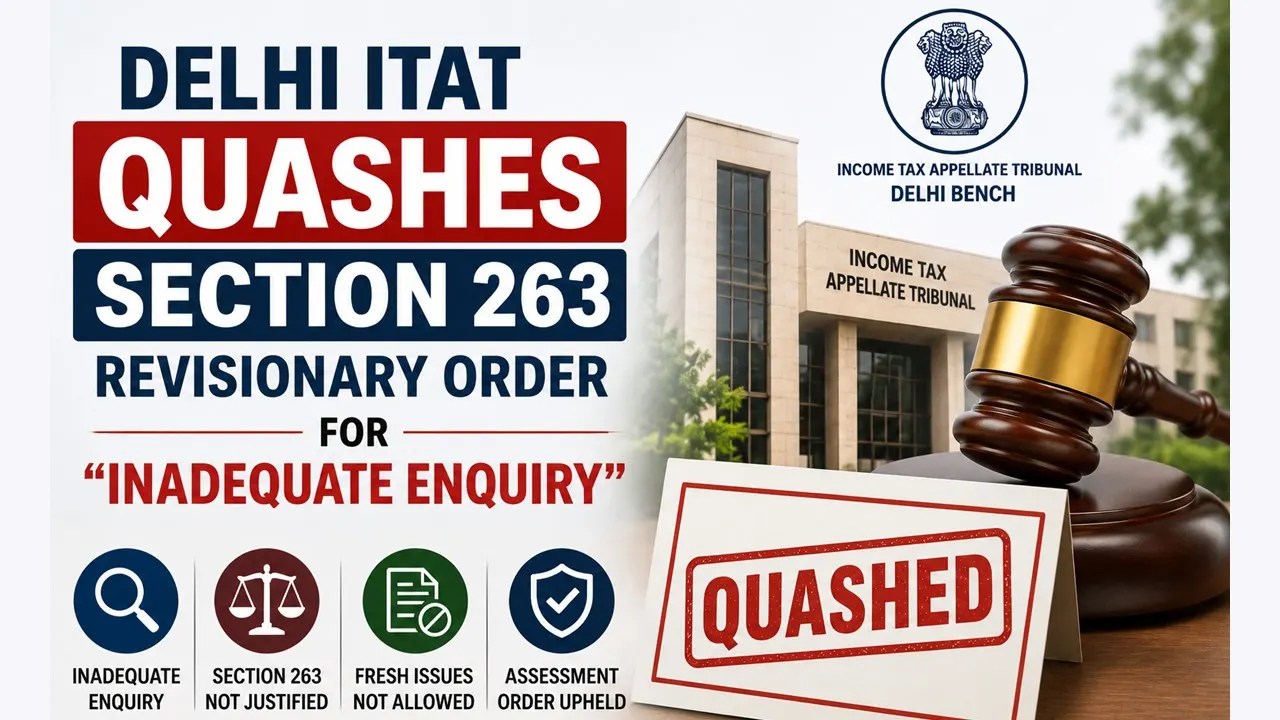
ITAT quashes Section 263 revision holding penalty proceedings independent from assessment proceedings under Income Tax Act.
Tribunal held assessment and penalty proceedings operate in separate legal spheres
 Meetu Kumari
 May 17, 2026
The Delhi Bench ‘B’ of the Income Tax Appellate Tribunal (ITAT) on 14 May held that revisionary powers under Section 263 of the Income-tax Act, 1961 cannot be invoked merely because the Assessing Officer failed to examine or initiate penalty proceedings relating to Section 269T of the Act. A Bench comprising Judicial Member Sudhir Kumar and Accountant Member Manish Agarwal set aside the revisionary order passed against KPA Apparels Private Limited and restored the original assessment order passed under Section 143(3). The Tribunal pointed out that
“Because penalty proceedings under Section 271E operate independently from regular income assessments, any omission to examine a Section 269T issue does not affect the computation of taxable income and therefore cannot render the assessment order prejudicial to the interests of the Revenue.”
The Assessing Officer (AO) had originally completed the assessment for AY 2020-21 under Section 143(3) after conducting detailed inquiries and accepted the returned loss declared by the assessee. Subsequently, the Principal Commissioner of Income Tax (PCIT) invoked revisionary jurisdiction under Section 263 on the basis of a Revenue audit objection.

The PCIT alleged that the assessee had violated Section 269T by repaying certain loans through journal entries instead of prescribed banking channels and that the AO failed to initiate penalty proceedings under Section 271E. The PCIT also raised issues regarding verification of business expenditure and directed fresh examination through a de novo assessment.
Before the Tribunal, KPA Apparels contended that the alleged non-examination of Section 269T had no impact on the computation of income or tax liability. It argued that penalty proceedings are independent from assessment proceedings and therefore the twin conditions necessary for invoking Section 263 that the order must be both erroneous and prejudicial to the interests of Revenue — were absent in the present case.

“Assessment proceedings and penalty proceedings are separate and distinct. Failure to invoke penalty provisions cannot by itself make an assessment order erroneous insofar as it is prejudicial to the interests of the Revenue.”
The Tribunal accepted the assessee’s submissions and observed that proceedings under Section 271E are separate from regular assessment proceedings. It held that even if there was a possible violation of Section 269T, the same would not alter the assessed income or tax payable under the assessment order.
The Bench also relied upon the Delhi High Court judgment in CIT vs. Noida Toll Bridge Co. Ltd. and observed that journal entries made for commercial adjustments do not automatically violate the intent behind anti-abuse provisions such as Section 269T.
On the issue of business expenditure, the Tribunal noted that the AO had already conducted inquiries during the original assessment proceedings and taken a plausible view after examining the material on record. It held that Section 263 cannot be invoked merely because the PCIT holds a different opinion or seeks a deeper verification.
Thus, the ITAT allowed the assessee’s appeal and quashed the revisionary order passed under Section 263.
To Read Full Order, Download PDF Given Below.
About Author


Meetu Kumari
Content Manager
 Studycafe
 Jodhpur, Rajasthan, India
 2264
2264My Recent Articles
- ITAT Condones 302-Day Delay, Restores Salary Assessment for Fresh VerificationPremium
- ITAT Condones Delay After Tax Consultant's Death, Restores Appeals for Fresh HearingPremium
- ITAT Remands Salary Addition, Says Taxability Depends on Salary Becoming Due, Not Mere ReceiptPremium
- ITAT Deletes TP Royalty Adjustment, Orders Fresh Review of Commission BenchmarkingPremium
- ITAT Quashes Reassessment Over Unsigned Section 148 Notice Issued to AssesseePremium
Loading suggestions…


Recent Posts


All Posts


Recent Posts
All Posts