Determination and apportionment of input tax credit in respect of capital goods
Determination and apportionment of input tax credit in respect of capital goods Input tax credit (the ITC ) is the backbone of GST. On a per
 CA Deepak Gupta
 Dec 11, 2018
Determination and apportionment of input tax credit in respect of capital goods
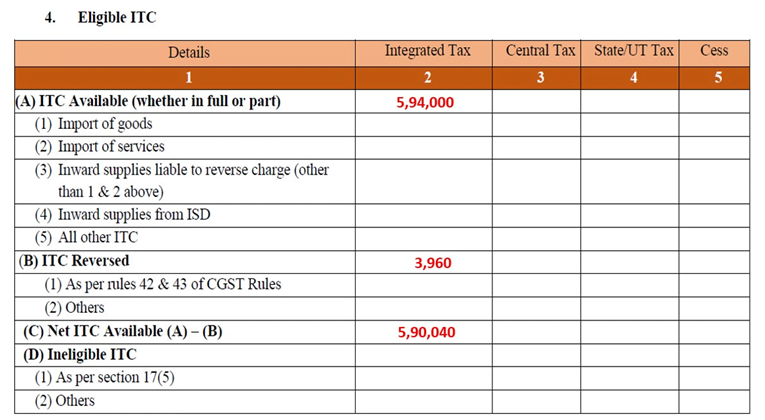
Input tax credit (the ITC) is the backbone of GST. On a perusal of section 73 and and 74 will reveal that wrong availment of ITC is being treated as violation, irrespective of its actual utilization. In this article, Rule 43 of CGST Rules, 2017 (the Rules) has been thoroughly discussed and critically analyzed so as to enable every reader to use this article as a ready reference. Rule 43 talks about ITC in respect of capital goods, so reference to any section in this article has been modified accordingly to concentrate on capital goods only. There are certain errors in drafting of Rule 43, which we see with the flow of discussion.
Issues to be analyzed
I. Emergence of Rule 43 and principles embedded therein
II. Express assumption taken by Rule 43 does it hold goods in all situations
III. Contradiction between Rule 43 and GSTR-3B
IV. Understanding Rule 43 an easy digest of a complex drafting!
V. Situations not specifically covered by law
all above issues has been analyzed in this article at length at relevant places in the form of discussion.
Emergence of Rule 43 and principles embedded therein
Section 17(1) and section 17(2) are cause of creation of Rule 43. Section 17(1) specifies that ITC in respect of capital goods shall not be available to the extent these are used for non-business purposes. Similarly, section 17(2) specifies that ITC in respect of capital goods shall not be available to the extent these are used for effecting exempt outward supplies.
So, Rule 43 is based on following principles
i. If inward supply of capital goods is used for effecting taxable outward supplies, then ITC shall be available in respect of such goods to the extent these are used for said purpose.
ii. If inward supply of capital goods is used for effecting zero rated outward supply, then ITC shall be available in respect of such goods to the extent these are used for said purpose.
iii. If inward supply of capital goods is used for effecting exempt outward supplies, then ITC shall not be available in respect of such goods to the extent these are used for said purpose.
iv. If inward supply of capital goods is used for non-business purpose, then ITC shall not be available in respect of capital goods to the extent these are used for said purpose.
ITC in respect of those capital goods shall also not be available, when such goods falls within the scope of section 17(5).
An express assumption taken by Rule 43 (for commonly used capital goods)
A capital good has a life of 5 years i.e. 60 months i.e. 20 quarters. So, ITC in respect of a capital goods shall be available over a period of 5years/60months/20 quarters. Rule 43 specifically uses 5% per quarter.
An implied intention of Rule 43
When we compare Rule 43 with Rule 42, there is no provision for annual recalculation in Rule 43 as in Rule 42. So, Rule 43 has been drafted in such a manner that calculation of credit for a particular tax period (month) must be accurate and final in that period itself.
In other words, as soon as a tax period (i.e. month) ends, self-assessment of 1/60th of the credit also must end. Noone needs revisit this 1/60th part in next tax period(s). Similarly, one can conclude that as soon a quarter ends, self-assessment of 5% for that quarter also ends. Rule 43 treats part of quarter as complete quarter for purpose of this computation exercise.
Some other aspects relevant for understanding Rule 43
One can take credit in respect of a capital goods as soon as four conditions as specified in section 16(2) are fulfilled, if not, credit is ineligible.
Click Here to Read the Complete Article
This article has been release byIndirect Taxes Committee of ICAI. This article has been drafted by CA Kasi Viswanathan and reviewed by CA A. Jatin Christopher.
DISCLAIMER
The views expressed in this article are of the author(s). The Institute of Chartered Accountants of India may not necessarily subscribe to the views expressed by the author(s).
The information cited in this article has been drawn from various sources. While every effort has been made to keep, the information cited in this article error free, the Institute or any office of the same does not take the responsibility for any typographical or clerical error which may have crept in while compiling the information provided in this article.
Tags :input tax credit on capital goods under gst, input tax credit on capital goods under gst with example, itc on capital goods under gst with example, gst input on fixed assets, itc on capital goods under gst tax guru, input tax credit on capital goods ledger is created under, input tax credit rules under gst, rule 43 of gst with example,Determination and apportionment of input tax credit in respect of capital goods,input tax credit on capital goods under gst with example
Click Here to Buy CA Final Pendrive Classes at Discounted Rate
About Author


CA Deepak Gupta
Co Founder
CA Deepak Gupta,is Co-founder of Studycafe. He is Microsoft Office Specialist and Corporate Trainer of AI Tools, Microsoft Excel.
He is Finance Influencer having more than 250K followers on Social Media. CA Deepak Gupta, is Having more than 14 plus years of experience, and he has Worked with best brands Like, Hero, Wipro, Ericsson before Starting Studycafe. He has Trained more than 20000 Persons in Microsoft Excel, PowerPoint, Power BI, Google Sheet, Google Forms and Other Tools.
CA Deepak Gupta,is Co-founder of Studycafe. He is Microsoft Office Specialist and Corporate Trainer of AI Tools, Microsoft Excel.
He is Finance Influencer having more than 250K followers on Social Media. CA Deepak Gupta, is Having more than 14 plus years of experience, and he has Worked with best brands Like, Hero, Wipro, Ericsson before Starting Studycafe. He has Trained more than 20000 Persons in Microsoft Excel, PowerPoint, Power BI, Google Sheet, Google Forms and Other Tools.
 StudyCafe
 Delhi, Delhi, India
 3423
3423My Recent Articles
- UltraTech Cement slapped with Rs. 808.78 Cr Income Tax Demand
- GST: High Court upheld constitutional validity of Section 16(2)(c), asks government to address ITC issues of genuine purchasers
- Old vs New Tax Regime for Tax Year 2026-27
- High court criticizes Income Tax Department for not releasing ITR Utilities despite 11 years of directions
- Fino Payments Bank CEO Rishi Gupta Gets Bail in GST Case, Bank Clarifies No Direct Link
Up Next
Loading suggestions…


Recent Posts

All Posts


Recent Posts
All Posts