Govt Proposes Major Amendments to Payment and Settlement Systems Act, 2007, and Income Tax Act, 2025:
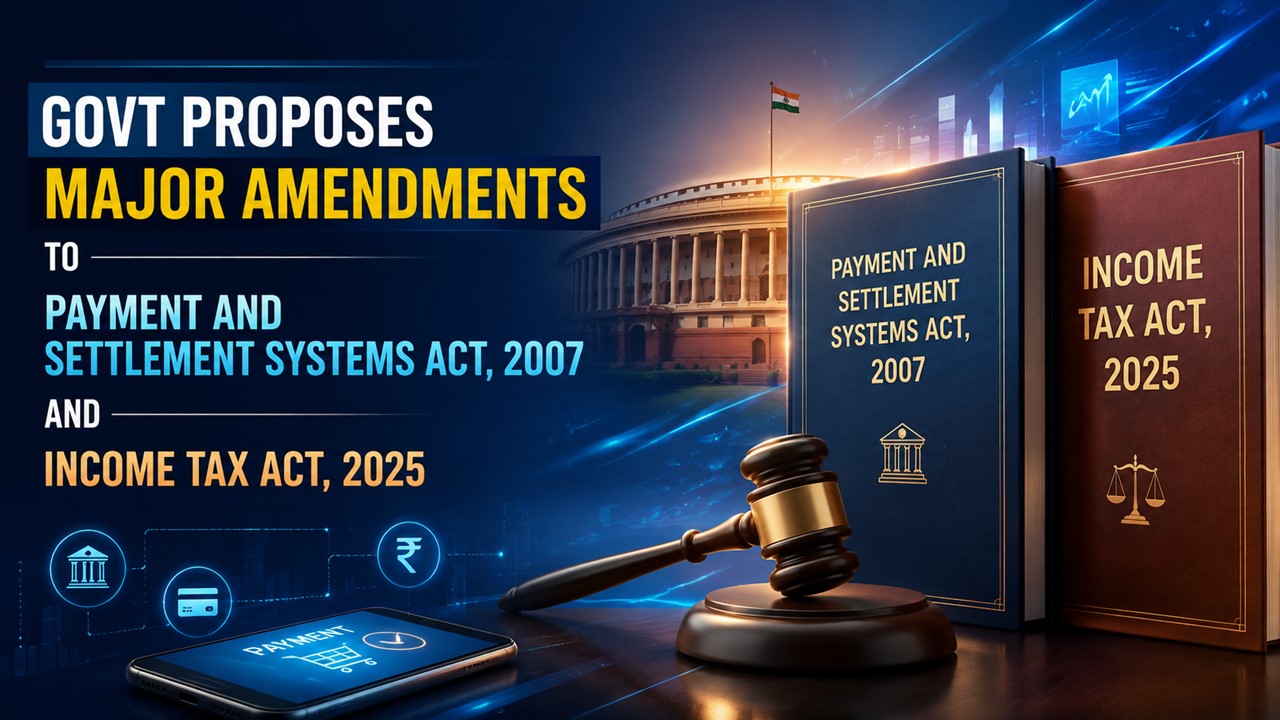
The Govt has proposed amendments to the Payment and Settlement Systems Act and the Income-tax Act to simplify digital payment compliance and provide greater flexibility for foreign investment funds.
Centre Proposes Flexible Digital Payment Rules and Revised Tax Norms for Foreign Funds
 Saloni Kumari
 Aug 7, 2026
The Central Government has proposed certain significant amendments to the Payment and Settlement Systems Act, 2007, and the Income Tax Act, 2025, to simplify compliance and provide greater flexibility.
Under the proposed amendment in the Payment and Settlement Systems Act, 2007, changes will be introduced to Section 10A to replace the existing requirement of accepting electronic payment modes prescribed under Section 269SU of the Income-tax Act, 1961. Instead, businesses will be required to provide one or more electronic payment modes that the Central Government may notify from time to time.

In the said Act, in Section 10A, in place of the words, figures and letters "the electronic modes of payment prescribed under section 269SU of the Income-tax Act, 1961", the words "one or more electronic modes of payment as the Central Government may, by notification, specify" will be replaced. This change is scheduled to take effect from the date of publication of this Act in the Official Gazette.
The Bill also proposes to substitute Schedule I of the Income-tax Act, 2025, which lays down the conditions under which certain activities of foreign investment funds will not be treated as creating a business connection in India.

Under the new provisions, an eligible investment fund must be established or incorporated outside India, should not be a resident of India, and must either belong to a country having a tax treaty with India or to a country notified by the Central Government. The investment by Indian residents in such a fund must generally not exceed 5% of its corpus.
However, contributions of up to Rs 25 crore made by an eligible fund manager during the fund's first three years will be excluded while calculating this limit. If the 5% threshold is temporarily crossed, the condition can still be satisfied if compliance is restored within four months.
As per the proposed Schedule, the fund must not carry on or control any business in India, except through the permitted activities of an eligible fund manager, ensuring that foreign investment funds can operate without unintentionally creating a taxable business presence in India.
About Author


Saloni Kumari
Content Writer
 StudyCafe
 Delhi, Delhi, India
 2889
2889My Recent Articles
- ITAT Sets Aside Rejection of Charitable Trust’s Section 12AB Registration Application, Remands Case to CIT(E) for Fresh Consideration
- Can Same-Sex Partners Claim Tax Exemption on Gifts as Spouses? Karnataka High Court to Examine
- ITAT Remits Section 80G Renewal Application to CIT(E) for Fresh Consideration in Light of CBDT Circular
- Dreamfolks Services Faces Rs 1.58 Crore IGST Demand Over ITC Availment on Invoices Issued by GST-Cancelled Supplier
- ITAT Restores Taxpayer's Appeal In Interest of Natural Justice After CIT(A)'s Failure to Decide Appeal on Merits
Loading suggestions…


Recent Posts

All Posts


Recent Posts
All Posts