Govt. Provides Financial Incentives to States to accelerate Power Sector Reforms; 12 States receive Rs.66,413 crore Incentives:
Ministry of Finance has given a boost to reforms by the States in power sector by providing financial incentives in the form of additional borrowing permissions.
Govt. Provides Financial Incentives to States
 Reetu
Reetu Jun 28, 2023
Govt. Provides Financial Incentives to States to accelerate Power Sector Reforms; 12 States receive Rs.66,413 crore Incentives
The Department of Expenditure, Ministry of Finance, has given a boost to reforms by the States in power sector by providing financial incentives in the form of additional borrowing permissions. This move aims to encourage and support the States in undertaking reforms to enhance the efficiency and performance of the power sector.
The initiative was launched by the Union Finance Minister in the Union Budget 2021-22. Under this programme, the States will be authorised to borrow up to 0.5 percent of their Gross State Domestic Product (GSDP) on a yearly basis for the next four years, from 2021-22 to 2024-25.
This additional financial window is dependent on implementation of specific reforms in the power sector by the States.
The effort has prompted state governments to begin the reform process, and numerous states have stepped forward and reported to the Ministry of Power information of the reforms implemented and successes in different areas.
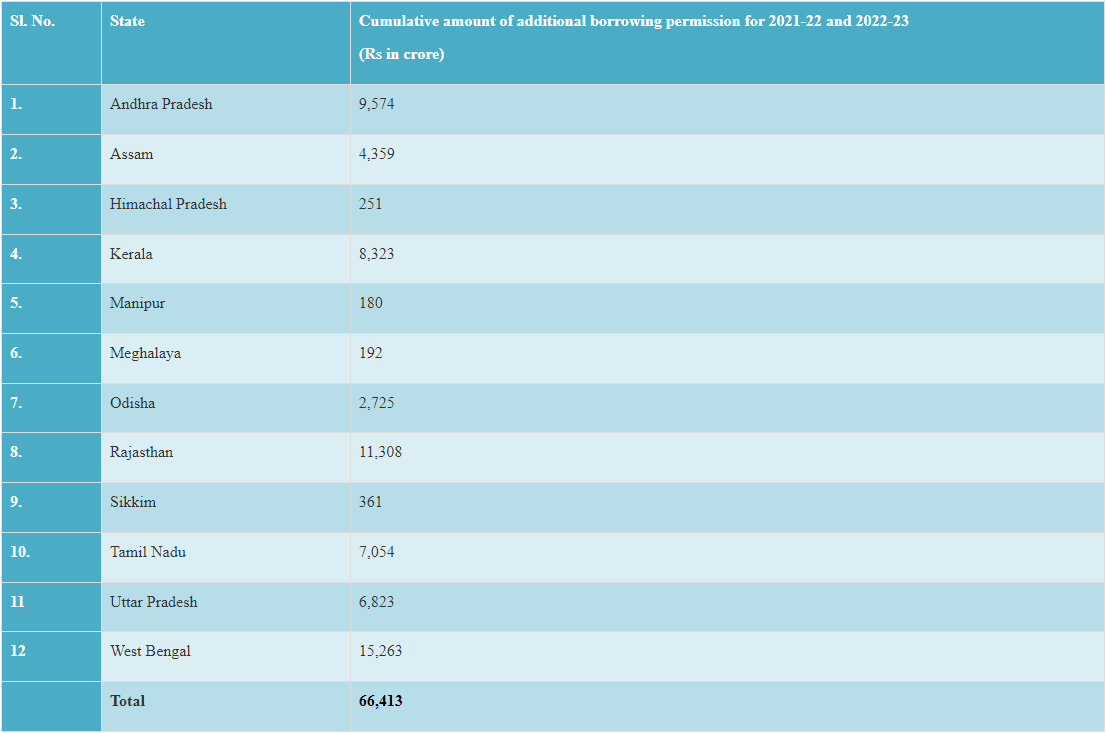
Based on the recommendations of the Ministry of Power, the Ministry of Finance has granted permission for reforms undertaken in 2021-22 and 2022-23 to 12 State Governments. Over the last two financial years, they have been allowed to raise financial resources of Rs. 66,413 crore through additional borrowing permissions.
The breakdown of the amount allowed for each State as an incentive to embark on the reform process is as follows:
 States can continue to use the extra borrowing facility tied to power sector changes in the financial year 2023-24. As an incentive for states to implement these changes in 2023-24, a sum of Rs.1,43,332 crore would be made available. States that were unable to finish the reform process in 2021-22 or 2022-23 may be eligible for extra borrowing in 2023-24 if they complete the changes in the current financial year.
The primary objectives of granting financial incentives for undertaking power sector reforms are to improve operational and economic efficiency within the sector and promote a sustained increase in paid electricity consumption.
To be eligible for the incentives, State governments must undertake a set of mandatory reforms and meet stipulated performance benchmarks.
The required reforms include:
States can continue to use the extra borrowing facility tied to power sector changes in the financial year 2023-24. As an incentive for states to implement these changes in 2023-24, a sum of Rs.1,43,332 crore would be made available. States that were unable to finish the reform process in 2021-22 or 2022-23 may be eligible for extra borrowing in 2023-24 if they complete the changes in the current financial year.
The primary objectives of granting financial incentives for undertaking power sector reforms are to improve operational and economic efficiency within the sector and promote a sustained increase in paid electricity consumption.
To be eligible for the incentives, State governments must undertake a set of mandatory reforms and meet stipulated performance benchmarks.
The required reforms include:
States can continue to use the extra borrowing facility tied to power sector changes in the financial year 2023-24. As an incentive for states to implement these changes in 2023-24, a sum of Rs.1,43,332 crore would be made available. States that were unable to finish the reform process in 2021-22 or 2022-23 may be eligible for extra borrowing in 2023-24 if they complete the changes in the current financial year.
The primary objectives of granting financial incentives for undertaking power sector reforms are to improve operational and economic efficiency within the sector and promote a sustained increase in paid electricity consumption.
To be eligible for the incentives, State governments must undertake a set of mandatory reforms and meet stipulated performance benchmarks.
The required reforms include:
- Progressive assumption of responsibility for losses of public sector power distribution companies (DISCOMs) by the State Government.
- Transparency in the reporting of financial affairs of power sector including payment of subsidies and recording of liabilities of Governments to DISCOMs and of DISCOMs to others.
- Timely rendition of financial and energy accounts and timely audit.
- Compliance with legal and regulatory requirements.
- Percentage of metered electricity consumption against total energy consumption, including agricultural connections.
- Subsidy payment by Direct Benefit Transfer (DBT) to consumers.
- Achievement of targets for reduction in Aggregate Technical & Commercial (AT&C) loss.
- Meeting the target of reduction in Average Cost of Supply and Average Realizable Revenue (ACS-ARR) Gap.
- Reduction in cross subsidies.
- Payment of Electricity bills by Government Departments and local bodies.
- Installation of prepaid meters in government office.
- Use of innovations and innovative technologies.
About Author


Reetu
Content Manager
Reetu is a Content Writer with 4+ years of experience in GST, Income Tax, Finance, Company Law, Education and Career Related Content. She is a B.COM (Honrs.) Graduate.
Reetu is a Content Writer with 4+ years of experience in GST, Income Tax, Finance, Company Law, Education and Career Related Content. She is a B.COM (Honrs.) Graduate.
 Studycafe
 Delhi, Delhi, India
 8071
8071My Recent Articles
- Income Tax Guide for Indian Defence Personnel for Tax Filing, Taxable Allowances and Other Benefits
- Income Tax Return Breaking: ITR Forms released for AY 25-26
- Ex-DRT Officials Sentenced to 5 Years Rigorous Imprisonment by Madras High Court along with Rs.27 Lakh Fine
- GSTN issued Advisory on Case Sensitivity in IRN Generation
- RBI to issue Notes of Rs.10 and Rs.500 bearing Signature of Guv Malhotra
Up Next
Loading suggestions…


Recent Posts
All Posts
Recent Posts
All Posts