Gross Non-Performing Assets of Scheduled Commercial Banks have Declined
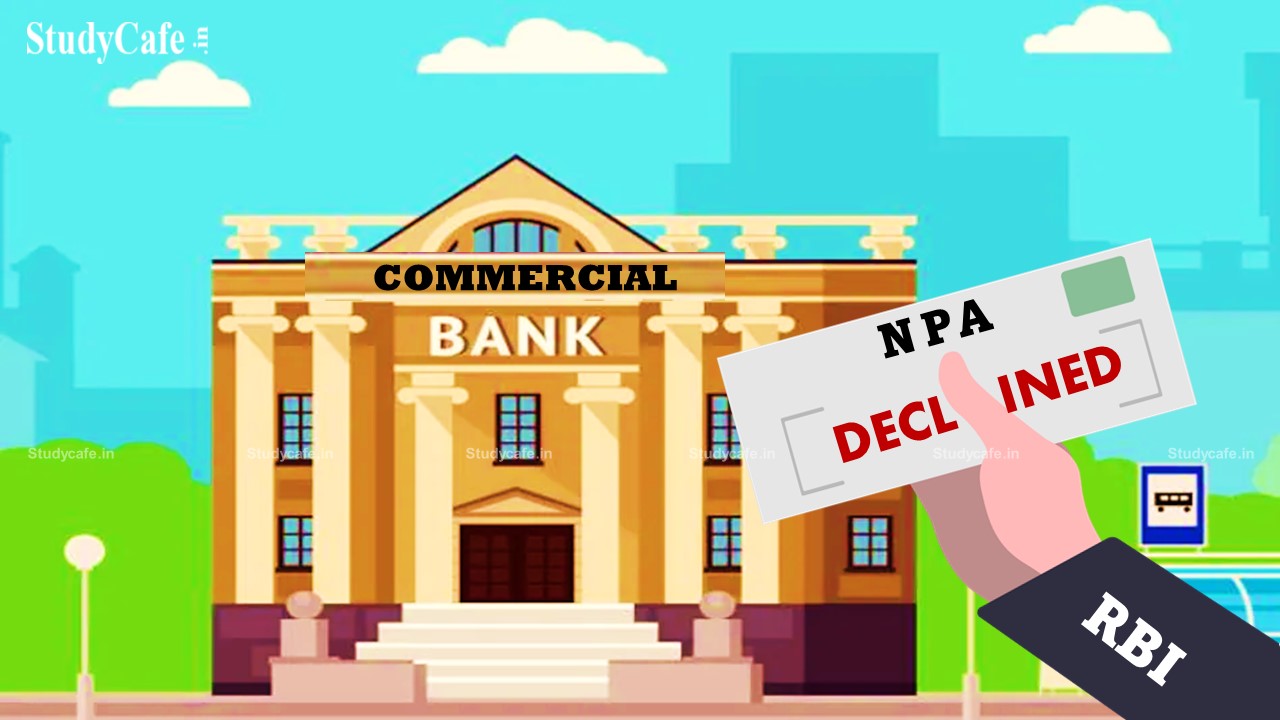
Gross Non-Performing Assets of Scheduled Commercial Banks have Declined As per Reserve Bank of India (RBI) data on global operations, gross non-perfo…
 Sushmita Goswami
 Feb 8, 2022
Table of Contents

Gross Non-Performing Assets of Scheduled Commercial Banks have Declined
As per Reserve Bank of India (RBI) data on global operations, gross non-performing assets (GNPAs) of scheduled commercial banks (SCBs) have declined from Rs. 9,33,779 crore (GNPA ratio of 9.07%) as on 31.3.2019 to Rs. 8,00,463 crore (GNPA ratio of 6.93%) as on 30.9.2021. This was stated by Union Minister of State for Finance Dr Bhagwat Kisanrao Karad in a written reply to a question in Lok Sabha today.
Further, the Minister stated, GNPAs of Deposit Taking-NBFCs and Non-Deposit taking Systemically Important-NBFCs were Rs. 1,91,413 crore (GNPA ratio of 6.87%) as on 30.9.2021.
Giving more details, the Minister stated that as per RBI inputs, GNPAs of Public Sector Banks (PSBs) as a proportion to that of SCBs have decreased from 79.2% as on 31.3.2019 to 75.7% as on 31.3.2020 to 73.8% as on 31.3.2021 and further to 72.3% as on 30.9.2021, whereas GNPAs of Private Sector Banks (PVBs) as a proportion to that of SCBs have increased from 19.4% as on 31.3.2019 to 23.0% as on 31.3.2020 to 24.2% as on 31.3.2021 and further to 24.9% as on 30.9.2021.
On the question of various corrective measures taken by the Government and the RBI, the Minister stated that several initiatives have been taken to increase the credit penetration in the economy, which includes, inter alia, the following —
1. 44.51 crore accounts opened under Pradhanmantri Jan Dhan Yojana (PMJDY), a scheme with a National Mission for Financial Inclusion to ensure access to financial services, namely, a basic savings and deposit accounts, remittance, credit, insurance, pension in an affordable manner;
2. Overdraft facility of limit upto Rs. 10,000 extended to eligible PMJDY account holders;
3. The PM Street Vendor’s Atmanirbhar Nidhi (PM SVANidhi) scheme launched by the Government to help poor street vendors, impacted by COVID-19 pandemic, to resume their livelihood activities has enabled 32.69 lakh street vendors to access credit amounting to Rs. 3,364 crore till 31.1.2022;
4. Operationalization of enhanced access to credit under Deendayal Antyodaya Yojana-National Rural Livelihoods Mission (DAY-NRLM) and Deendayal Antyodaya Yojana-National Urban Livelihoods Mission (DAY-NULM) schemes for self-employment programme, under which 78,66,199 and 16,63,704 beneficiaries, respectively have been provided credit facilities in the last three financial years;
5. Bank credit to Non-Banking Financial Institutions (NBFCs) other than NBFCs-Micro Finance Institutions (MFIs) for on-lending to agriculture, micro and small enterprises, and housing has been made eligible for classification as priority sector;
6. Digitalization in lending to increase reach of institutional credit;
- Initiation of digital lending has been made contactless through PSBloansin59minutes.com, to provide online in principle approval of loans to Micro, Small and Medium Enterprises (MSMEs), Home Loans, Personal Loans and Auto Loans to individuals;
- Online bill discounting for MSMEs has been enabled on competitive basis through Public Sector Banks (PSBs) onboarding onto the Trade Receivables Discounting System (TReDS) platform;
- End-to-end automated digital lending has been introduced in larger PSBs for unsecured personal loans (in five PSBs), loans to micro-enterprises (“Shishu Mudra”, in five PSBs) and renewals of loans to MSMEs (in three PSBs);
- Customer-need-driven, analytics-base credit offers have been given an impetus, resulting in Rs. 49,777 crore of fresh retail loan disbursements by the seven larger PSBs in the financial year 2020-2021; and
- Setting up of Loan Management Systems and Centralized Processing Centres in Public Sector Banks (PSBs) for improving the turn-around-time (TAT).
The Minister further stated that several measures have been taken to promote regular repayment and prevent those loan accounts turning into non-performing assets (NPAs), which includes, inter alia, the following —
- instituting use of third party data sources in PSBs for comprehensive due diligence across data sources at the sanction stage itself, to mitigate risk on account of misrepresentation and fraud;
- classification of accounts as special mentioned accounts (SMA) for early recognition of signs of incipient stress resulting in default in timely servicing of debt obligations, enabling banks to initiate timely remedial actions to prevent their potential slippages into NPAs;
- institution of comprehensive, automated Early Warning Systems (EWS) in banks, with ~80 EWS triggers, using third-party data and workflow for time-bound remedial actions, to proactively detect stress and reducing slippage into NPAs;
- incentivizing regular repayment through linking of eligibility for the next cycle of working capital loan with an enhanced limit with on-time or early repayment of existing loan under PM SVANidhi scheme; and
- repayment behavior of borrowers in their loan accounts is reported to credit information companies (CICs), and banks include these information in the credit appraisal and decision making process for further sanctioning of loans to borrowers.
About Author


Sushmita Goswami
Content Manager
Sushmita Goswami is a content writer with 2+ years of experience in Finance, Recruitment, Education and career Related Content. She is a Graduate from Delhi University in Journalism and Mass Communication
Sushmita Goswami is a content writer with 2+ years of experience in Finance, Recruitment, Education and career Related Content. She is a Graduate from Delhi University in Journalism and Mass Communication
 Studycafe
  New Delhi , Delhi, India
 886
886My Recent Articles
- What to Consider When Choosing an Online Trading Platform?
- Post Office Franchise Scheme: Take Post Office Franchise at Rs 5000 and Earn Commission upto 20%; Check Details Here
- IAN invests INR 4.5 crore in Fintech NBFC Indium Finance
- UPI a Digital Public Good, No Charges in Consideration: Finance Ministry
- ITR Filing Penalty: Check Taxpayers Exempt from Paying a Late Fee even Missing the Deadline
Up Next
Loading suggestions…


Recent Posts
All Posts
Recent Posts
All Posts