GST Annual Return 2024-25: Understanding Spillover Adjustment:
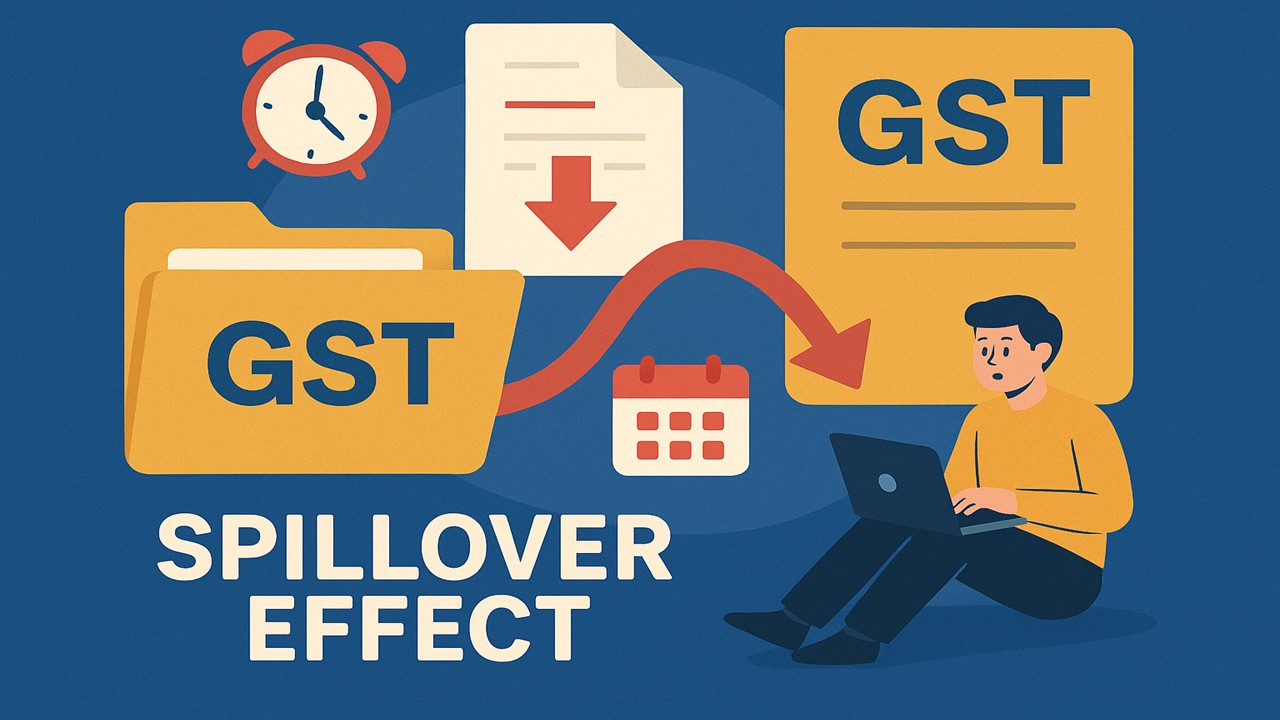
The spillover effect happens when transactions from the previous financial year are reported in the current financial year by mistake
What is Spillover Effect in GST
 Nidhi
Nidhi Nov 16, 2025
Table of Contents

GST Annual Return 2024-25: Understanding Spillover Adjustment
Sometimes the business mistakenly reports some transactions from one financial year in the next year's returns. This is because in the GST system, there is no way to correct or amend filed returns once they’ve been submitted. This creates a Spillover Effect.
If an invoice for the FY 2024-25 is reported in the next financial year 2025-26.
If ITC for 2024-25 is claimed in 2025-26 (up to the specified date)
What is Spillover Effect?
The spillover effect happens when transactions from the previous financial year are reported in the current financial year by mistake. For example, if a business issues an invoice on March 31, 2024, but forgets to report it in March 2024's GST-1 and GSTR-3B, and instead reports it in April 2024. This misreporting can result in mismatches in your return. When filing your GSTR-9, only transactions of the relevant Financial year should be reported against the Table serial numbers 4, 5, and 7. The value related to the previous financial must not be reported here. Let us understand this with the help of some scenarios.Sale/ Outward Supply Transactions
If the invoice for the FY 2023-24 is reported in the next financial year 2024-25.| Period | GSTR 9 | GSTR 9C |
| FY 2024-25 | Auto-populated data will not have such data dated for FY 2023-24. | As the invoice is dated for FY 2023-24, it will not be available in FY 2024-25 in books, and since GSTR 9 also excludes such invoices, there will not be any difference in GSTR 9 and books. |
| FY 2025-26 | No impact on this year. | No impact on this year. |
| Period | GSTR 9 | GSTR 9C |
| FY 2024-25 | Table 4 will not capture these invoices, and such invoices to be reported in Table 10 or 11 of GSTR 9 of FY 2024-25. | Table 5Q of GSTR 9C drives value after considering Table 5N, 10 and 11, therefore, no further reconciliation is required for this adjustment. |
| FY 2025-26 | No impact on this year. | No impact on this year. |
Inward Supply Transaction
If ITC for FY 2023-24 is claimed in FY 2024-25 (Up to specified date)| Period | GSTR 9 | GSTR 9C |
| FY 2023-24 | Disclose in Table 8C and Table 13 of GSTR 9 | Disclose in Table 12C of GSTR 9C |
| FY 2024-25 | Taxpayers are required to report this ITC in the newly inserted Table 6A1. The taxpayer may check the previous year Table 8C/Table 13 of GSTR 9 for this figure. | No adjustment required |
| FY 2025-26 | No impact on this year | No impact on this year |
| Period | GSTR 9 | GSTR 9C |
| FY 2023-24 | No Impact | No Impact |
| FY 2024-25 | Need to report under Table 8C and Table 13 of GSTR 9 | Need to disclose in Table 12C of GSTR 9C |
| FY 2025-26 | Taxpayers need to report this ITC in the newly inserted Table 6A1. The taxpayer may check the previous year Table 8C/Table 13 of GSTR 9 for this figure. | No adjustment needed |
About Author


Nidhi
Content Writer
Nidhi is a skilled content writer specializing in personal finance. She creates clear, engaging articles on mutual funds, investments, insurance, and wealth-building strategies. With a passion for simplifying complex financial topics, Nidhi helps readers make informed money decisions with confidence. She can be reached at [email protected]
Nidhi is a skilled content writer specializing in personal finance. She creates clear, engaging articles on mutual funds, investments, insurance, and wealth-building strategies. With a passion for simplifying complex financial topics, Nidhi helps readers make informed money decisions with confidence. She can be reached at [email protected]
 Studycafe
 New Delhi, Delhi, India
 1832
1832My Recent Articles
- Karnataka High Court Gives Another Chance in GST Matter Due to Lack of Hearing
- Delay Should Be Condoned if Explanation is Unrefuted: ITAT
- Non-Service of Income Tax Notice, Ill health of taxpayer, ITAT condones Appeal filing delay
- Books of Accounts Cannot be Rejected Without Any Specific Defect: ITAT Kolkata
- Karnataka High Court Sends ITC Matter Back to GST Authorities for Reconsideration
Up Next
Loading suggestions…


Recent Posts

All Posts


Recent Posts
All Posts