GST Appeal Rejection Quashed After Wrong Limitation Calculation by Authority:
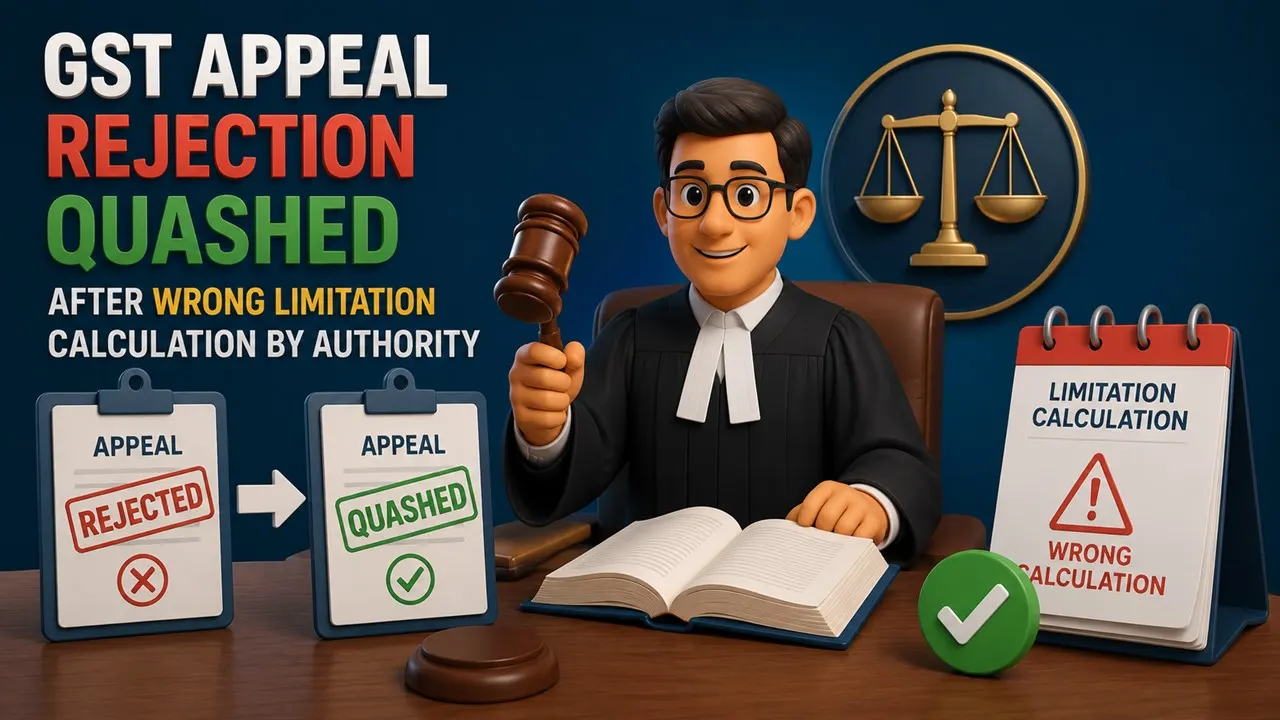
High Court restores GST appeal after finding incorrect computation of statutory limitation period.
GST Appeal Restored for Adjudication on Merits After Remand
 Meetu Kumari
 Jun 9, 2026
The Orissa High Court set aside an appellate order that had rejected a GST appeal as time-barred, holding that the Appellate Authority had incorrectly computed the limitation period under Section 107 of the GST Act. A Division Bench comprising Justice Mruganka Sekhar Sahoo and Justice M.S. Raman remanded the matter to the appellate authority for fresh consideration of the assessee’s application for condonation of delay.
The dispute arose after an adjudication order under Section 73 of the GST Act was passed against M/s. Mahesh Value Products Pvt. Ltd. on 15 October 2025 for the tax period April 2022 to March 2023. Aggrieved by the order, the assessee filed an appeal on 13 February 2026. The Appellate Authority, however, rejected the appeal on the ground that it was filed beyond the maximum condonable period prescribed under Section 107 of the GST Act.
Before the High Court, the petitioner contended that the appellate authority had wrongly calculated the limitation period. It was argued that the adjudication order was communicated on 15 October 2025 and, in view of Section 9 of the General Clauses Act, the date of communication had to be excluded while computing limitation. Accordingly, the three-month limitation period expired on 15 January 2026 and the further condonable period of one month expired on 15 February 2026. Since the appeal was filed on 13 February 2026, it was within the outer limit prescribed under Section 107(4) of the GST Act.

The Revenue did not dispute the relevant dates but submitted that the petitioner had an alternative statutory remedy and could pursue the matter in accordance with law.
“The expression ‘three months from the date on which the said decision or order is communicated’ requires exclusion of the date of communication and computation of limitation from the succeeding day.”

The High Court examined the provisions of Section 107 of the GST Act along with Section 9 of the General Clauses Act and referred to several judicial precedents dealing with computation of limitation. The Court reiterated that the term “month” refers to a calendar month and not a fixed period of thirty days, and that the first day from which limitation is to be reckoned must be excluded.
Applying these principles, the Court held that the Appellate Authority had committed an apparent error in treating the appeal as being beyond the condonable period. It observed that the delay was only 29 days and the appeal had been filed within the maximum period during which delay could legally be condoned.
The Court also noted that the petitioner had filed a detailed reply to the show cause notice issued by the Appellate Authority explaining the delay. However, while rejecting the appeal, the authority incorrectly recorded that no reply had been filed and failed to consider the explanation already available on record.
“Non-consideration of the explanation filed by the petitioner and treating it as if no reply was on record constituted an error apparent on the face of the record.”
Holding that both the computation of limitation and the failure to consider the petitioner’s reply vitiated the appellate order, the High Court set aside the order dated 23 March 2026. The matter was remanded to the Additional Commissioner of State Tax (Appeal), Central Zone-I, Cuttack, to consider the petitioner’s explanation for the 29-day delay and decide the issue of condonation in accordance with law.
The Court clarified that it had expressed no opinion on the merits of either the appeal or the condonation application and directed the Appellate Authority to proceed independently in accordance with the statutory provisions.
To Read Full Judgment, Download PDF Given Below.
About Author


Meetu Kumari
Content Manager
 Studycafe
 Jodhpur, Rajasthan, India
 2264
2264My Recent Articles
- ITAT Condones 302-Day Delay, Restores Salary Assessment for Fresh VerificationPremium
- ITAT Condones Delay After Tax Consultant's Death, Restores Appeals for Fresh HearingPremium
- ITAT Remands Salary Addition, Says Taxability Depends on Salary Becoming Due, Not Mere ReceiptPremium
- ITAT Deletes TP Royalty Adjustment, Orders Fresh Review of Commission BenchmarkingPremium
- ITAT Quashes Reassessment Over Unsigned Section 148 Notice Issued to AssesseePremium
Loading suggestions…


Recent Posts


All Posts


Recent Posts
All Posts