High Court Grants Bail in GST Fake Invoicing Economic Offence Case:
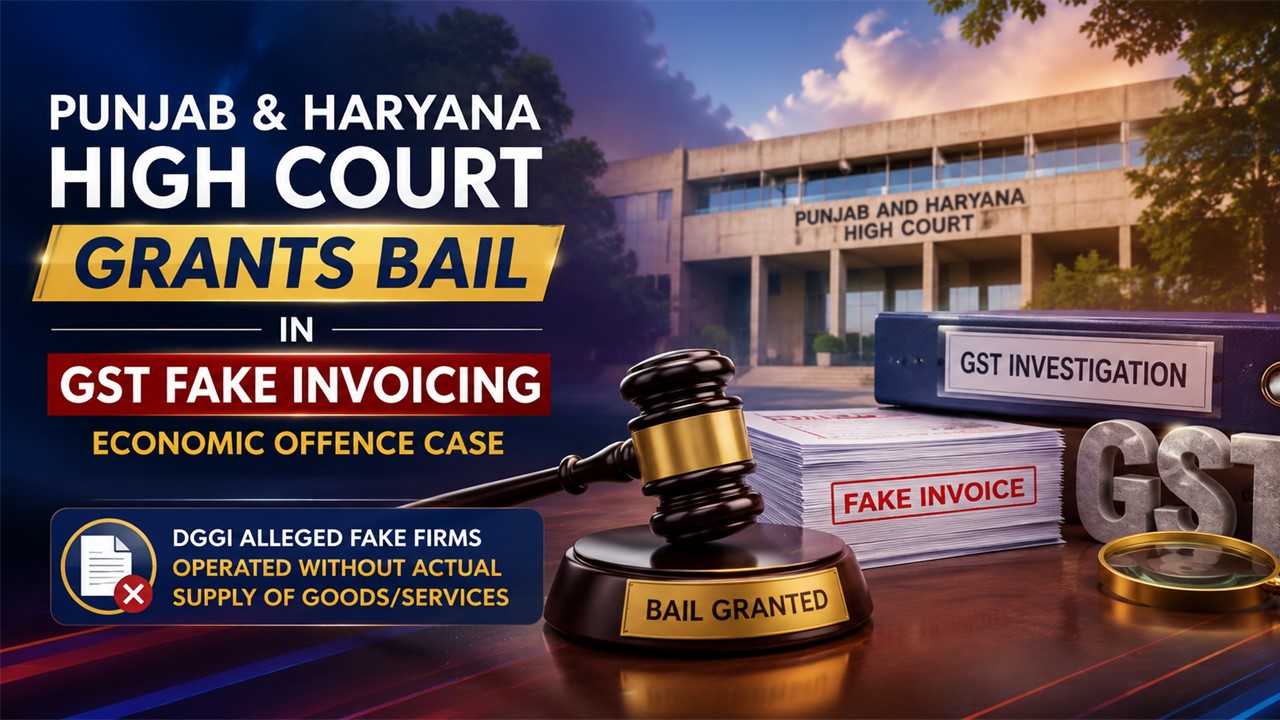
Continued incarceration is unjustified where a trial is likely delayed and a co-accused has already been granted bail.
DGGI Alleged Fake Firms Operated Without Actual Supply of Goods Services
 Meetu Kumari
 May 25, 2026
The Punjab and Haryana High Court, on 22 May 2026 granted regular bail to an accused arrested in connection with an alleged fake GST invoice racket involving wrongful availment and passing of Input Tax Credit (ITC). Justice H.S. Grewal observed that continued incarceration would serve no useful purpose, particularly when the co-accused had already been granted bail and the trial was likely to take considerable time.
The petitioner had approached the High Court under Section 483 of the Bharatiya Nagarik Suraksha Sanhita, 2023 seeking regular bail in connection with proceedings initiated by the Directorate General of GST Intelligence (DGGI) for alleged offences under Sections 132(1)(b), 132(1)(c) and 132(5) of the CGST Act read with Section 20(xv) of the IGST Act.

According to the prosecution, the petitioner was involved in the issuance of fake invoices without the actual supply of goods or services through six allegedly non-existent firms. The DGGI alleged that the petitioner and others had wrongfully availed, utilised, and passed on ineligible ITC amounting to several crores of rupees, causing substantial loss to the public exchequer.
Before the Court, the petitioner contended that he had been falsely implicated and was merely working under another individual who allegedly operated the business network. It was further argued that the case was entirely based on documentary evidence and that a similarly placed co-accused had already been granted regular bail by the High Court.

The DGGI opposed the bail plea and submitted that the investigation had revealed a money trail showing receipt of proceeds in the petitioner’s bank accounts. It was also pointed out that another FIR was pending against the petitioner at Panipat. The Court pointed out that, “The trial is likely to take considerable time to conclude, this Court is of the view that no useful purpose would be served by further incarceration of the petitioner.”
Taking note of the petitioner’s custody of more than four months, the grant of bail to the co-accused, and the likely delay in the conclusion of the trial, the High Court granted regular bail during the pendency of the trial.
The Court clarified that the observations made in the order would not amount to an expression on the merits of the case and further observed that if the petitioner indulges in any other criminal activity while on bail, it would be open to the State to seek cancellation of bail.
To Read Full Judgment, Download PDF Given Below.
About Author


Meetu Kumari
Content Manager
 Studycafe
 Jodhpur, Rajasthan, India
 2264
2264My Recent Articles
- ITAT Condones 302-Day Delay, Restores Salary Assessment for Fresh VerificationPremium
- ITAT Condones Delay After Tax Consultant's Death, Restores Appeals for Fresh HearingPremium
- ITAT Remands Salary Addition, Says Taxability Depends on Salary Becoming Due, Not Mere ReceiptPremium
- ITAT Deletes TP Royalty Adjustment, Orders Fresh Review of Commission BenchmarkingPremium
- ITAT Quashes Reassessment Over Unsigned Section 148 Notice Issued to AssesseePremium
Loading suggestions…


Recent Posts

All Posts



Recent Posts
All Posts