ITAT Sets Aside Ex Parte CIT(A) Order, Gives Assessee One More Opportunity to Prove Source of Rs 52.59 Lakh Cash Deposits:
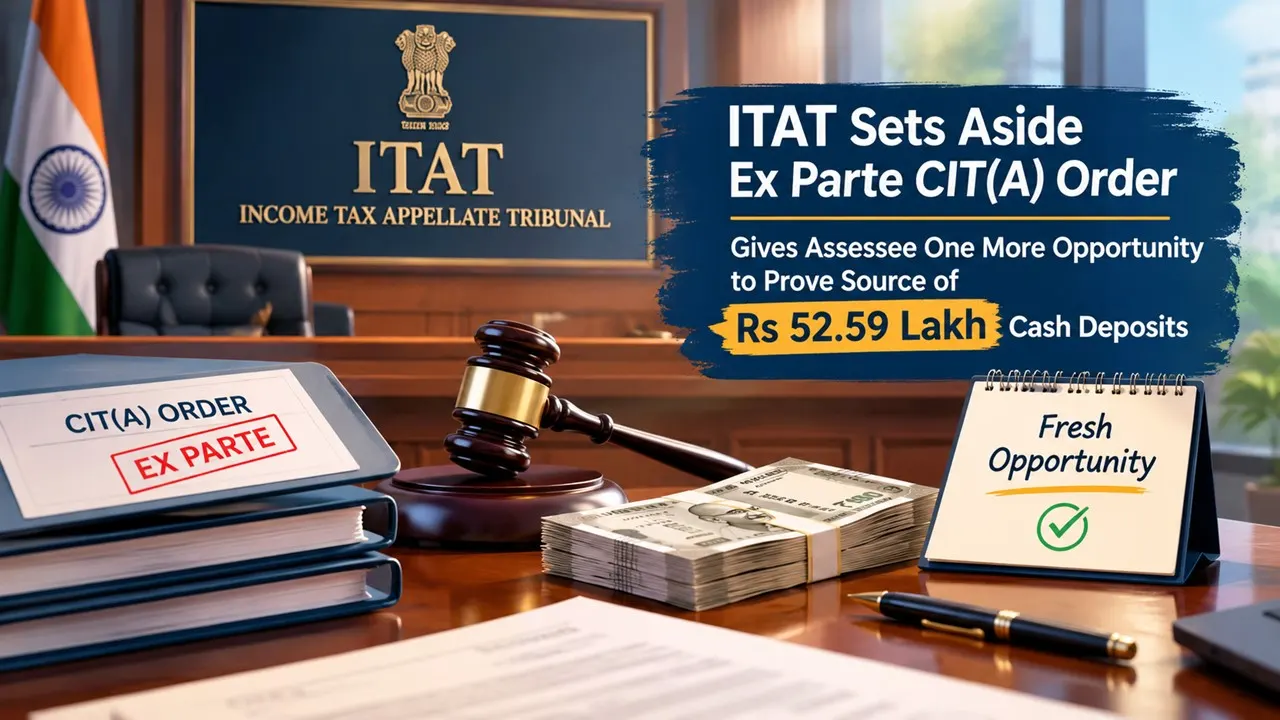
ITAT sets aside the ex parte CIT(A) order and grants Vanitha a fresh opportunity to explain the source of Rs 52.59 lakh cash deposits and contest the additions on merits.
ITAT Remands Cash Deposit Dispute to CIT(A)
 Saloni Kumari
 Oct 3, 2026
The ITAT Bangalore Bench has set aside an ex parte order passed by the Commissioner of Income Tax (Appeals) [CIT(A)] and granted the assessee another opportunity to explain the source of cash deposits. The ruling was delivered in the case of Vanitha for Assessment Year (AY) 2016-17.
Vanitha had not filed an income tax return (ITR) for the Assessment Year 2016-17; however, she had made cash deposits amounting to Rs 52.59 lakh in her bank accounts (cash deposit of Rs 5.20 lakh claimed on account of sundry debtors, Rs 25.10 lakh claimed on account of cash balance accumulated, Rs 5.08 lakh claimed on account of closing stock, and Rs 7.50 lakh claimed on account of own savings). Consequently, the Assessing Officer (AO) issued a show cause notice under section 148A(b) of the Income Tax Act to the assessee. Subsequently, an order under section 148A(d) of the Act was issued after the assessee's failure to respond to the SCN.

During the course of assessment proceedings, the assessee was asked to furnish all relevant documents to prove the source of deposits in question. However, the assessee again failed to furnish any documentary evidence. Hence, the AO treated all deposits as unexplained money and made an addition of the entire deposit amount to the assessee's income.
In response to the AO's move, the assessee furnished certain documents to explain the source of credits. However, the AO did not accept any submissions made by the assessee and rejected the reliance placed upon the profit and loss account and balance sheet for the assessment years 2013-14, 2014-15, and 2015-16 on the basis that without filing the income tax return or audit report, the self-made profit and loss account and balance sheet cannot be relied upon.

When the assessee approached the first appellate authority, i.e., the Commissioner of Income Tax (Appeals) [CIT(A)], challenging the additions made by the AO, the appeal was dismissed vide the impugned order on the failure to respond to the hearing notices despite grant of multiple opportunities.
Thereafter, the assessee filed an appeal before the Income Tax Appellate Tribunal (ITAT), Bangalore. Before the Tribunal, the assessee was represented by an authorised representative and sought an opportunity to contest the additions on merits.
The Tribunal held that "it is evident that the learned CIT(A) has passed the order ex parte due to the non-appearance of/on behalf of the assessee. Now, in the appeal before us, the assessee is duly represented by the learned AR and wishes to pursue the litigation against the addition made by the AO. Therefore, in view of the above, we are of the considered opinion that, in the interest of justice, the assessee be hereby granted one more opportunity to represent its case on merits before the learned CIT(A)."
Considering the circumstances, the ITAT set aside the CIT(A)’s order and restored the matter for fresh adjudication on merits. The CIT(A) was directed to provide a reasonable opportunity of hearing and consider the documents and submissions filed by the assessee. The assessee was also directed to appear on all future hearing dates without default.
The Tribunal further permitted the assessee to raise the jurisdictional grounds before the CIT(A), which are to be examined in accordance with law. Accordingly, the appeal was allowed for statistical purposes.
About Author


Saloni Kumari
Content Writer
 StudyCafe
 Delhi, Delhi, India
 2959
2959My Recent Articles
- Sakshi Chandak Secures AIR 1 in CA Intermediate September 2026 Exam with 83.67% After Studying Up to 16 Hours a Day
- MCA Releases List of Companies Struck Off Under Section 248(2) for September 2026 at mca.gov.in
- ITAT Deletes Section 43 Penalty for Non-Disclosure of Foreign Assets in Schedule FA
- CBI Arrests Proclaimed Offender in Fodder Scam Case Absconding for Over 25 Years
- ITAT Allows Appeal Over Rs 26.03 Lakh Addition After Assessee Settles Tax Dispute Under Vivad Se Vishwas Scheme 2024
Loading suggestions…


Recent Posts



All Posts


Recent Posts
All Posts