High Court Holds GST Notices and Orders Valid Despite No Visible Digital Signature:
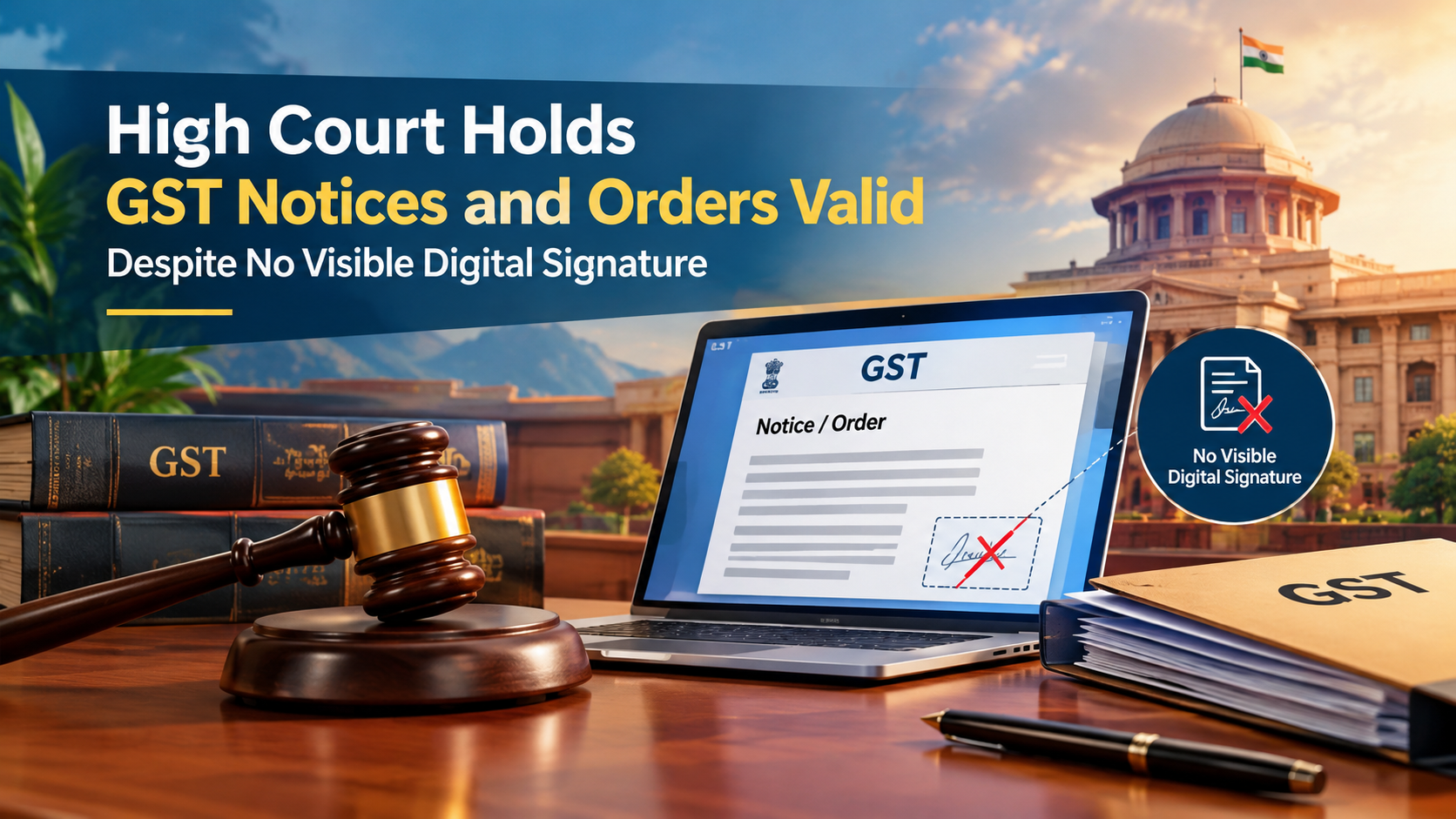
The Telangana High Court rules GSTN electronic authentication as sufficient and grants two weeks to file statutory appeals.
High Court Holds DIN And RFN Mandatory
 Saima
Saima Oct 8, 2026
The Telangana High Court was considering a large batch of writ petitions challenging GST show cause notices and adjudication orders principally on the ground that the documents downloaded from the GST common portal did not bear a visible physical or digital signature.
The matter came before the court because of divergent views of coordinate benches regarding the requirement of digital signatures on notices and orders issued under Chapter XVIII of the CGST Rules.

The Court examined the scheme of the CGST Act, CGST Rules, particularly Chapter XVIII relating to Demands and Recovery, and the Information Technology Act, along with the electronic authentication mechanism employed by GSTN. It noted that the GST system requires the proper officer to authenticate himself using a digital signature certificate before a notice or order can be issued. The system creates an immutable digital record and maintains traceability of the officer's digital signature.
Accordingly, the Court held that the requirement is electronic authentication through the GSTN system, and not the presence of a visible digital signature on the PDF downloaded from the portal. Thus, notices and orders electronically authenticated by the proper officer and uploaded on the common portal are valid documents in law.

The Court further held that uploading a show cause notice or order on the common portal amounts to valid service under Section 169(1)(d) of the CGST Act. The limitation period for availing a statutory remedy or complying with the order would consequently run from the date on which the notice or order is uploaded on the common portal.
Since the writ petitions had remained pending for a long period, the Court granted the petitioners liberty to avail the statutory remedy of appeal within two weeks.
About Author


Saima
Content Writer
 StudyCafe
 Delhi, Delhi, India
 518
518My Recent Articles
- ITAT Remits Rs.49.55 Lakh Agricultural Income Addition to CIT(A)
- ITAT Remits Profit Estimation and Salary Disallowance Matter for Fresh Adjudication
- ITAT Deletes Additions Against Jaya Bachchan Over Alleged Noida Property Cash Receipt
- ITAT Deletes Section 271AAA Penalty on Diamond Stock Discrepancy for Failure to Establish Undisclosed Income
- GST Refund Cannot Be Treated as Taxable Income Merely on Tax Audit Disclosure
Loading suggestions…