High Court Strikes Down Retrospective Section 147A of Income Tax Act:
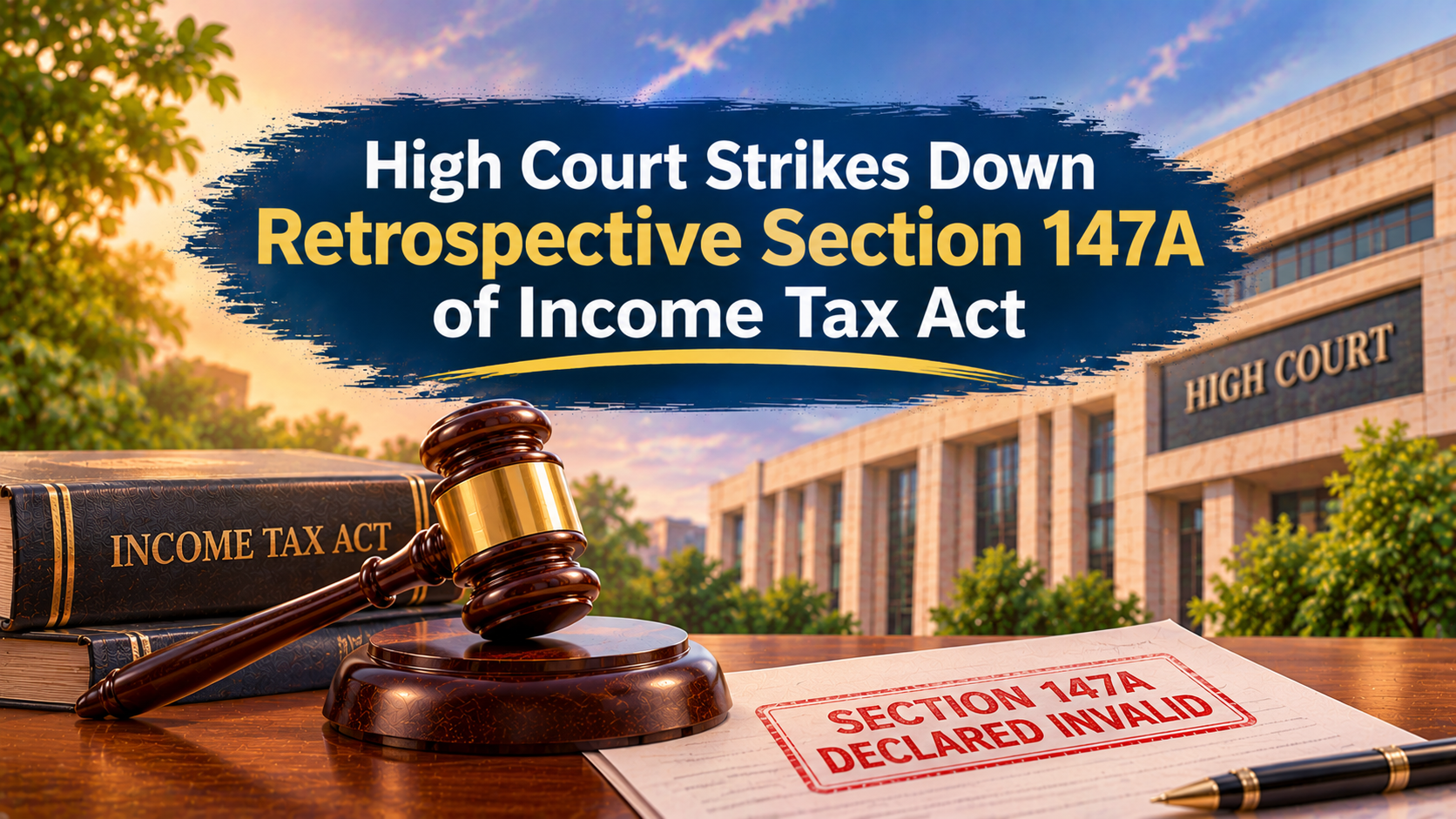
The Andhra Pradesh High Court holds Section 147A Unconstitutional for Retrospectively Conferring Jurisdiction on AOs.
High Court Quashes Reassessment Proceedings
 Saima
Saima Oct 17, 2026
The petitioners approached the High Court challenging reassessment notices and orders issued by Jurisdictional AOs under Sections 148A and 148 of the Income Tax Act, 1961. They submitted that the proceedings were without jurisdiction because the e-Assessment of Income Escaping Assessment Scheme, 2022, notified on March 29, 2022, required the relevant proceedings to be conducted through automated allocation and in a faceless manner.
Earlier, a Bench of the Andhra Pradesh High Court, by an order dated October 28, 2025, had allowed similar writ petitions and set aside the notices and orders, holding that the actions of the JAOs were contrary to Section 151A read with the notification dated March 29, 2022. The Revenue challenged the earlier decision before the Supreme Court. During the pendency of those proceedings, Parliament introduced Section 147A through the Finance Act, 2026, deeming it effective from April 1, 2021. The provision clarified that, for Sections 148 and 148A, an AO would mean an officer other than the NFAC or an assessment unit under Section 144B. The Supreme Court remitted the matters to the respective High Courts for fresh consideration, leaving the constitutional validity and other issues concerning the amendment open.

The petitioners argued that Section 147A was unconstitutional and violated the rule of law and the doctrine of separation of powers. According to them, Parliament could not nullify judicial decisions merely by introducing a retrospective amendment without removing the legal basis of those decisions. They further argued that Sections 151A and 144B, read with the 2022 Scheme, required reassessment proceedings to be conducted through the faceless mechanism. The retrospective amendment, without a corresponding amendment to the existing scheme, could not confer jurisdiction on JAOs to issue notices under Sections 148A and 148.
The Court examined Section 151A of the Income Tax Act, 1961, and the e-Assessment of Income Escaping Assessment Scheme, 2022. It observed that the statutory framework expressly included the issuance of notices under Section 148 within the scheme. The Court held that, once Section 148 had been included in the scheme, the Revenue could not contend that the provision was excluded from the faceless mechanism. It also rejected the argument that Section 148A could be exercised by JAOs merely because that provision was not expressly mentioned in the scheme. The pre-assessment procedure under Section 148A was integral to the reassessment process under Section 147.

The Court noted that Section 147A was introduced to clarify the jurisdiction of officers under Sections 148 and 148A, but the scheme framed under Section 151A remained unamended. Since the scheme under Section 151A continued to require faceless proceedings and had not been amended, the insertion of Section 147A could not be sustained as a valid exercise of retrospective validation. The Court also noted that the Finance Act, 2026, expressly provided that the relevant provisions would come into force on April 1, 2026, although the Act had received Presidential assent on March 30, 2026. Consequently, the amendment could not be treated as having come into force before the specified commencement date merely because Presidential assent had been granted earlier.
The Andhra Pradesh High Court held that Section 147A of the Income Tax Act, 1961, was unconstitutional and accordingly struck it down.
About Author


Saima
Content Writer
 StudyCafe
 Delhi, Delhi, India
 550
550My Recent Articles
- High Court Directs Assessee to Avail Statutory Remedies
- ITAT Quashes Reassessment as Section 148 Approval Was Obtained from PCIT Instead of Pr. CCIT
- ITAT Admits Additional Evidence Relating to Unexplained Cash Credits
- ITAT Directs CIT(A) to Condonе 315-Day Delay and Decide Income Tax Appeal on Merits
- ITAT Quashes Section 263 Revision as AO Had Examined Related-Party Payments Under Section 40A(2)(b)
Loading suggestions…


Recent Posts


All Posts


Recent Posts
All Posts