How Preferential Voting System works in ICAI Election
icai election procedure, icai elections 2018 dates, icai council elections 2018, icai branch election guidelines, icai central council elect
 CA Deepak Gupta
 Nov 24, 2018
Table of Contents

icai election procedure, icai elections 2018 dates, icai council elections 2018, icai branch election guidelines, icai central council election 2018, icai election rules, icai election 2015, icai president election procedure, How Preferential Voting System works in ICAI Election,ICAI Elections 2018 : Recording of vote to be done in Arabic numerical numbers only, How to give vote in ICAI election, ICAI Election 2018,What is Single Transferable System of Voting : ICAI Elections 2018, ICAI explains Single Transferable System of Voting, Single Transferable System of Voting,Counting of votes in Preferential system of voting ICAI Elections, ICAI election procedure
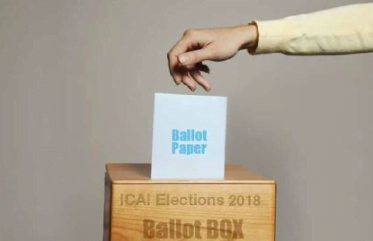
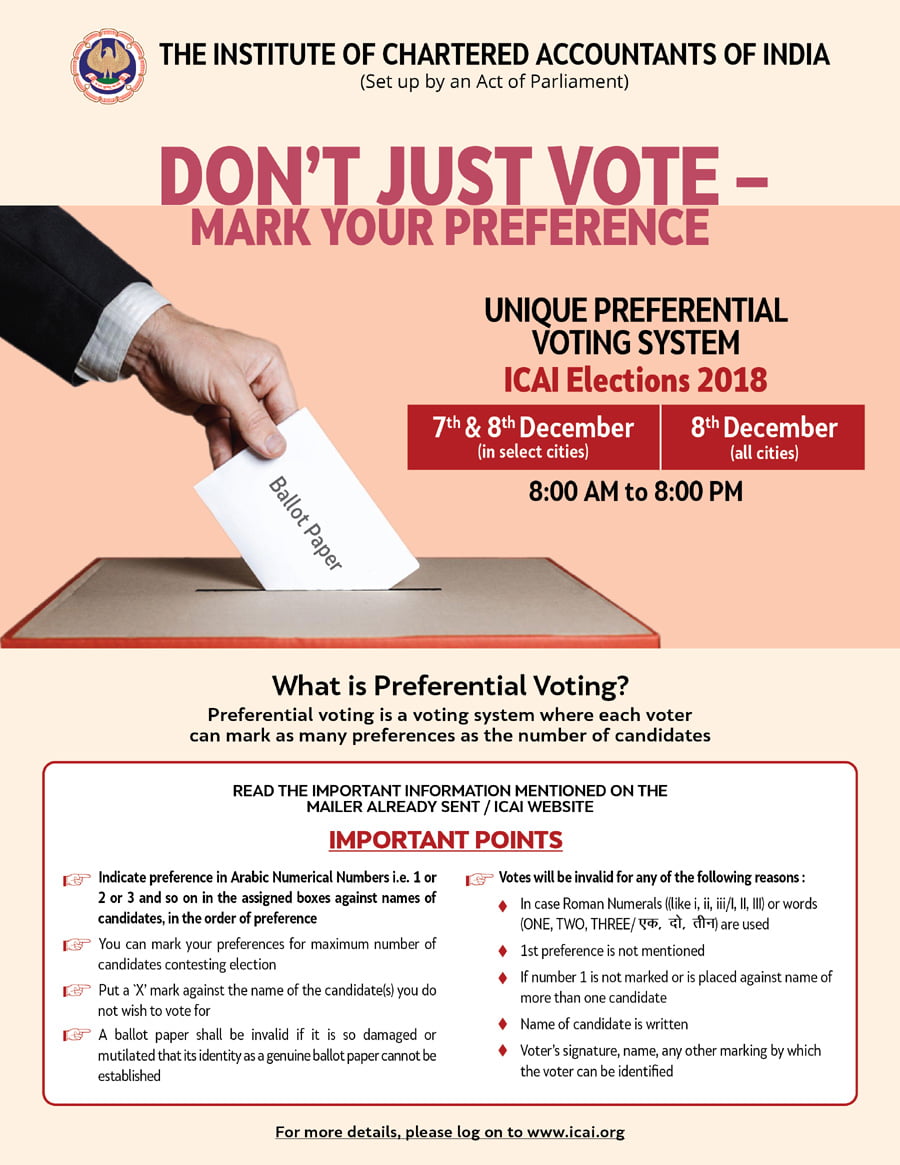
How Preferential Voting System works in ICAI Election :As you are aware that ICAI Elections for Central Council & Regional Councils are scheduled on 07th and 8th December 2018 and therefore I feel it appropriate to share with you information on Preferential voting system being followed by our esteemed Institute. In other words, it's called a Preferential Voting System. Each Voter (a member of the ICAI irrespective of whether he holds Certificate of Practice ' COP ' or works in Industry) can vote for Central as well as Regional Council Elections.How Preferential Voting System works in ICAI Election |Counting of votes in Preferential system of voting ICAI Elections
For Central Region, In all 6 candidates will be elected to Central Council from Central Region and 11 candidates will be elected to CIRC (Regional Council). On the ballot paper, to cast a formal vote- place a one (1) in the box beside your first preference;
- a two (2) in the box beside your second preference;
- a three (3) in the box beside your third preference;
Distribution of votes:
| Candidates | Original Votes |
| A | 550 |
| B | 475 |
| C | 375 |
| D | 350 |
| E | 325 |
| F | 320 |
| G | 300 |
| H | 150 |
| I | 100 |
| J | 55 |
| TOTAL | 3000 |
First Count:
(i) Candidate A will be declared elected as he gets more than 500 votes. (ii) Surplus of 50 votes will be distributed to other candidates. For this purpose the value of surplus votes will be worked out and distributed will be worked out and distributed to candidates who have been marked second preferences. (iii) If only 500 out of 550 voters have exercised their second preferences, the value of each surplus vote will work out to 50 divided by 500 i.e. 10%. On distribution of second preference votes, the position of the other candidates will be as under, if these preferences are received by B, C D and E only.| Candidates | Original Votes | Distribution of Votes | Votes distribution after Second preference |
| B | 475 | (250) 25 | 500 |
| C | 375 | (100) 10 | 385 |
| D | 350 | (100) 10 | 360 |
| E | 325 | (50) 5 | 330 |
Elimination candidates:
(i) Since there are no surpluses with other candidates, the candidate who has got the lowest number of votes will be eliminated. (ii)In the given case J will be the first to be eliminated. 55 votes in his packet will be distributed to candidates who have been marked second or subsequent preferences at full value. If only 50 voters have marked second or subsequent preferences the distribution will be as under:| Candidates | Votes distribution after Second preference | Votes of J | Votes distribution after elimination of J |
| C | 385 | 0 | 385 |
| D | 360 | 0 | 360 |
| E | 330 | 0 | 330 |
| F | 320 | 5 | 325 |
| G | 300 | 45 | 345 |
| H | 150 | 0 | 150 |
| I | 100 | 0 | 100 |
| Candidates | Votes distribution after Second preference | Votes of I | Votes distribution after elimination of I |
| C | 385 | 0 | 385 |
| D | 360 | 40 | 400 |
| E | 330 | 10 | 340 |
| F | 325 | 10 | 335 |
| G | 345 | 40 | 385 |
| H | 150 | 0 | 150 |
| Candidates | Votes distribution after Second preference | Votes of H | Votes distribution after elimination of H |
| C | 385 | 20 | 405 |
| D | 400 | 100 | 500 |
| E | 340 | 0 | 340 |
| F | 335 | 0 | 335 |
| G | 385 | 30 | 415 |
| Candidates | Votes distribution after Second preference | Votes of F | Votes distribution after elimination of F |
| C | 405 | 50 | 455 |
| E | 340 | 130 | 470 |
| G | 415 | 95 | 510 |
What is Single Transferable System of Voting : ICAI Elections 2018
Click here to Read FurtherRecording of vote to be done in Arabic numerical numbers only [ i.e. 1, 2 and so on]
Click here to Read FurtherAbout Author


CA Deepak Gupta
Co Founder
 StudyCafe
 Delhi, Delhi, India
 3423
3423My Recent Articles
- UltraTech Cement slapped with Rs. 808.78 Cr Income Tax Demand
- GST: High Court upheld constitutional validity of Section 16(2)(c), asks government to address ITC issues of genuine purchasers
- Old vs New Tax Regime for Tax Year 2026-27
- High court criticizes Income Tax Department for not releasing ITR Utilities despite 11 years of directions
- Fino Payments Bank CEO Rishi Gupta Gets Bail in GST Case, Bank Clarifies No Direct Link
Loading suggestions…


Recent Posts

All Posts


Tags
No tags yet.
Recent Posts
All Posts
Tags
No tags yet.