ICAI Releases Handbook on Residential Status for NRIs: Key Tax and FEMA Aspects Explained:
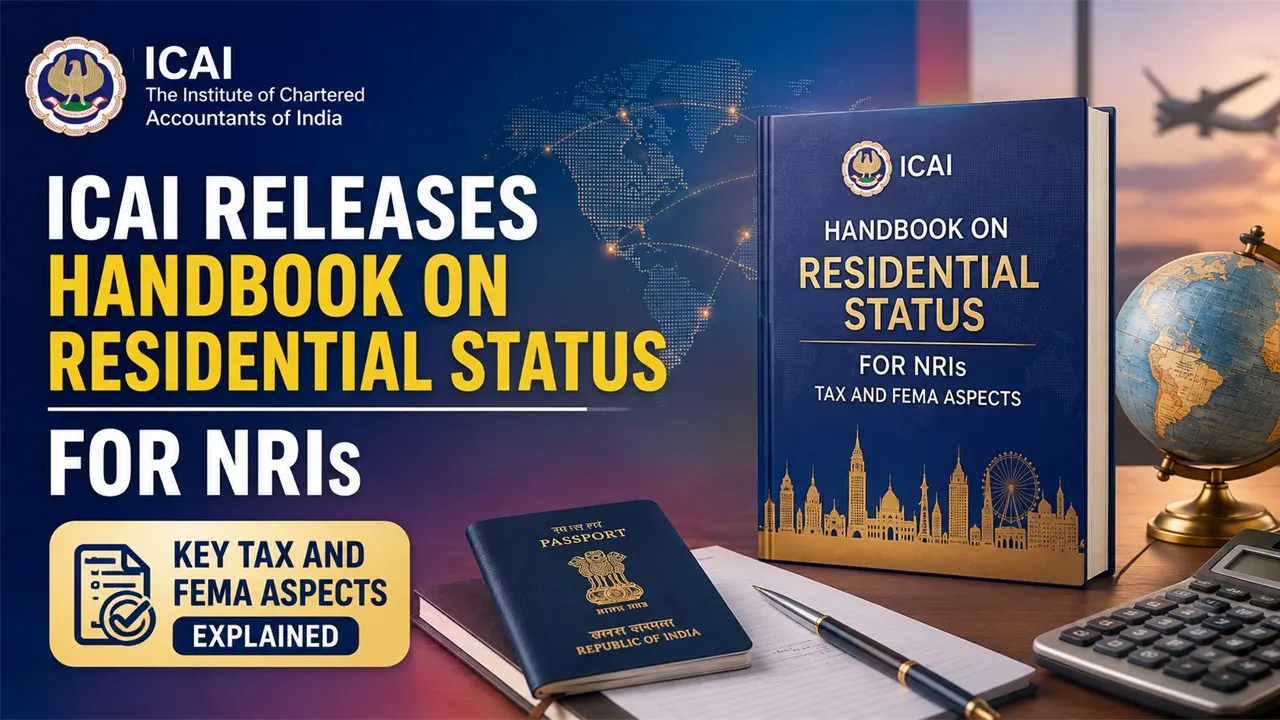
ICAI’s new handbook explains residential status under the Income-tax Act and FEMA, covering key tax implications for NRIs amid changes introduced by the Income-tax Act, 2025.
ICAI Handbook on NRI Residential Status
 Saloni Kumari
 Aug 13, 2026
The Institute of Chartered Accountants of India (ICAI) has released a publication titled "Handbook on Residential Status for NRIs Tax and FEMA Aspects". The handbook has comprehensively explained the principles governing residential status under both the Income Tax Act and FEMA, allowing readers to understand and resolve practical problems without any ambiguity, with greater confidence.
The president of ICAI has sincerely appreciated the efforts of the CA. Satish Kumar Gupta, Chairman; CA. Vishnu Kumar Agarwal, Vice-Chairman; and all members of the International Taxation Committee and the Study Group involved in preparing this useful publication for giving their valuable time.

In India, determining an individual’s residential status has become increasingly important due to the growing movement of professionals, investments, and businesses across countries. Although the rules for determining residential status are well established, applying them has become more complicated.
Many Indian professionals now work abroad and return to India after short periods. Families may spend time in different countries, while individuals may have investments, properties, and businesses in several jurisdictions. Therefore, the traditional idea that a person belongs to only one country during a financial year may not always reflect today’s realities.

Residential status determines the extent of a person’s tax liability in India. The introduction of the Income Tax Act, 2025, has added another aspect to this area. It restructures and renumbers the provisions relating to residential status that were in place for more than six decades. Taxpayers and professionals will therefore need to understand two laws: the Income-tax Act, 1961, for earlier years and the Income-tax Act, 2025, for future years. At the same time, they must understand both the continuing principles and the changes introduced by the new law.
For more information, refer to the official PDF of the publication.
About Author


Saloni Kumari
Content Writer
 StudyCafe
 Delhi, Delhi, India
 2949
2949My Recent Articles
- ITAT Remands LTCG Dispute After Senior Citizen Misses Online Notices Due to Lack of Digital Knowledge
- Maharashtra Govt Eases Registration of Jointly Owned Land Sales, ‘KA’ Copy Can Replace Co-Owners’ NOC
- No Separate Section 69C Unexplained Expenditure Addition Allowed After Accepting Section 44AD Income Without Supporting Evidence: ITAT
- RBI Imposes Restrictions on Puducherry Co-operative Urban Bank for Six Months, Caps Cash Withdrawals at Rs 5,000
- ICAI Opens Application Window for Empanelment of Members to Act as Observer at CA January 2027 Exams
Loading suggestions…


Recent Posts



All Posts


Recent Posts
All Posts