Income Tax Rules 2026: CBDT Introduces Major Updates to include crypto-assets:
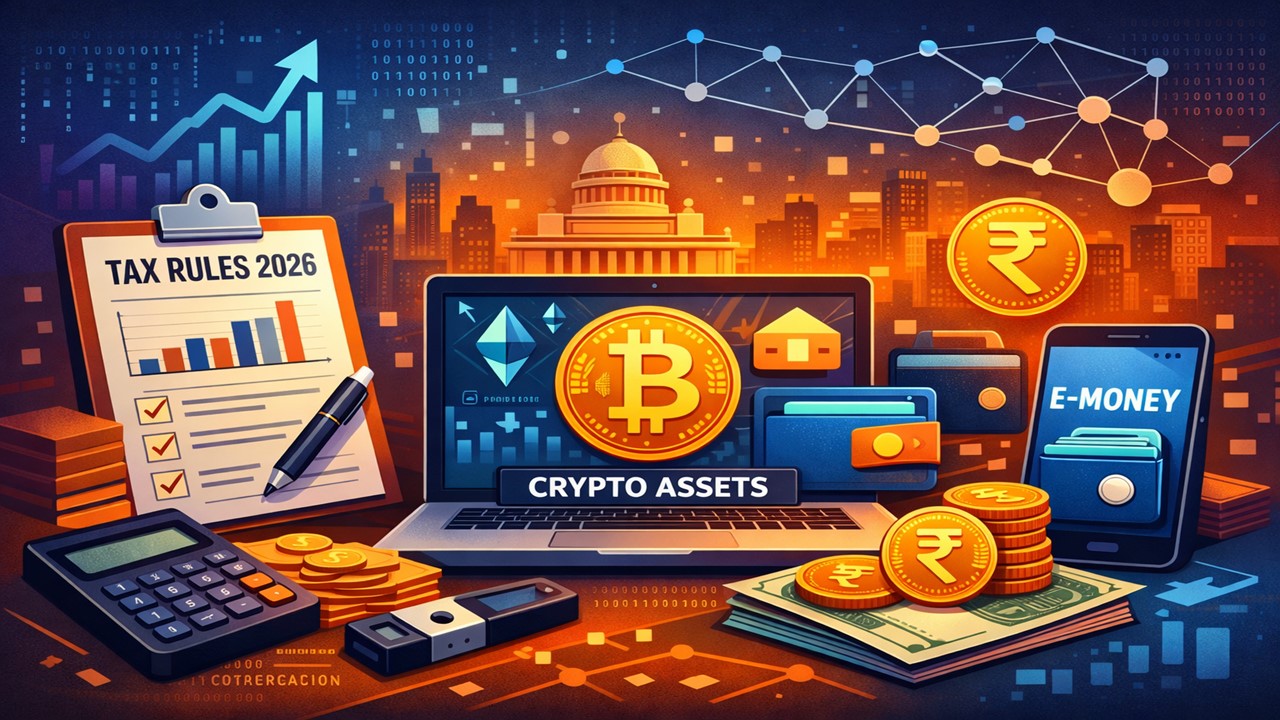
These changes are mainly related to digital currencies, crypto-assets, and electronic money and are effective from January 1, 2026.
New Tax Rules for Crypto and Digital Currencies
 Nidhi
Nidhi Mar 6, 2026
Income Tax Rules 2026: CBDT Introduces Major Updates to include crypto-assets
The Central Board of Direct Taxes (CBDT) under the Ministry of Finance has issued a notification (G.S.R. 158(E) dated 5th March, 2026), introducing the changes made to the Income Tax Rules, 1961. These changes are made by the central government under section 295 read with section 285BA of the Income Tax Act, 1961 (43 of 1961).
The new rules are known as Income-tax (Amendment) Rules, 2026. The changes are mainly related to digital currencies, crypto-assets, and electronic money and are effective from January 1, 2026.
The major changes are made to Rule 114F, Rule 114G and Rule 114H.
Rule 114F Changes
The notification mainly brings changes to Rule 114F of the income tax rules, which outlines the framework for the financial institutions to report information on foreign accounts under FATCA (Foreign Account Tax Compliance Act) and CRS (Common Reporting Standard). This rule mandates reporting on US reportable accounts, including self-certification. The new amendments revise some definitions under this rule.
Changes in Rule 114G
Rule 114G outlines the reporting requirements for financial institutions regarding the reportable account, including interest, dividends, and other income. As per the new amendment, the institutions must also report whether the account holder has provided a valid self-certification and whether the account is a joint account, including the number of joint account holders.
Changes to Rule 114H
Rule 114H of the Income Tax Rules requires the strict due diligence process for financial institutions to identify and report foreign tax residency accounts.
Non-U.S. account holders' banks must use similar anti-money laundering steps to identify controllers, even if not legally required under PMLA 2002.
Refer to the official notification for more information.
About Author


Nidhi
Content Writer
Nidhi is a skilled content writer specializing in personal finance. She creates clear, engaging articles on mutual funds, investments, insurance, and wealth-building strategies. With a passion for simplifying complex financial topics, Nidhi helps readers make informed money decisions with confidence. She can be reached at [email protected]
Nidhi is a skilled content writer specializing in personal finance. She creates clear, engaging articles on mutual funds, investments, insurance, and wealth-building strategies. With a passion for simplifying complex financial topics, Nidhi helps readers make informed money decisions with confidence. She can be reached at [email protected]
 Studycafe
 New Delhi, Delhi, India
 1832
1832My Recent Articles
- Karnataka High Court Gives Another Chance in GST Matter Due to Lack of Hearing
- Delay Should Be Condoned if Explanation is Unrefuted: ITAT
- Non-Service of Income Tax Notice, Ill health of taxpayer, ITAT condones Appeal filing delay
- Books of Accounts Cannot be Rejected Without Any Specific Defect: ITAT Kolkata
- Karnataka High Court Sends ITC Matter Back to GST Authorities for Reconsideration
Up Next
Loading suggestions…


Recent Posts


All Posts
Recent Posts
All Posts