ITAT Quashes Reassessment Notice Issued After 31 March 2022 for AY 2015-16 as Time-Barred:
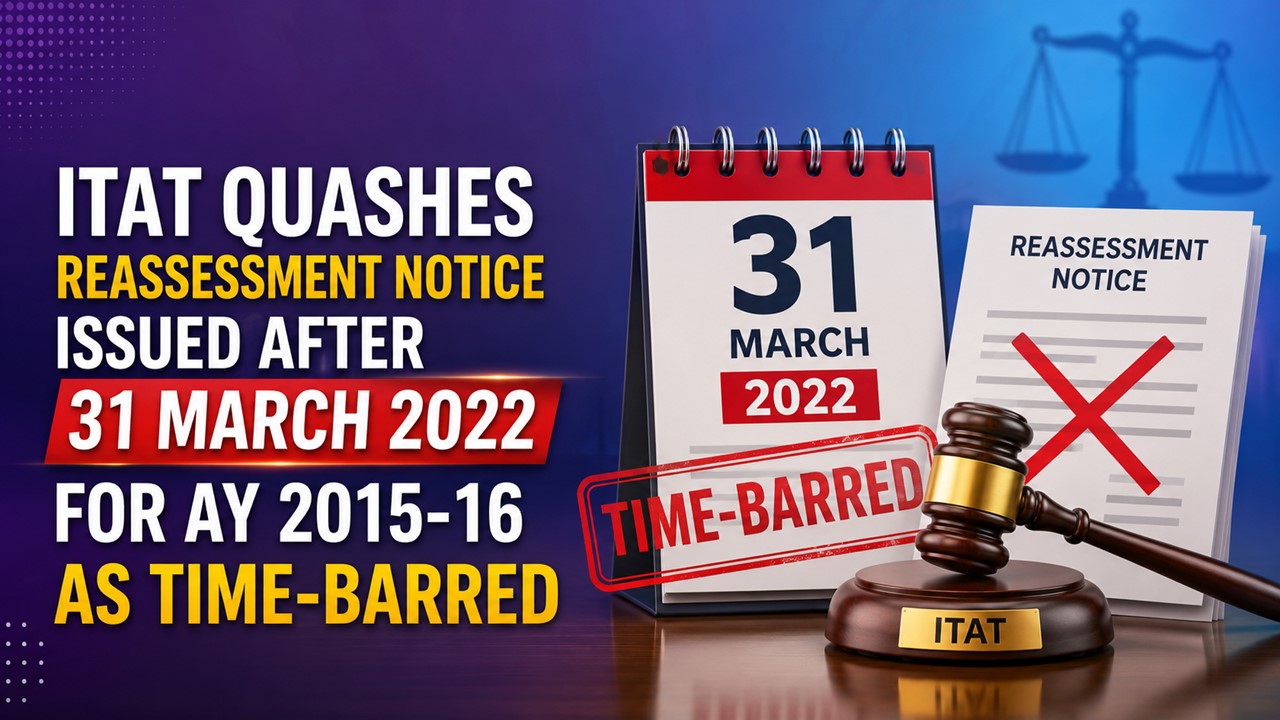
ITAT quashes reassessment, holding Section 148A proceedings cannot revive a notice already barred by limitation.
Time-Barred Reassessment Notice Declared Invalid Despite Section 148A Proceedings
 Meetu Kumari
 Jun 29, 2026
The Chennai Bench of the Income Tax Appellate Tribunal (ITAT) has held that a reassessment notice issued under Section 148 on 7 April 2022 for Assessment Year (AY) 2015-16 was barred by limitation and consequently quashed the entire reassessment proceedings. The Tribunal ruled that the extended reassessment time limit introduced by the Finance Act, 2021 could not revive cases that had already become time-barred under the earlier law.
The assessee challenged the reassessment proceedings on the ground that the notice under Section 148 had been issued beyond the six-year limitation period prescribed under the pre-amended provisions of the Income Tax Act. According to the assessee, for AY 2015-16 the limitation expired on 31 March 2022, whereas the notice was issued only on 7 April 2022. Reliance was placed on the Supreme Court's ruling in Union of India v. Rajiv Bansal and the Chennai Tribunal's earlier decision in Ms. Thirumoorthy Revathy v. ITO.

The Revenue argued that the delay stood saved by the third and fourth provisos to Section 149(1), contending that the period granted to the assessee for replying to the notice issued under Section 148A(b) had to be excluded while computing the limitation period. According to the department, after such exclusion, the notice issued on 7 April 2022 remained within the permissible period.
The Tribunal rejected the Revenue's contention. It observed that before applying the exclusion provisions contained in the third proviso to Section 149(1), the notice must first satisfy the basic limitation prescribed under the first proviso. Referring extensively to the Supreme Court's judgment in Union of India v. Rajiv Bansal, the Tribunal reiterated that reassessment notices for assessment years preceding AY 2021-22 cannot be issued after expiry of the six-year limitation available under the old law. Since the limitation for AY 2015-16 expired on 31 March 2022, the notice dated 7 April 2022 was inherently invalid and could not be rescued by excluding the period consumed during proceedings under Section 148A.

The Bench also relied on its earlier decision in Ms. Thirumoorthy Revathy v. ITO, as well as the Madras High Court's decision in Sridhar Lokesh v. ITO, which had followed the Bombay High Court's ruling in Hexaware Technologies Ltd. on the same issue.
Therefore, the Tribunal held that the notice issued under Section 148 was barred by limitation, quashed the reassessment proceedings and deleted the additions made pursuant to the invalid notice. Since the appeal was allowed on the legal issue, the Tribunal left all grounds on merits open without adjudicating them.
To Read Full Order, Download PDF Given Below
About Author


Meetu Kumari
Content Manager
 Studycafe
 Jodhpur, Rajasthan, India
 2264
2264My Recent Articles
- ITAT Condones 302-Day Delay, Restores Salary Assessment for Fresh VerificationPremium
- ITAT Condones Delay After Tax Consultant's Death, Restores Appeals for Fresh HearingPremium
- ITAT Remands Salary Addition, Says Taxability Depends on Salary Becoming Due, Not Mere ReceiptPremium
- ITAT Deletes TP Royalty Adjustment, Orders Fresh Review of Commission BenchmarkingPremium
- ITAT Quashes Reassessment Over Unsigned Section 148 Notice Issued to AssesseePremium
Loading suggestions…


Recent Posts

All Posts
Recent Posts
All Posts