ITAT Quashes Section 270A Penalty as Assessee Was Not Informed of Actual Charge:
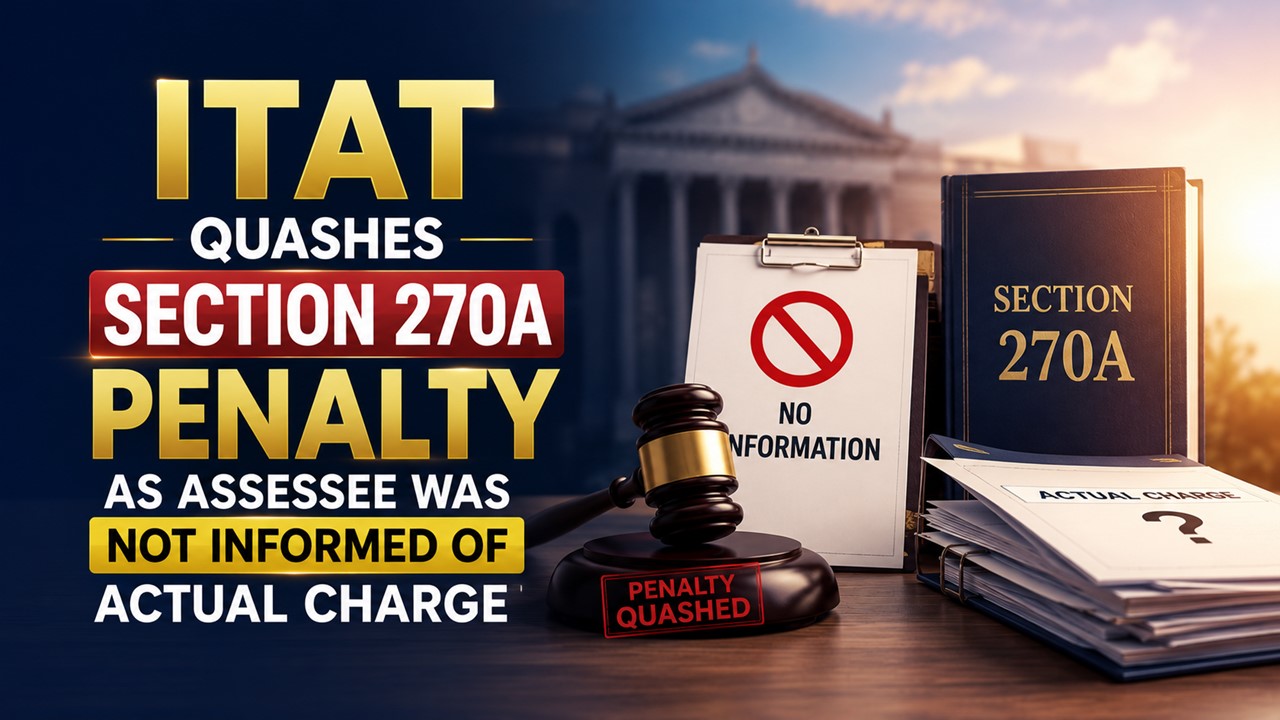
The Income Tax Appellate Tribunal (ITAT) Bangalore has quashed the penalty imposed under Section 270A holding that the assessee was never made aware of the actual charge.
ITAT Holds Penalty Proceedings Invalid
 Saima
Saima Jun 29, 2026
ITAT Quashes Section 270A Penalty as Assessee Was Not Informed of Actual Charge
The Income Tax Appellate Tribunal (ITAT), Bangalore, has observed that initiation of penalty proceedings for "misreporting of income" followed by levy of penalty for "under-reporting of income" rendered the entire penalty proceedings legally unsustainable.
The assessee had filed her return of income for the assessment year 2022-23. During scrutiny assessment under Section 143(3) of the Income Tax Act, the AO disallowed deductions claimed under Chapter VIA, resulting in an increase in the assessed income. After the assessment, penalty proceedings under Section 270A were initiated on the ground that the assessee had under-reported income. Later, the AO imposed a penalty of Rs 677,651 under Section 270A at 50% of the tax payable on the under-reported income.
The CIT(A) upheld the penalty, aggrieved by which the assessee preferred an appeal before the ITAT.
[related id="425275 "]
The Tribunal observed that Section 270A clearly provides a difference between under-reporting of income and misreporting of income. While under-reporting costs a penalty of 50% of the tax payable on the under-reported income, misreporting attracts a higher penalty of 200%. The Act also separately provides the circumstances that would cause under-reporting under Section 270A(2) and misreporting under Section 270A(9).
On examining the record, the Tribunal found that the notice issued under Section 274 read with Section 270A was based on the allegation of under-reporting arising from misreporting. However, the AO eventually levied the penalty only for under-reporting of income at 50%. The Tribunal held that the charge forming the basis of initiation of penalty proceedings was fundamentally different from the charge on which the penalty was imposed. Since the assessee was not informed of the exact allegation that formed the basis of the penalty, the proceedings suffered from a fundamental defect and violated the principles of natural justice.
Accordingly, the Tribunal held that the entire penalty proceedings were unsustainable. The penalty order passed under Section 270A was quashed and the appeal of the assessee was allowed.
About Author


Saima
Content Writer
Saima is a Law graduate with a passion for research and content writing. She writes for Finance, Taxation and Legal Updates at Studycafe.in, simplifying complex legal decisions by the ITAT, High Court, AAR and GSTAT into uncomplicated and clear explanations.
Saima is a Law graduate with a passion for research and content writing. She writes for Finance, Taxation and Legal Updates at Studycafe.in, simplifying complex legal decisions by the ITAT, High Court, AAR and GSTAT into uncomplicated and clear explanations.
 StudyCafe
 Delhi, Delhi, India
 530
530My Recent Articles
- ITAT Deletes Unexplained Money Addition After Finding No Evidence of Accommodation Entries
- ITAT Dismisses Duplicate Appeal as Withdrawn After Assessee Confirms Earlier Filing
- ITAT Remands Reassessment Case for Fresh Adjudication
- ITAT Remands Ex-Parte Appeal for Fresh Adjudication
- ITAT Condones 115-Day Delay in Appeal To Provide Substantive Justice
Up Next
Loading suggestions…


Recent Posts


All Posts


Recent Posts
All Posts