ITAT Restricts Tax Addition to 8% Profit on Undisclosed Bank Deposits:
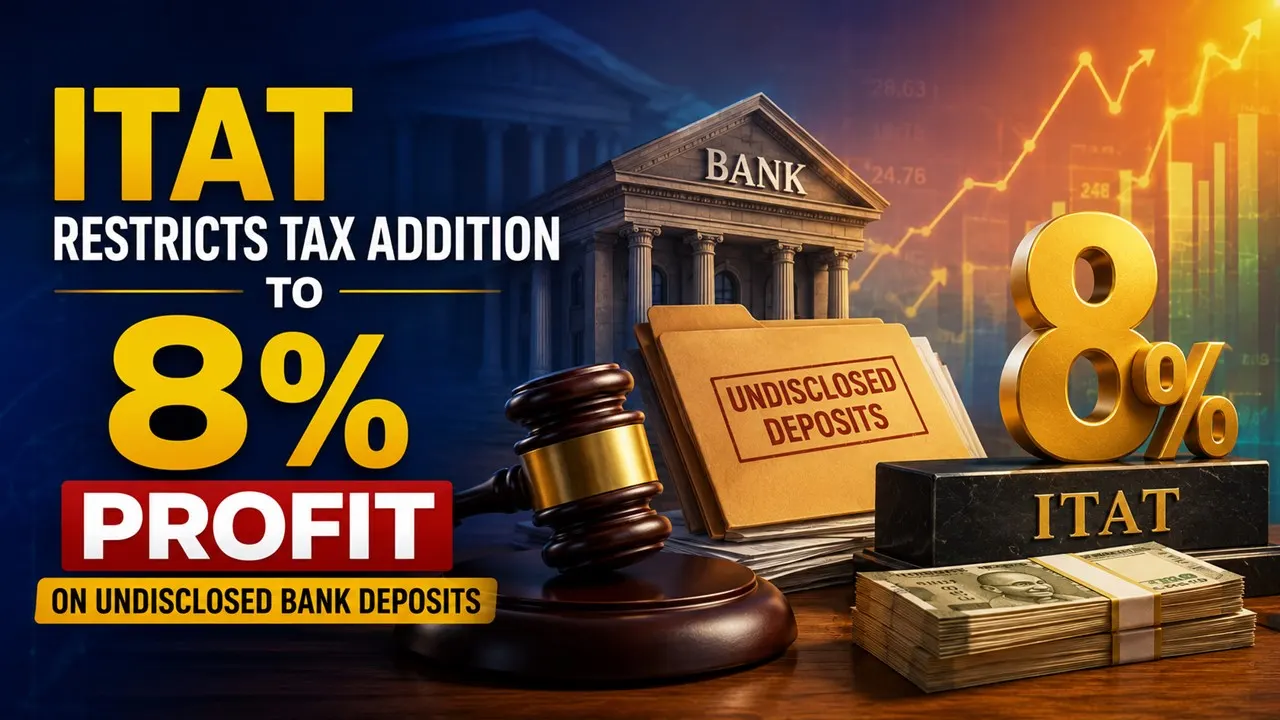
Granting partial relief, the ITAT restricted the tax addition to 8% of undisclosed bank deposits representing business transactions.
ITAT Favors Taxpayer in Bank Deposit Case
 Vanshika verma
 Jul 5, 2026
The Ahmedabad Bench of the Income Tax Appellate Tribunal (ITAT) has held that where deposits in an undisclosed bank account represent business transactions, the Income Tax Department cannot tax the entire amount deposited. Instead, only the profit element embedded in those transactions can be brought to tax.
The case involved taxpayer Ravi Lalwani, whose assessment for AY 2016-17 was reopened after the Income Tax Department found credits of around Rs. 6,96,60,251 in a bank account maintained with Shri Renuka Multi State Urban Co-operative Credit Society Ltd. The account had not been disclosed in his books of account or original income tax return.

During the reassessment proceedings, the taxpayer filed a fresh return declaring higher income. He explained that the deposits in the Renuka account represented sales proceeds from his milk and dairy business. According to him, the account was opened mainly because many of his customers were located in Maharashtra. He also offered an additional income of Rs.20,68,578, being the estimated profit earned from those undisclosed business transactions.
The Assessing Officer did not accept the explanation and observed that the taxpayer had not produced any evidence in support like purchase bills, sales invoices, records relating to transport or delivery documents. The officer added the entire credits of Rs. 6,75,91,673 to the income of the taxpayer treating the deposits as unexplained money under Section 69A of the Income Tax Act. The National Faceless Appeal Centre (NFAC) also upheld this addition.
Before the Tribunal, the taxpayer argued that the deposits were business receipts and that the corresponding withdrawals from the same account were used for making business payments. Therefore, taxing the entire deposits would amount to taxing turnover instead of income. He also relied on earlier ITAT decisions where only the profit element in similar transactions through the same co-operative society was taxed.

The Revenue, however, maintained that the taxpayer had failed to establish that the deposits represented genuine business sales because no documentary evidence was produced to support the claim.
The Tribunal first upheld the reopening of the assessment. It observed that the undisclosed Renuka bank account had never been reflected in the taxpayer's balance sheet or books of account, and the turnover routed through that account was also omitted from the original return. Since the taxpayer himself admitted these facts and disclosed additional profit only after receiving the reassessment notice, the reopening was held to be valid.
On the main issue, however, the Tribunal disagreed with the tax authorities. The bank statement showed ongoing deposits and withdrawals mostly in cash, which indicated ongoing business transactions rather than unexplained income, it said. The Tribunal noted that the deposits and withdrawals were interconnected, and only the profit earned from such transactions could be taxed and not the entire turnover.
Relying on its earlier decisions in similar cases involving transactions through the same Renuka Co-operative Credit Society, the Tribunal held that estimating profit at 8% of the total credits was reasonable. Accordingly, it restricted the addition to 8% of the deposits of Rs. 6,75,91,673 instead of the entire amount.
The Tribunal stated that "The assessee should be allowed set-off for additional profit of Rs 20,68,578 offered in the revised return filed in response to notice u/s. 148 of the Act, in respect of profit element pertaining to the transactions/credit entries in the bank account of Shri Renuka Multi State Urban Co-operative Credit Society Limited."
The Tribunal dismissed the taxpayer's challenge to the reopening of the assessment and also rejected the grounds relating to penalty proceedings and interest, holding that those issues were consequential. As a result, the appeal was partly allowed.
About Author


Vanshika verma
Content Writer
 Studycafe
 Delhi, Delhi, India
 2128
2128My Recent Articles
- Opium Poppy Licence Policy 2026-27: Check Who Can Apply, Minimum Morphine Yield Criteria, and Other Details
- Hindustan Foods Gets Rs 17.15 Lakh GST Demand Order, Says No Material Impact on Financials or Operations
- Centre Announces New Opium Poppy Cultivation Policy for 2026-27, Sets Minimum Yield Benchmark of 800 Kg per Hectare [Read Notification]
- Pratapgarh Police Inspector Death Case: Lucknow Special CBI Court Sentences Accused to 10 Years in Prison
- eMudhra Announces Exit From Global Digital Certificate Business After Major Security Flaw Raises Internet Safety Concerns
Loading suggestions…


Recent Posts



All Posts


Recent Posts
All Posts