ITAT Upholds Pass-Through Taxation for Revocable Securitisation Trust Under Income Tax Act:
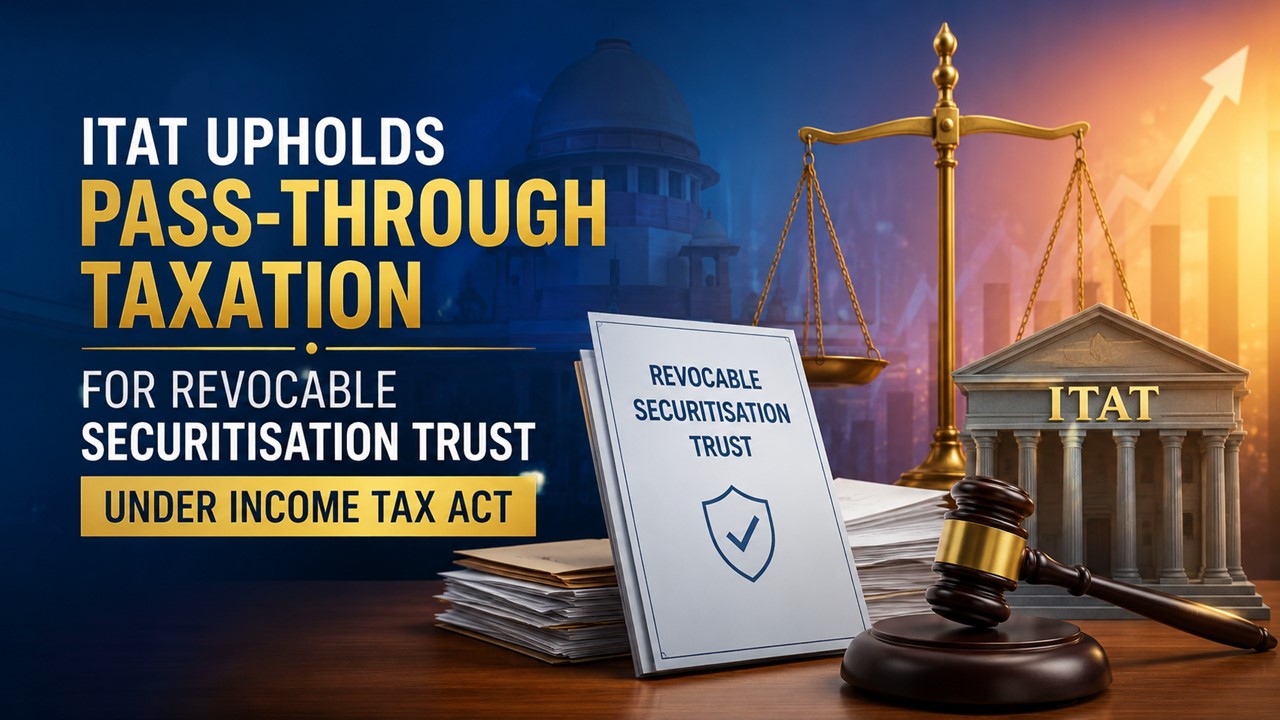
ITAT rules revocable determinate securitisation trust qualifies for pass-through taxation, rejecting assessment as an AOP.
Revocable Determinate Trust Entitled To Pass-Through Taxation Under Sections 61 To 63
 Meetu Kumari
 Jun 30, 2026
The Mumbai Bench of the Income Tax Appellate Tribunal (ITAT) upheld the deletion of an addition of Rs 8.88 crore and held that a securitisation trust constituted under the SARFAESI Act is a revocable determinate trust entitled to pass-through treatment under Sections 61 to 63 of the Income Tax Act and cannot be assessed as an Association of Persons (AOP). A Bench comprising Judicial Member Beena Pillai and Accountant Member Jagadish dismissed the Revenue’s appeal against ARCIL CPS 012 I Trust for AY 2016-17.
The assessee, a trust constituted by Asset Reconstruction Company (India) Ltd. (ARCIL) under the framework of the SARFAESI Act, filed its return declaring nil income. It claimed that, being a revocable determinate trust, the income earned from acquisition and resolution of non-performing assets (NPAs) was taxable directly in the hands of the Security Receipt (SR) holders and not in the hands of the trust.

During assessment proceedings, the Assessing Officer rejected the claim and treated the trust as an Association of Persons (AOP), holding that the contributors and beneficiaries had come together with a common objective of acquiring distressed assets and earning profits. Consequently, income of Rs.8.88 crore from business and other sources was brought to tax in the hands of the trust. The Commissioner of Income Tax (Appeals) deleted the addition after accepting the assessee’s claim that it was a revocable determinate trust eligible for pass-through treatment.
Before the Tribunal, the Revenue argued that the trust was carrying on organised commercial activities with a profit motive and therefore could not be regarded as a pass-through entity. It was also contended that the contributors had no effective control over the trust and that the conditions of a revocable transfer under Sections 61 to 63 were not satisfied.

The assessee, on the other hand, relied upon a series of Tribunal decisions involving similarly placed ARCIL trusts and submitted that the issue was squarely covered in its favour. It contended that the Security Receipt holders were identifiable beneficiaries with determinate shares and that the trust structure satisfied the requirements of a revocable trust under the Act.
“For constituting an AOP, there must exist voluntary combination of persons acting together with a common design and common management for earning income.”
The Tribunal observed that the issue was no longer res integra and stood covered by the Bombay High Court as well as several coordinate bench decisions concerning securitisation trusts. It found that the Revenue had failed to produce any material to establish that the Security Receipt holders had acted jointly or carried on any common enterprise so as to constitute an AOP. The Tribunal also noted that the trust had been created under the statutory framework governing securitisation transactions and was managed by the trustee in accordance with the trust deed.
“The essential ingredients necessary for treating the assessee as an AOP are conspicuously absent.”
Following the binding precedents and the consistent view taken in earlier cases involving ARCIL trusts, the Tribunal upheld the order of the CIT(A), held that the assessee was entitled to be assessed as a revocable determinate trust under Sections 61 to 63 of the Act, and dismissed the Revenue’s appeal.
To Read Full Order, Download PDF Given Below
About Author


Meetu Kumari
Content Manager
 Studycafe
 Jodhpur, Rajasthan, India
 2264
2264My Recent Articles
- ITAT Condones 302-Day Delay, Restores Salary Assessment for Fresh VerificationPremium
- ITAT Condones Delay After Tax Consultant's Death, Restores Appeals for Fresh HearingPremium
- ITAT Remands Salary Addition, Says Taxability Depends on Salary Becoming Due, Not Mere ReceiptPremium
- ITAT Deletes TP Royalty Adjustment, Orders Fresh Review of Commission BenchmarkingPremium
- ITAT Quashes Reassessment Over Unsigned Section 148 Notice Issued to AssesseePremium
Loading suggestions…


Recent Posts
All Posts

Recent Posts
All Posts