ITAT Deletes Rs 33 Lakh Addition, Holds Genuine Sales Cannot Be Treated as Unexplained Money Merely on CBIC Information:
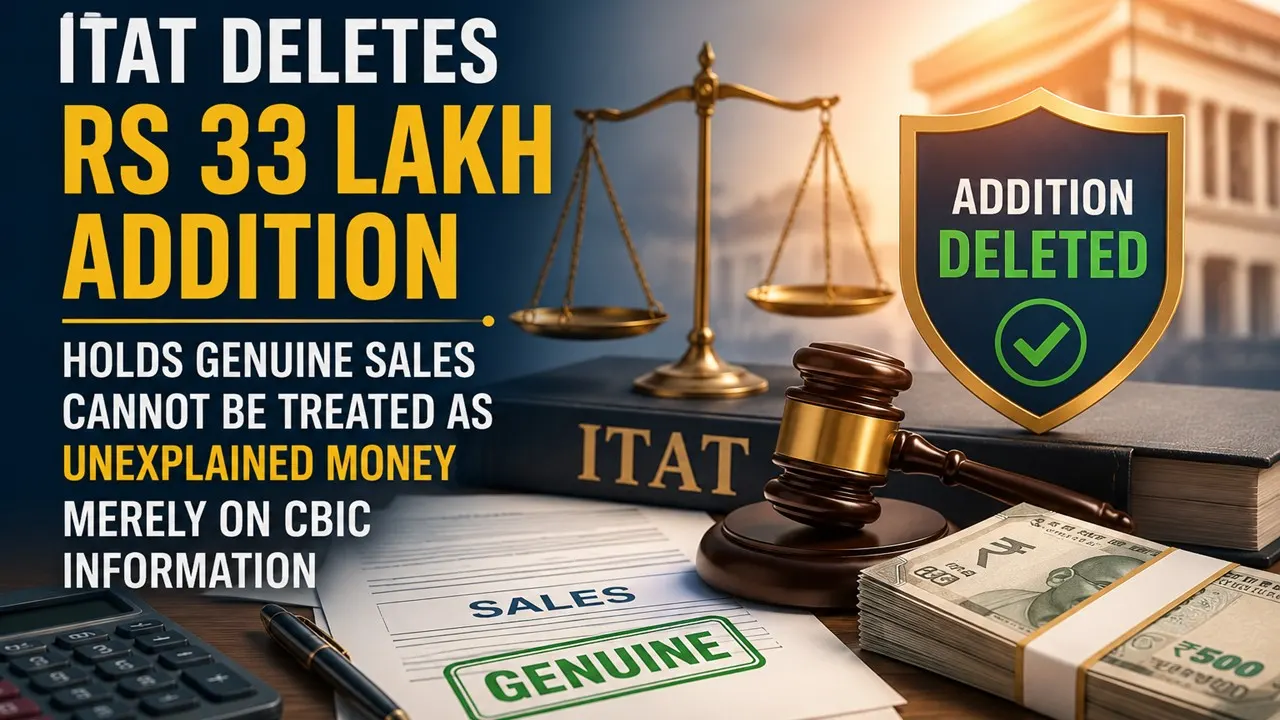
Recorded sales supported by books cannot be treated as unexplained money. Books Of Account Accepted, Yet Sale Proceeds Wrongly Treated as Unexplained Income Recorded sales supported by books cannot be treated as unexplained money.
Books Of Account Accepted, Yet Sale Proceeds Wrongly Treated as Unexplained Income
 Meetu Kumari
 Jun 27, 2026
The Delhi Income Tax Appellate Tribunal (ITAT) has deleted an addition of Rs.33 lakh made against an individual taxpayer after holding that genuine sales recorded in the books of account cannot be treated as unexplained money merely because the buyers were later identified by the tax authorities as entities involved in issuing fake invoices. However, the Tribunal upheld the validity of the reassessment proceedings initiated under Sections 147 and 148 of the Income-tax Act.
The assessee, Gaurav Mittal, had filed his return for AY 2018-19 declaring an income of Rs 26.90 lakh. The case was reopened after the Assessing Officer received information from the CBIC that certain entities, including M/s Rajesh Kumar Suresh Kumar & Sons and M/s Sonu Monu Telecom Centre Pvt. Ltd., were allegedly engaged in issuing and availing bogus sale and purchase bills. Since the assessee's name appeared as one of the beneficiaries, reassessment proceedings were initiated.

During the reassessment, the assessee filed a fresh return under Section 148 along with ledger accounts, bank statements, audit report, balance sheet and other supporting documents. The Assessing Officer nevertheless treated receipts of Rs 33,00,190 from the two parties as unexplained cash credits and made an addition.
Before the Tribunal, the assessee challenged both the legality of the reassessment and the addition. It was argued that the return filed under Section 148 had not been properly considered and that the addition was made solely on suspicion despite complete documentary evidence proving the transactions.
The Tribunal first rejected the challenge to the reopening. It observed that the notice under Section 148 had been issued on 31 March 2022, which was within the limitation period prescribed under Section 149. Accordingly, the reassessment proceedings were held to be valid.

On the merits, however, the Tribunal found significant inconsistencies in the assessment order. It noted that the Assessing Officer had incorrectly referred to transactions relating to AY 2015-16, whereas the reassessment pertained to AY 2018-19. More importantly, the assessee had explained with documentary evidence that the transactions represented genuine sales of mobile phones, supported by invoices, ledger accounts, bank receipts through RTGS, an audit report, a balance sheet and a profit and loss account.
The Tribunal observed that the assessee had specifically demonstrated that Rs 25 lakh represented an advance received through RTGS against the sale of mobile phones to M/s Rajesh Kumar Suresh Kumar & Sons, while Rs 8 lakh related to another sale made to M/s Sonu Monu Telecom Centre Pvt. Ltd. These sales and corresponding receipts were duly recorded in the books of account and had not been disputed by the Assessing Officer.
The Bench held that once the sales, receipts and accounting records were accepted, the addition under Section 69A could not be sustained merely because information received from the CBIC suggested that the purchasers were involved in issuing fake invoices. Since the receipts were fully reflected in the books and supported by documentary evidence, they could not be treated as unexplained money.
Thus, the Tribunal deleted the addition of Rs 33,00,190 while upholding the validity of the reassessment proceedings. The appeal was partly allowed.
About Author


Meetu Kumari
Content Manager
 Studycafe
 Jodhpur, Rajasthan, India
 2264
2264My Recent Articles
- ITAT Condones 302-Day Delay, Restores Salary Assessment for Fresh VerificationPremium
- ITAT Condones Delay After Tax Consultant's Death, Restores Appeals for Fresh HearingPremium
- ITAT Remands Salary Addition, Says Taxability Depends on Salary Becoming Due, Not Mere ReceiptPremium
- ITAT Deletes TP Royalty Adjustment, Orders Fresh Review of Commission BenchmarkingPremium
- ITAT Quashes Reassessment Over Unsigned Section 148 Notice Issued to AssesseePremium
Loading suggestions…


Recent Posts


All Posts

Recent Posts
All Posts