ITR Filing: Deductions Available to Taxpayers Opting for New Tax Regime:
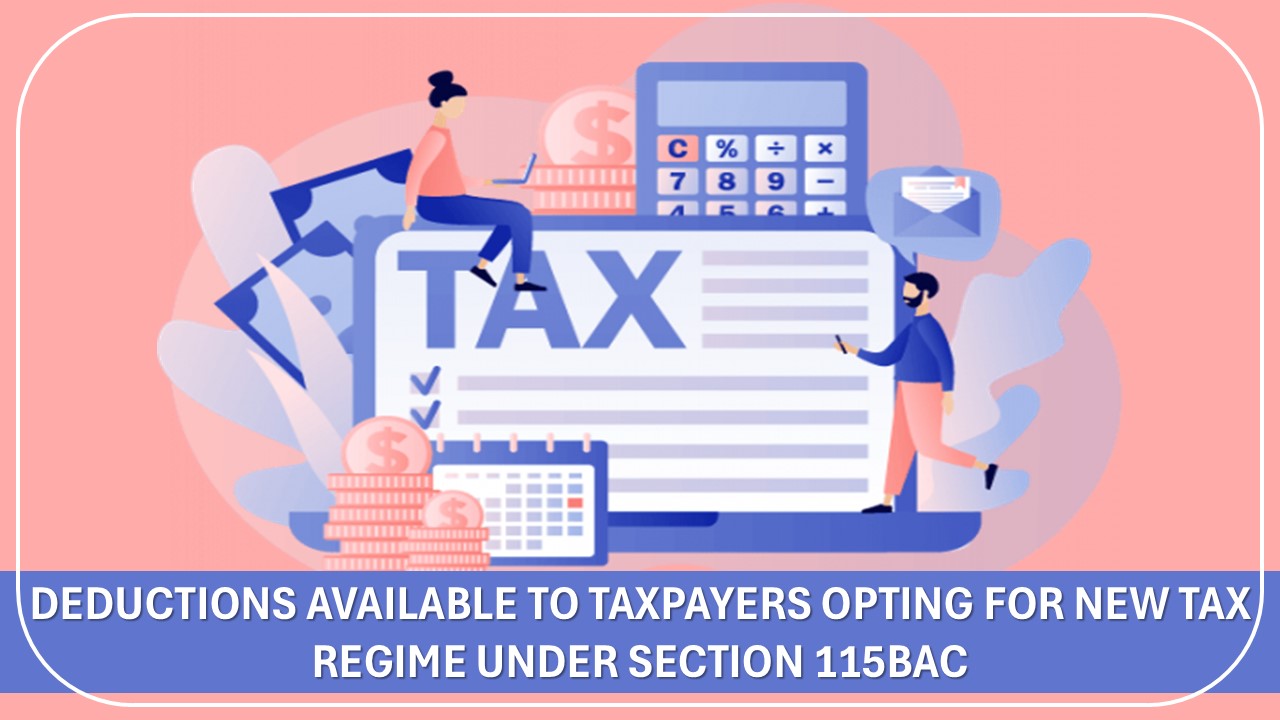
Below are listed the deductions available to taxpayers choosing the New Tax Regime as per section 115 BAC.
Deductions Allowed in 115BAC Regime
 Saloni Kumari
 Apr 15, 2025
Table of Contents

ITR Filing: Deductions Available to Taxpayers Opting for New Tax Regime
Below are listed the deductions available to taxpayers choosing the New Tax Regime as per section 115 BAC.
Section 24(b): Deduction From Income From House Property on Interest Paid on Housing Loan:
Overview:
- Section 24(b) allows a deduction on the interest paid on a housing loan availed for the construction or purchase of a house property. The most important thing here is the nature of the property and the intention of the loan.
Nature of Property:
- This deduction is applicable when the property is rented out. If the property is for self-occupation, different rules apply, and it is not applicable under this section.
Purpose of Loan:
- The loan must be taken for the purpose of construction or purchase of a residential property. The funds used must be directly connected to the construction or purchase of the house.
Allowable Deduction (Maximum Limit):
- For rented-out property, there is no maximum limit on the deduction for interest paid on the loan. This means that you can claim the full amount of interest you pay on the home loan as a deduction from your total taxable income.
2. Section 80CCD(2): Employer Contribution to Pension Scheme
Overview:- Section 80CCD(2) allows employees to take a deduction for the employer's contribution to their pension under the Central Government's pension scheme. This is separate from the employee's contribution, which can be allowed under Section 80C or Section 80CCD(1).
For All Categories of Employers:
- This rule is applicable to all employers, including government or private organizations. If the employer is contributing to a pension plan under the Central Government scheme (e.g., the National Pension Scheme or NPS), then the employee is eligible for deduction on this contribution.
Deduction Limit:
- The deduction limit for employer contributions is 14% of the employee’s salary (for both government and Non Govt-employees).
What is covered in the Salary?
- Salary here refers to basic pay, dearness allowance, and commission (if it’s part of the salary). It does not include bonuses, perquisites, etc.
3. Section 80CCH – Contribution to Agnipath Scheme
Overview:
- Section 80CCH is specifically meant for taxpayers who are joining the Agnipath Scheme, a scheme initiated by the government for army services. Based on this scheme, the person (referred to as an Agniveer) is able to make contributions to a fund known as the Agniveer Corpus Fund, and even the government may contribute to such a fund. The government provides a deduction in respect of such contributions.
- Only those persons enrolled in the Agnipath Scheme and contributing to the Agniveer Corpus Fund are eligible for this deduction.
For what is the Deduction?
- The deduction is for sums deposited or contributed by an Agniveer into his Agniveer Corpus Fund.
- The entire sum contributed by the individual or the Central Government to the Agniveer fund can be claimed as a deduction from taxable income.
When does the Central Government contribute?
- If the contribution of the Central Government is also made to the Agniveer account of the individual, then that contribution is also eligible for a full deduction from the taxable income of the individual.
Deduction in Total Income:
- Both the government contribution and the individual contribution are deducted entirely from the total income of the taxpayer, which implies that they lower the taxable income.
About Author


Saloni Kumari
Content Writer
Saloni is a Content Writer with 2+ years of experience at studycafe.in. She writes legal, taxation, and finance related content including GST, Income Tax etc. Skilled in translating complex judicial pronouncements and regulatory developments into clear, and reader-friendly articles. Experienced in covering judgements of ITAT, High Court, GSTAT, and news related to Income Tax, GST, and corporate law. She can be reached at [email protected].
Saloni is a Content Writer with 2+ years of experience at studycafe.in. She writes legal, taxation, and finance related content including GST, Income Tax etc. Skilled in translating complex judicial pronouncements and regulatory developments into clear, and reader-friendly articles. Experienced in covering judgements of ITAT, High Court, GSTAT, and news related to Income Tax, GST, and corporate law. She can be reached at [email protected].
 StudyCafe
 Delhi, Delhi, India
 2901
2901My Recent Articles
- ICAI Issues New Tender Guidelines for Practising CAs to Prevent Unfair Fee Competition
- CBI Court Convicts and Sentences Two Postal Officials in Bribery Case Involving Recurring Deposit Accounts
- EPFO Extends September 2026 ECR Filing and PF Payment Deadline to October 31
- ITAT Says Cash Sales Cannot Be Treated as Bogus Without Proper Enquiry, Deletes Rs 24.59 Lakh Demonetisation Addition
- CIT(E) Cannot Impose Future Litigation Conditions on Section 12AB Registration and Section 80G Approval, Says ITAT
Up Next
Loading suggestions…


Recent Posts


All Posts


Tags
No tags yet.
Recent Posts
All Posts
Tags
No tags yet.