ITR Filing for a Deceased Taxpayer: Legal Heir Registration, Partial-Year Income, and Form Selection:
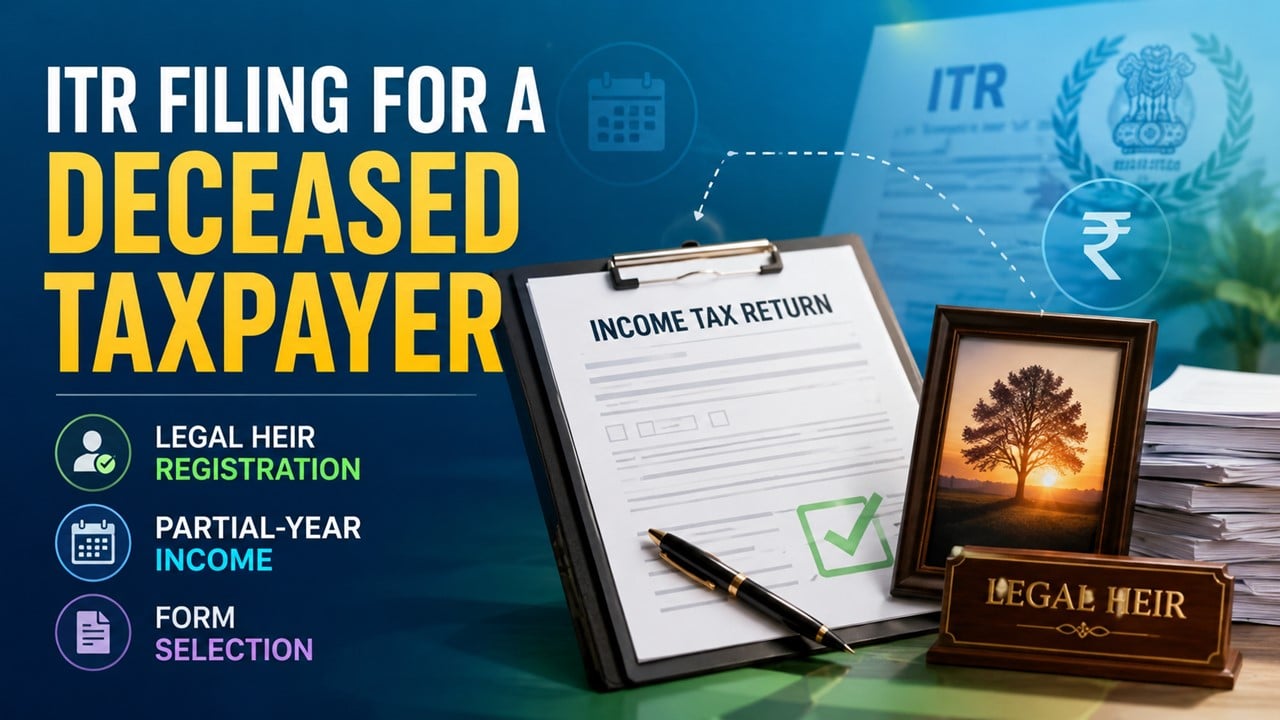
Complete guide to ITR filing after death covering legal heir registration, income allocation, and correct ITR form selection in India.
Filing Income Tax Return for a Deceased Taxpayer
 Khush Trivedi
 Jun 28, 2026
ITR Filing for a Deceased Taxpayer: Legal Heir Registration, Partial-Year Income, and Form Selection
Death does not close books on a person's tax liability. If a deceased person earned any taxable income in the financial year, then the income must be reported to the income tax department, and it is the responsibility of the legal heir. This is a compulsion of the Income Tax Act 1961. Ignorance of this can trigger notices, penalties, interest, etc.
This article gives importance to three things: first, registering themselves as a legal heir on the e-filing portal; second, finding out which income to report; and third, selecting the ITR form.
Steps to Register as a Legal Heir
Step 1: Register as a Legal Heir on the e-filing Portal
Before filing any return, a legal heir must register themselves on the e-filing portal as a “representative assessee". That links the PAN of the legal heir with the PAN of the deceased.
HOW to register:
- Log in to the e-filing portal using your own (the legal heir's) credentials.
- Go to Authorized Partners → Register as Representative Assessee.
- Click "Let's Get Started", then "Create New Request".
- Under "Category of Assessee you want to represent", select Deceased (Legal Heir).
- Enter the deceased's PAN, date of birth, and date of death.
- Upload the required documents (see below).
- The request goes to the e-Filing Administrator for approval.
- Death certificate (scanned copy)
- PAN card of the deceased
- PAN card of the legal heir
- Proof of legal heirship, any one of the following:
- Legal heir certificate issued by a court or local revenue authority
- Surviving family member certificate issued by a local revenue authority
- Registered will
- Family pension certificate issued by the state or central government
- A notarised affidavit (in front of a Magistrate or notary), where none of the above is readily available

- Deceased’s Return: From 1 April to the date of death.
- Legal heir’s own return: His personal income of the full year plus the income of deceased persons, which was generated after the death.
- If there is a refund due, then it is paid out to the legal heir.
- Liability is capped. Under Section 159 of the Income-tax Act, the legal heir's liability for the deceased's unpaid tax, penalty, or interest is limited strictly to the value of assets inherited from the deceased, not the heir's personal wealth. If the inherited assets are worth ₹5 lakh and the deceased's tax dues are ₹7.5 lakh, the heir cannot be made to pay more than ₹5 lakh.
- Assessment or reassessment procedure also can be done against a legal heir even after the death of the deceased person, but the same cap as above also applies.
About Author


Khush Trivedi
Content writer
 Study cafe
 AHMEDABAD, Gujarat, India
 46
46My Recent Articles
- Taxation of Preliminary Expenses Under the Income Tax Act: Complete Guide to Section 35D
- Selling a Property or Asset? Know These Capital Gains Tax Exemptions
- Taxation of Joint Development Agreements (JDA): Everything Landowners Need to Know
- Section 139(9) Defective Return Notice: Complete Guide to Fixing Your ITR
- Section 32 of the Income Tax Act, 1961: Depreciation on Business Assets
Up Next
Loading suggestions…


Recent Posts


All Posts



Recent Posts
All Posts