ITR Filing Season: 5 Important Deductions/Exemptions Available to Salaried Taxpayers:
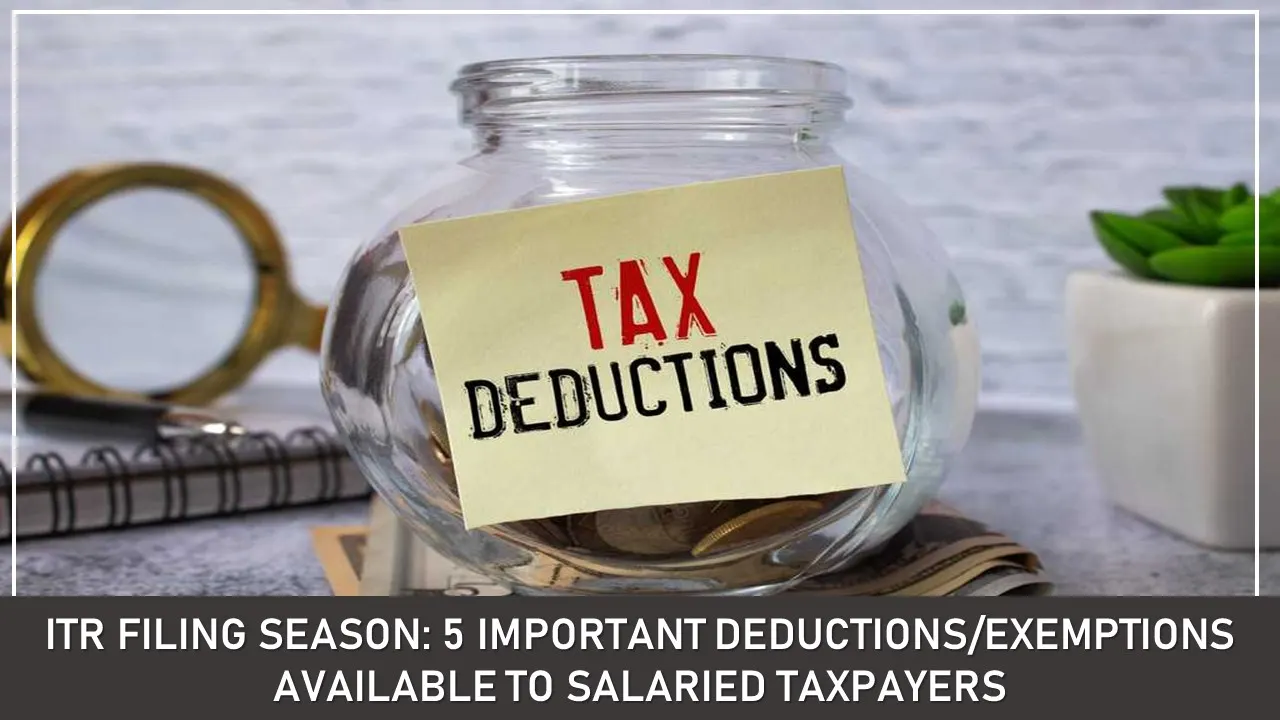
These 5 deductions and Exemptions are available for salaried employees that can significantly reduce their tax liability.
Tax Saving: 5 Key Deductions/Exemptions Available to Salaried Individuals
 Nidhi
Nidhi Apr 21, 2025
Table of Contents

ITR Filing Season: 5 Important Deductions/Exemptions Available to Salaried Taxpayers
As the Income Tax Return (ITR) filing season is here, many individuals gear up to file their ITR. The Income Tax Act offers benefits to salaried individuals by allowing various deductions and allowances. However, many people just rush to file their returns and end up missing out on chances to save money. Here are 5 deductions and Exemptions available for salaried employees that can significantly reduce their tax liability.
1. Section 80C
Section 80C of the Income Tax Act allows taxpayers to claim deductions up to Rs. 1,50,000 for specified investments or expenditures. These investments are as follows:- Payment for the life insurance premium
- Sum paid under a contract for a deferred annuity
- Contributions to the Employees’ or Recognised Provident Fund
- Contribution to Public Provident Fund Account
- Contribution to an approved superannuation fund
- Subscription to any notified security or notified deposit scheme (Sukanya Samriddhi Account Scheme)
- Subscription to notified savings certificates
- Contribution to the notified unit-linked insurance plan
- Tuition fees for the full-time education of any 2 children
- Certain payments for the purchase/construction of residential house property
- Notified annuity plan of LIC or other insurers
- Term deposits for a fixed period of not less than 5 years with a scheduled bank
- Deposit in Senior Citizen Savings Scheme
- Contribution to Tier-II NPS account by the central government’s employees.
2. Section 80CCD
Section 80CCD allows taxpayers to claim a deduction on the contribution made towards the New Pension Scheme (NPS) as notified by the Central Government. Contributions made by employers are also included in this section. The section has 3 parts: Section 80CCD(1), 80CCD(1B) and Section 80CCD(2)Section 80CCD
The Section 80CCD(1) is related to the income tax deduction available to the employer's contribution made towards NPS. Such a taxpayer can claim a deduction of up to Rs. 1,50,000. However, the salaried individual cannot claim more than 10% of their salary as NPS contributions. For self-employed individuals, the limit is 20% of gross income. Here, salary means basic salary plus dearness allowance.Get additional benefit under Section 80CCD(1B)
In addition to this, Section 80CCD(1B) offers an additional deduction up to Rs. 50,000 for contributions made to NPS above the deductions available under 80CCD(1).Section 80CCD(2)
If your employer contributes to your NPS account, you can also claim that as a deduction. For central or state government employees, the employer can contribute up to 14% of salary (basic + DA), and that whole amount is deductible. For other employers, the limit is 10% or 14%, as the case may be.3. Section 80D
Section 80D of the Income Tax Act allows taxpayers to claim deductions for payments made towards Health Insurance premiums and Preventive Health check-ups for self, spouse, dependent children or parents. The maximum deduction allowed for Self, spouse and dependent children is up to Rs. 25,000. The limit is increased to 50,000 if the specified person is a senior citizen. Along with this, the individual can claim additional deductions up to Rs. 25,000 for their parents below the age of 60 and Rs. 50,000 if the parent is a senior citizen. Section 80D also allows a deduction of up to Rs. 5,000 for payments made towards preventive health check-ups of self, spouse, dependent children or parents. The payment made for preventive health check-ups may be made in cash. In case, your parents are senior citizens and they do not have any health insurance, you can still claim Rs. 50,000 towards their medical expenditure incurred.3. Exemption for House Rent Allowance
House Rent Allowance (HRA) is an allowance given to an employee by an employer to cover the cost of living in a rented house. Employees can also claim exemptions on these allowances. However, only those salaried taxpayers who are residing in a rented home and actually pay rent for the rented accommodation can claim the exemption. Employees living in an accommodation owned by him or where he does not pay rent towards the accommodation cannot claim exemption for HRA. 'Salary' here includes the basic salary, dearness allowance (if it forms part of the salary for retirement benefits), and commission paid to the employee. The exemption is only available for the period during which the rented house is occupied by the employee and not for any period before or after that. No exemption will be allowed in case your rent is less than 10% of your salary.How to calculate HRA?
The lowest of the following can be claimed by an individual as an HRA exemption:- The total amount of HRA received by an employee from the employer,
- 50% of salary if living in metro cities or 40% of salary if living in non-metro cities,
- Actual rent paid minus 10% of salary.
About Author


Nidhi
Content Writer
Nidhi is a skilled content writer specializing in personal finance. She creates clear, engaging articles on mutual funds, investments, insurance, and wealth-building strategies. With a passion for simplifying complex financial topics, Nidhi helps readers make informed money decisions with confidence. She can be reached at [email protected]
Nidhi is a skilled content writer specializing in personal finance. She creates clear, engaging articles on mutual funds, investments, insurance, and wealth-building strategies. With a passion for simplifying complex financial topics, Nidhi helps readers make informed money decisions with confidence. She can be reached at [email protected]
 Studycafe
 New Delhi, Delhi, India
 1832
1832My Recent Articles
- Karnataka High Court Gives Another Chance in GST Matter Due to Lack of Hearing
- Delay Should Be Condoned if Explanation is Unrefuted: ITAT
- Non-Service of Income Tax Notice, Ill health of taxpayer, ITAT condones Appeal filing delay
- Books of Accounts Cannot be Rejected Without Any Specific Defect: ITAT Kolkata
- Karnataka High Court Sends ITC Matter Back to GST Authorities for Reconsideration
Up Next
Loading suggestions…


Recent Posts


All Posts



Tags
No tags yet.
Recent Posts
All Posts
Tags
No tags yet.