Key Changes and Deadlines in March 2025:
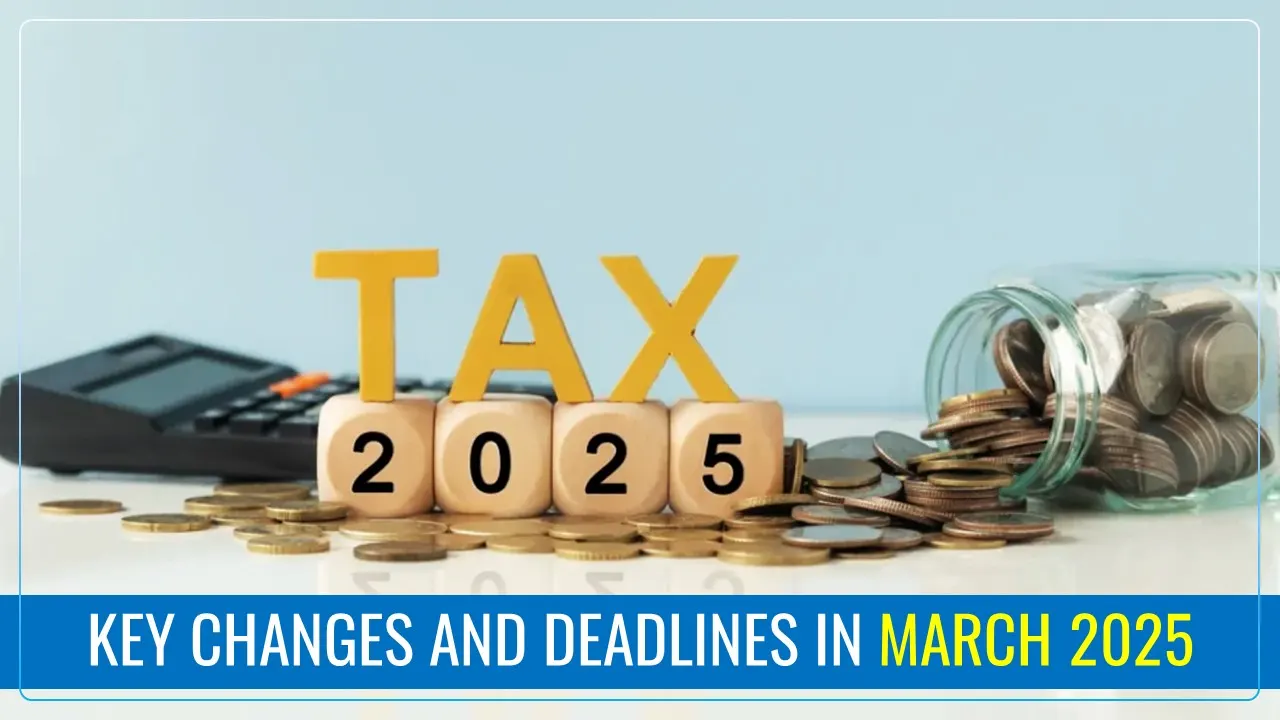
As we approach the next financial year 2025-26, several major regulatory and financial changes will take effect on March 1, 2025.
Financial and Tax Changes in March 2025
 Reetu
Reetu Mar 5, 2025
Table of Contents

Key Changes and Deadlines in March 2025
As we approach the next financial year 2025-26, several major regulatory and financial changes will take effect on March 1, 2025. These changes will affect taxpayers, businesses, investors, and consumers in general. The changes include income tax, GST, the e-way bill, SEBI regulations, banking, and other issues.
Here is a comprehensive summary of all the significant changes, along with compliance dates, to facilitate a smooth transition into the next financial year.

Introduction of the New Income Tax Bill 2025
The Income Tax Bill 2025 has been introduced and is now being approved. Once enacted, it will supersede the Income Tax Act of 1961, bringing modernised tax rules to simplify compliance and improve tax administration.Finance Bill 2025 bring Key Taxation Changes
The Finance Bill 2025 will shortly be approved, becoming the Finance Act 2025, bringing numerous key tax changes:- Taxpayers earning up to Rs.12 lakh will be exempt from income tax under the new tax regime (New Slab Rate).
- Changes to TDS and TCS Thresholds - Various TDS (Tax Deducted at Source) and TCS (Tax Collected at Source) thresholds will be altered, affecting businesses that conduct high-value transactions.
- No TCS on sale from April 1, 2025.
- Changes to Self-Occupied House Property Rules.
- Rebate and Marginal Relief Changes.
- New Deduction. NPS 'Vatsalya' (Section 80CCD(1B)) would provide additional tax benefits for National Pension Scheme (NPS) investments.
- Revised Turnover and Investment Limits for MSMEs.
- Increased Period for Filing Updated Income Tax Returns - Taxpayers can now file updated income tax returns up to 48 months after the end of the assessment year, giving them additional time to correct previous returns.
E-Way Bill for Unregistered Persons
Unregistered users can now generate an e-Way Bill using Form ENR-03, which is available on the e-Way Bill portal. This change will benefit people and businesses that are not registered for GST but are active in goods transit.New GST Registration Process (Rule 8 of CGST Rules 2017)
GST registration now involves tougher authentication measures:- Applicants who do not choose for Aadhaar authentication must visit a GST Suvidha Kendra (GSK) for photo capture and document verification.
- To complete Aadhaar authentication with biometric verification, Promoters/Partners must visit GSK.
- If you have already been verified in another state or territory, all you need to do is verify your documents.
- Failure to complete verification within 15 days will result in non-generation of the Application Reference Number (ARN).
GST Updates Effective from March 1, 2025
Following updates in GST in the month of March:- Businesses can now disclose negative liability in GSTR-3B, which improves the accuracy of GST returns.
- GSTR-1 and GSTR-1A now use a drop-down menu for HSN code selection and validation, reducing mistakes from manual entry.
- Table-12 is now divided into B2B and B2C transactions for easier reporting.
- Initial validation warnings will be sent for invalid values, but they will not block filing.
Important GST and Tax Compliance Deadlines Before March 31, 2025
Deadlines related to GST and Tax Compliance:- LUT (Letter of Undertaking) Renewal - For tax-free exports, submit Form GST RFD-11 by March 31, 2025.
- Composition Scheme Enrollment - To enrol in the Composition Scheme, complete Form CMP-02 by March 31, 2025.
- QRMP Scheme Selection - Opt in or out of Quarterly Return Filing by April 30, 2025.
- Declaration for GTA Taxpayers - File Annexures V and VI by March 31, 2025.
- GST Refund for FY 2022-23 - Claim any overdue GST refunds before March 31, 2025.
- E-invoicing - Starting April 1, 2025, businesses with a turnover above Rs.5 crore must have mandatory e-invoicing systems.
- GST Amnesty Scheme under Section 128A - To receive GST penalty relief, pay tax due by March 31, 2025.
Changes in Fixed Deposit (FD) Interest Rate
Major banks have changed their FD interest rates, effective March 1, 2025. Investors should analyse the new rates to ensure that their savings are aligned with their financial goals.Rules Updated for SEBI Nomination
SEBI requires all trading and demat account holders to either name a beneficiary or opt out by March 31, 2025. Failure to comply will result in an account freeze, limiting trading and investment operations.About Author


Reetu
Content Manager
Reetu is a Content Writer with 4+ years of experience in GST, Income Tax, Finance, Company Law, Education and Career Related Content. She is a B.COM (Honrs.) Graduate.
Reetu is a Content Writer with 4+ years of experience in GST, Income Tax, Finance, Company Law, Education and Career Related Content. She is a B.COM (Honrs.) Graduate.
 Studycafe
 Delhi, Delhi, India
 8071
8071My Recent Articles
- Income Tax Guide for Indian Defence Personnel for Tax Filing, Taxable Allowances and Other Benefits
- Income Tax Return Breaking: ITR Forms released for AY 25-26
- Ex-DRT Officials Sentenced to 5 Years Rigorous Imprisonment by Madras High Court along with Rs.27 Lakh Fine
- GSTN issued Advisory on Case Sensitivity in IRN Generation
- RBI to issue Notes of Rs.10 and Rs.500 bearing Signature of Guv Malhotra
Up Next
Loading suggestions…


Recent Posts



All Posts


Tags
No tags yet.
Recent Posts
All Posts
Tags
No tags yet.