NITI Aayog Releases Discussion Paper on Digital Banks Seeking Comments
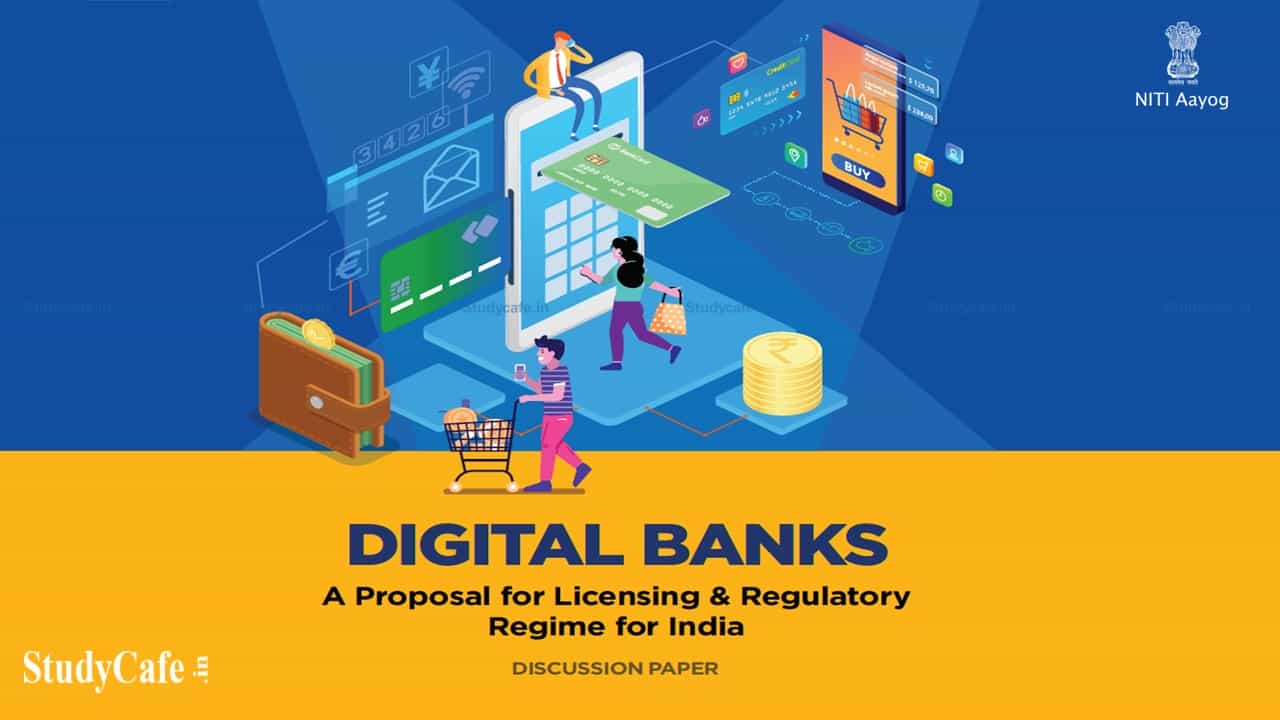
NITI Aayog Releases Discussion Paper on Digital Banks Seeking Comments The NITI Aayog has issued a Discussion Paper titled "Digital Banks: A Proposal…
 Reetu
Reetu Nov 25, 2021
Table of Contents

NITI Aayog Releases Discussion Paper on Digital Banks Seeking Comments
The NITI Aayog has issued a Discussion Paper titled "Digital Banks: A Proposal for Licensing & Regulatory Regime in India," which is open for comments until December 31, 2021. The Discussion Paper is available on the website of the NITI Aayog.
NITI Aayog created the Discussion Paper in consultation with notable experts in finance, technology, and law, and it is based on inter-ministerial dialogues.
Financial Inclusion as a Context for the Case of Digital Banks in India
With the help of PMJDY and the India stack, India has achieved rapid progress toward financial inclusion. However, credit penetration remains a public policy challenge, particularly for the nation's 63 million or so MSMEs, which contribute approximately 30% of GDP, approximately 45 percent of manufacturing output, and more than 40% of exports while employing a significant portion of the population, ranking second only to agriculture in terms of volume[1]. This is impeding the creation of a favourable business climate for the rise of the MSME sector. Financial inclusion has become a possible reality for Indian residents in recent years, with to unprecedented levels of technology-led digitization and digital disruption heralded by the Jan Dan-Aadhar-Mobile (JAM) trinity, biometric Aadhar system, and so on. This has been aided by the Unified Payments Interface (UPI), which has seen widespread adoption. In just October 2021, UPI recorded over 4.2 billion transactions worth over $7.7 trillion. The platform approach taken by the government in conceptualising UPI has resulted in valuable payment products being developed on top of it, as a result of which payments can be made with the click of a mobile phone not only at retail outlets but also peer to peer, completely redefining how money is transferred between individuals. A "whole-of-India approach" to financial inclusion has also resulted in Direct Benefit Transfer (DBT) via apps like PM-KISAN and the extension of microcredit to street sellers via PM-SVANIDHI apps. Parallel to this, India has taken efforts toward implementing its own form of "Open banking" under the Account Aggregator ("AA") regulatory framework enacted by the RBI. Once commercially adopted, the AA framework is expected to catalyse credit deepening among previously underserved groups. India's success in retail payments and credit has yet to be replicated when it comes to the payments and credit demands of its micro, small, and medium-sized companies. The present credit gap, as well as business and governmental constraints, highlight the importance of successfully harnessing technology to meet the demands of this group and bring them deeper into the formal financial fold.Summary of Proposed Reforms - Digital Banks:
The Discussion Paper makes a case for, and provides a blueprint and roadmap for, an Indian Digital Bank licencing and regulatory environment. The Discussion Paper also offers regulatory innovations such as the Digital Bank licence, which have the potential to solve as well as mitigate the financial deepening difficulties that are currently being confronted. The Paper begins by defining the term "Digital Bank" and highlighting the promise it represents while mapping the popular business models. It goes on to discuss the difficulties faced by the "partnership model" of neo-banking that has arisen in India as a result of regulatory vacuum and the lack of a Digital Bank licence In accordance with the NITI Aayog methodology for licencing and regulatory templates, the Paper creates an equal-weighted "Digital Bank Regulatory Index" comprised of four factors: Entry obstacles; Competition; Business Restrictions; and Technological Neutrality are mapped against the five benchmark jurisdictions of Singapore, Hong Kong, the United Kingdom, Malaysia, Australia, and South Korea. The Paper also suggests a two-stage strategy, beginning with a Digital Business Bank licence and progressing to a Digital (Universal) Bank licence after policymakers and regulators have gained experience with the former. A key advice is to eliminate any regulatory or policy arbitrage and to provide a level playing field. Furthermore, even with the Digital Business Bank licence, it suggests a properly calibrated approach that includes the following steps: Issue of a limited Digital Business Bank licence (to a specific application) (the licence will be limited in terms of the volume/value of customers serviced and other factors). Enrollment (of the licensee) in the RBI's regulatory sandbox framework. A "full-stack" Digital Business Bank licence will be issued (contingent on satisfactory performance of the licensee in the regulatory sandbox including saliently, prudential and technological risk management).About Author


Reetu
Content Manager
Reetu is a Content Writer with 4+ years of experience in GST, Income Tax, Finance, Company Law, Education and Career Related Content. She is a B.COM (Honrs.) Graduate.
Reetu is a Content Writer with 4+ years of experience in GST, Income Tax, Finance, Company Law, Education and Career Related Content. She is a B.COM (Honrs.) Graduate.
 Studycafe
 Delhi, Delhi, India
 8071
8071My Recent Articles
- Income Tax Guide for Indian Defence Personnel for Tax Filing, Taxable Allowances and Other Benefits
- Income Tax Return Breaking: ITR Forms released for AY 25-26
- Ex-DRT Officials Sentenced to 5 Years Rigorous Imprisonment by Madras High Court along with Rs.27 Lakh Fine
- GSTN issued Advisory on Case Sensitivity in IRN Generation
- RBI to issue Notes of Rs.10 and Rs.500 bearing Signature of Guv Malhotra
Up Next
Loading suggestions…


Recent Posts



All Posts



Tags
No tags yet.
Recent Posts
All Posts
Tags
No tags yet.