Overall Credit disbursement to Priority Sectors saw an increase of 19.7 Lakh Crore over Six-year period, Says FM:
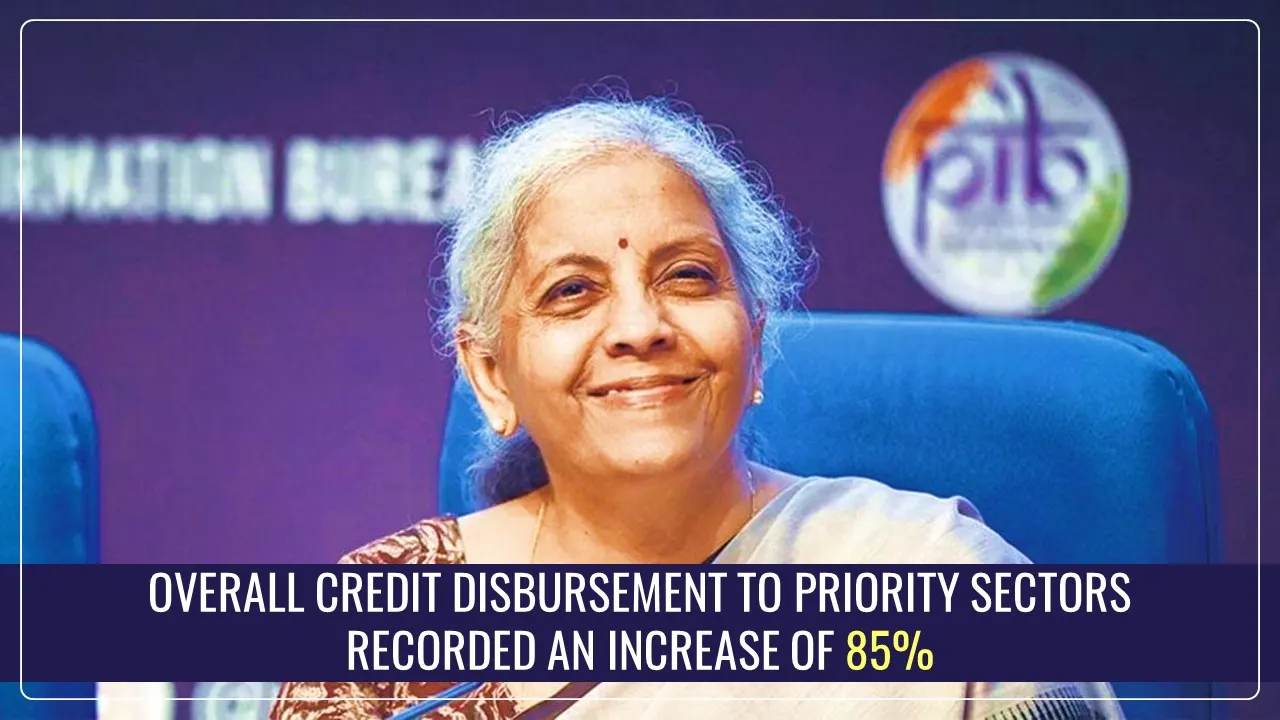
Finance Minister in a written reply in Lok Sabha announced that India’s overall credit disbursement to priority sectors recorded an increase of 85% over the six-year period.
Overall credit disbursement to priority sectors recorded an increase of 85%
 Reetu
Reetu Mar 13, 2025
Overall Credit disbursement to Priority Sectors saw an increase of 19.7 Lakh Crore over Six-year period, Says FM
Union Finance Minister Nirmala Sitharaman, in a written reply in Lok Sabha announced that India’s overall credit disbursement to priority sectors including Agriculture, MSME and Social Infrastructure by banks in 2019 was Rs.23,01,567 crores, which has risen to Rs.42,73,161 crores in 2024, recording an increase of 85% over the six-year period.
From 2019 to 2024, overall credit disbursement to the agriculture industry has increased steadily and positively. In 2019, the total disbursement to the sector was Rs.8,86,791 crore. By 2024, it has greatly climbed to Rs.18,27,666 crore (Data for agro includes credit disbursement for agro infrastructure by banks). Credit disbursement to the MSME sector has consistently increased from Rs.10,99,055 crore in 2019 to Rs.21,73,679 crore by 2024.
As the financial landscape evolves and banks strive to improve the quality of banking services for customers, they have collaborated with FinTechs to provide a variety of services.
Some of the major areas where FinTechs are further augmenting Banking products / services with seamless delivery thereby enhancing customer experience are:
Openings of savings account through e-KYC, V-KYC processes leveraging Artificial Intelligence (AI) technology for Face recognition and Name match etc.
Digital Loan journeys such as account statement analysis, leveraging alternate data in Underwriting etc. for quick credit assessment and real-time decision making.
Development of innovative products for customers using APIs of banks.
The Reserve Bank of India (RBI) has stated that compliance with its guidelines is examined on a sample basis during the Supervisory Assessment, and any non-compliance observed is taken up with the relevant supervised entities for rectification, in addition to initiating supervisory/enforcement action as deemed appropriate. In terms of financial stability, the RBI's regulatory and supervisory framework is guided by the overarching principles of protecting customers' interests and maintaining financial stability, among other things, as mandated by the Banking Regulation Act of 1949 and the Reserve Bank of India Act of 1934.
Furthermore, the regulatory and supervisory frameworks for regulated firms have been created in accordance with the idea of proportionality, taking into account their risk profile. The RBI has made many steps to tighten its supervisory approach by making it more forward-looking, risk-oriented, and analytical, with the goal of identifying susceptible sectors, borrowers, and supervised firms.
The government and RBI have implemented a variety of steps to improve bank financial health and address issues such as credit discipline, responsible lending and improved governance, technology adoption, recovery, and NPA reduction.
These measures include, inter alia, the following:
Public Sector Banks have set-up specialized stressed assets management verticals and branches for effective monitoring and focused follow-up of NPA accounts, which facilitates quicker and improved resolution/ recoveries. Deployment of Business correspondents and adoption of Feet-on-street model have also boosted the recovery trajectory of NPAs in banks.
Prudential Framework for resolution of stressed assets was issued by RBI to provide a framework for early recognition, reporting and time bound resolution of stressed assets, with a build-in incentive to lenders for early adoption of a resolution plan.
Minimum provisioning requirements have been prescribed for both standard and non-performing advances.
Credit discipline was instilled through the enactment of the Insolvency and bankruptcy Code, set up of the Central Repository of Information on Large Credits and systematic checking of high-value accounts for wilful default and fraud.
The Securitisation and Reconstruction of Financial Assets and Enforcement of Security Interest (SARFAESI) Act, 2002 and the Recovery of Debt and Bankruptcy Act have been amended to make it more effective. vi. Institution of comprehensive, automated Early Warning Systems in banks to proactively detect stress and reduce slippage into NPAs.
A Reform Agenda of PSBs through a unique Enhanced Access & Service Excellence (EASE) Reforms has been initiated. It has enabled objective and benchmarked progress on all key areas in PSBs viz., governance, prudential lending, risk management, technology, data-driven banking and outcome-centric HR.
The amalgamation of banks, the efficacy and effectiveness of the banking sector has been enhanced by leveraging economies of scale and synergies.
About Author


Reetu
Content Manager
Reetu is a Content Writer with 4+ years of experience in GST, Income Tax, Finance, Company Law, Education and Career Related Content. She is a B.COM (Honrs.) Graduate.
Reetu is a Content Writer with 4+ years of experience in GST, Income Tax, Finance, Company Law, Education and Career Related Content. She is a B.COM (Honrs.) Graduate.
 Studycafe
 Delhi, Delhi, India
 8071
8071My Recent Articles
- Income Tax Guide for Indian Defence Personnel for Tax Filing, Taxable Allowances and Other Benefits
- Income Tax Return Breaking: ITR Forms released for AY 25-26
- Ex-DRT Officials Sentenced to 5 Years Rigorous Imprisonment by Madras High Court along with Rs.27 Lakh Fine
- GSTN issued Advisory on Case Sensitivity in IRN Generation
- RBI to issue Notes of Rs.10 and Rs.500 bearing Signature of Guv Malhotra
Up Next
Loading suggestions…


Recent Posts



All Posts



Tags
No tags yet.
Recent Posts
All Posts
Tags
No tags yet.