Penalty can be imposed for default/delay in payment of Service Tax u/s 76 or 78
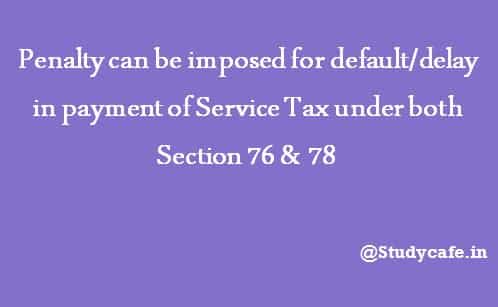
Penalty can be imposed for default/delay in payment of Service Tax u/s 76 or 78 ORDER THE RELEVANT TEXT OF THE ORDER AS FOLLOWS : 5.11 Penal
 Reetu
Reetu Dec 24, 2019
Penalty can be imposed for default/delay in payment of Service Tax u/s 76 or 78
ORDER
THE RELEVANT TEXT OF THE ORDER AS FOLLOWS : 5.11 Penalty under Section 76 of the Act is imposed for failure to pay Service Tax by the due date. Kerala High Court has in case of Krishna Poduval {2006 (1) STR 185 (Ker)] held follows: “11. The penalty imposable under S. 76 is for failure to pay service tax by the person liable to pay the same in accordance with the provisions of S. 68 and the Rules made thereunder, whereas S. 78 relates to penalty for suppression of the value of taxable service. Of course these two offences may arise in the course of the same transaction, or from the same act of the person concerned. But we are of opinion that the incidents of imposition of penalty are distinct and separate and even if the offences are committed in the course of same transaction or arises out of the same act, the penalty is imposable for ingredients of both the offences. There can be a situation where even without suppressing value of taxable service, the person liable to pay service tax fails to pay. Therefore, penalty can certainly be imposed on erring persons under both the above Sections, especially since the ingredients of the two offences are distinct and separate. Perhaps invoking powers under S. 80 of the Finance Act, the appropriate authority could have decided not to impose penalty on the assessee if the assessee proved that there was reasonable cause for the said failure in respect of one or both of the offences. However, no circumstances are either pleaded or proved for invocation of the said Section also. In any event we are not satisfied that an assessee who is guilty of suppression deserves such sympathy. As such, we are of opinion that the learned Single Judge was not correct in directing the 1st appellant to modify the demand withdrawing penalty under S. 76. Therefore, the judgment of the learned Single Judge, to the extent it directs the first appellant to modify Ext. P1 by withdrawing penalty levied under S. 76, is liable to be set aside and we do so. The cumulative result of the above findings would be that the Writ Petitions are liable to be dismissed and we do so. However, we do not make any order as to costs.” Same view was again expressed by Kerala High Court in case of Lawson Travel and Tours (I)(P) Ltd [2015 (37) ELT 183 (Ker)] as follows: “5. What we notice is, the liability to pay Service Tax is in accordance with the Finance Act, 1994, as the taxable services involved in the matter was for the period from April, 2000 to March, 2004. The decision of this High Court referred above in Krishna Poduval’s case (supra) was also prior to Finance Act, 2008, which made a remarkable distinction between Sections 76 and 78 of Service Tax Act. As the period in question relates prior to Finance Act, 2008, the assessing authority and later the Tribunal were justified in placing reliance on Krishna Poduval’s case (supra) by the High Court of Kerala. 6. We find no good reason to opine that both Sections 76 and 78 are not applicable to the case of the appellant. On the other hand, we find, at the relevant point of time prior to Finance Act, 2008, penalty could be imposed under both the provisions and it is for appellant/assessee to convince authorities concerned by evidence that they are not liable to pay Service Tax and that there is justification in the defence raised by them regarding refund of the amounts. Accordingly, the appeal is dismissed.” Tribunal has in case of Checkmate Industries Services [2016 (44) STR 290 (T-Mum)]] held as follows: “5.4 With regard to penalties imposed on the appellant, penalty under Section 76 is imposed for default in payment of tax and, no mensrea is required to be proved for imposing such penalty. For mere default and delay in payment of tax, the liability to penalty arises. The Hon’ble High Court of Kerala in the case of Asst. Commissioner of Central Excise v. Krishna Poduval - 2006 (1) S.T.R. 185 (Ker.) has held that penalty under Section 76 of the Finance Act, 1994 can be imposed for mere default/delay in payment of Service Tax in addition to the penalty under Section 78 and these penalties are mutually exclusive and even if offences are committed in the course of same transaction or arise out of same act, penalty is imposable for ingredients of both offences.” In view of the discussions as above we do not find any merits in the appeal filed by the appellants and dismiss the same. (Order pronounced in the open court on 28.08.2019) To Download Copy of Order - Click Here For Regular Updates Join : https://t.me/Studycafe Tags : Judgement, Appellant TribunalAbout Author


Reetu
Content Manager
Reetu is a Content Writer with 4+ years of experience in GST, Income Tax, Finance, Company Law, Education and Career Related Content. She is a B.COM (Honrs.) Graduate.
Reetu is a Content Writer with 4+ years of experience in GST, Income Tax, Finance, Company Law, Education and Career Related Content. She is a B.COM (Honrs.) Graduate.
 Studycafe
 Delhi, Delhi, India
 8071
8071My Recent Articles
- Income Tax Guide for Indian Defence Personnel for Tax Filing, Taxable Allowances and Other Benefits
- Income Tax Return Breaking: ITR Forms released for AY 25-26
- Ex-DRT Officials Sentenced to 5 Years Rigorous Imprisonment by Madras High Court along with Rs.27 Lakh Fine
- GSTN issued Advisory on Case Sensitivity in IRN Generation
- RBI to issue Notes of Rs.10 and Rs.500 bearing Signature of Guv Malhotra
Up Next
Loading suggestions…


Recent Posts
All Posts

Recent Posts
All Posts