Steps Taken by Government to improve Tax Collection and Recovery:
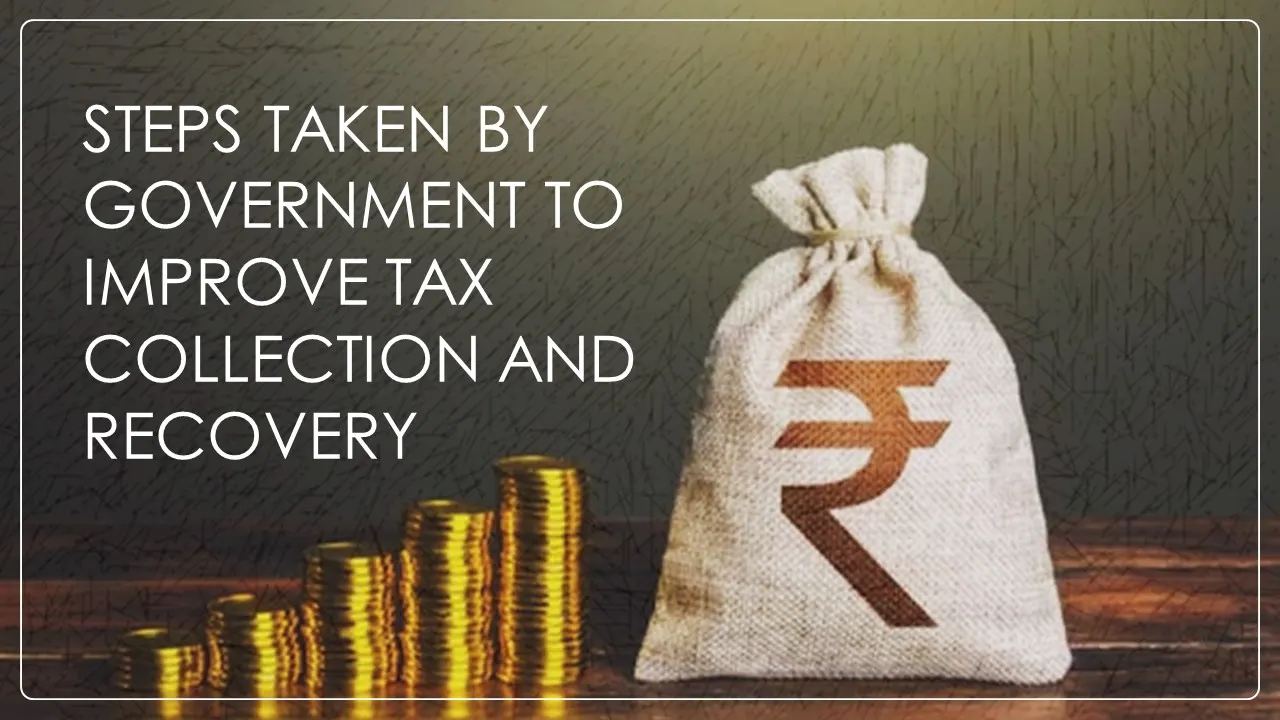
The Minister Pankaj Chaudhary, in a written reply to a question asked in Lok Sabha, said, “Steps Taken had been by Government to improve Tax Collection and Recovery”.
Government took steps to improve Tax Collection and Recovery
 Reetu
Reetu Mar 13, 2025
- Demand is stayed by courts/ITAT/IT authorities.
- Assessee is not traceable.
- There are no assets/inadequate assets for recovery.
- Arrear where appeal period is not over.
- Arrears in Litigation/Appeal: SC/HC/CESTAT/Commissioner (Appeal)/ Additional Secretary (Revision Application).
- Restrained Arrear: OL//DRT/BIFR/NCLT-Units taken over by Financial Institutions.
- Many assessees are not found at their registered addresses.
- Several pending cases involve businesses that have shut down.
- Defaulters are difficult to locate, and efforts are being made through FIU-IND to trace them.
- Some defaulters have filed writ petitions in the High Court, delaying recovery.
- Some assessees had leased land, preventing its attachment for recovery.
- Notices were sent to banks to freeze accounts and recover dues, but in many cases, accounts had insufficient or no balance.
(i) Phasing out of exemptions and deductions and simplification/rationalisation of tax laws.
(ii) Reducing litigation and widening of tax base by promoting voluntary compliance which includes New Form 26AS, Pre-filling of Income-tax Returns, E-Verification Scheme, facility to the taxpayer for Updated Return, and expansion of TDS/TCS by bringing new transactions into its ambit, etc.
(iii) Steps taken to promote digital transactions to create less cash economy such as TDS on cash withdrawal above a threshold.

(iv) Awareness programmes to generate awareness about the installments of advance tax, timely payment of self-assessment tax and regular assessment tax, etc.
(v) Other steps such as, making the payment of tax easier through online mode like RTGS, NEFT, Debt/credit card or Net Banking.
(vi) Launch of mobile app (available on Android/IOS platform) and responsive version of the Tax Payer Services (TPS) section at the national website called “Aaykar Setu” to facilitate online payment/calculation of the taxes.

(i) A Demand Facilitation Centre (DFC) for facilitation of arear demand management has been set up.
(ii) Monitoring the arrear demand reduction in respect of the top 5000 cases of arrear demand in all the jurisdictions.
(iii) Targets have been given to field formations for annual cash collection and reduction of the demand.
(iv) Specific steps have been outlined, such as litigation management, appeal/rectification effects, demand segregation, etc.
(v) Efforts of the assessing officer to collect/recover the outstanding demand are regularly reviewed/monitored by the superior authorities.
(vi) Databases like the Individual Transaction Statement and 360-degree profile generated by the Department and those maintained by other agencies like FIU-IND have been made available to the field units for identification of assets for recovery.
(vii) Guidelines for Tax Recovery Officers for recovery and guidelines to filed authorities for dealing with stay petitions have been issued.
In respect of indirect taxes, some of the recent policy measures taken by the Government, to improve tax collection mechanism and recovery are as under:i. In respect of the recoverable arrears, letters have been issued to the taxpayers from time to time for payment of outstanding Government dues and also issued Detention Notices. Correspondences with the local authorities (viz. RTO/ Municipality/ Sub-Registrar/ Banks) are being made for identification of the property and other details of the defaulters and also, placing alert in the EDI system for recovery of arrears. Letters are also being written to authorities like NSDL and CDSL, so that details of their investments could be obtained and recovery can be initiated.
ii. For cases under litigation, regular monitoring of the cases is being carried out for early disposal of the cases and taking proactive measures by filing Petition before legal forums such as Hon’ble CESTAT and Commissioner (Appeals) for early hearing, and prompt follow up of appeal.
iii. In cases, where PAN/ Bank Account details of the defaulters are identified, letters are being written to the Chief Compliance Officer/ Branch Manager of the banks so that Govt. dues could be recovered.
iv. All measures including visits to known addresses of assesses, issuance of Detention Notices, correspondence with other Govt. agencies viz. Income Tax, GST etc. are being made in all cases where recovery has not been stayed by any Appellate Authority/ Judicial fora.
v. Co-ordination with State Revenue authorities is being done at Commissionerate/ Divisional level in all the cases of arrears where defaulters are not traceable.
vi. Provisions have been made for cleaning up the taxpayer base by strengthening verification of business entities through Biometric-based Aadhaar authentication for new registrations.
vii. Centralized suspension of registrations pertaining to registered persons who do not file returns continuously for a period of six months is carried out in terms of provisions of Rule 21A of the CGST Rules, 2017.
viii. Provisions have been made to restrict the generation of E-way bills by non-compliant taxpayers.
ix. Availment of Input tax credit in respect of those invoices where details have not been furnished by the suppliers in their outward supply statement has been restricted to the eligible credit in respect of invoices the details of which have been furnished by the suppliers.
x. A registered person is not allowed to furnish the details of outward supplies under section 37 in FORM GSTR-1 if he has not furnished the return in FORM GSTR-3B for the preceding tax period.
xi. Electronic invoicing has been extended to cover taxpayers having aggregate turnover exceeding Rs.5 crores.
xii. Artificial intelligence based on network analysis have been implemented to identify risky taxpayers.
xiii. Nationwide special drive has been carried out against unscrupulous entities for availing and passing on Input Tax Credit (ITC) fraudulently on the strength of fake/bogus invoices.
The government, on the recommendations of the GST Council, has taken several reforms in GST. These measures have improved the GST compliance and increased the GST collection. These inter alia include:-i. Structural changes like calibration of GST rates for correcting inverted duty structure and pruning of exemptions;
ii. Measures for improving tax compliance such as mandating e-way bill, ITC matching, mandating e-invoice, deployment of artificial intelligence and machine-based analytics, aadhaar authentication for registration, calibrated action on non-filers, stop filers, targeted assessment-based action on risky tax payer, integration of e-way bill with fast tag etc.
System based analytical tools and system generated red flag reports are being shared with Central as well State Tax authorities to take action against tax evaders.About Author


Reetu
Content Manager
 Studycafe
 Delhi, Delhi, India
 8071
8071My Recent Articles
- Income Tax Guide for Indian Defence Personnel for Tax Filing, Taxable Allowances and Other Benefits
- Income Tax Return Breaking: ITR Forms released for AY 25-26
- Ex-DRT Officials Sentenced to 5 Years Rigorous Imprisonment by Madras High Court along with Rs.27 Lakh Fine
- GSTN issued Advisory on Case Sensitivity in IRN Generation
- RBI to issue Notes of Rs.10 and Rs.500 bearing Signature of Guv Malhotra
Loading suggestions…


Recent Posts
All Posts

Tags
No tags yet.
Recent Posts
All Posts
Tags
No tags yet.