Supreme Court refuses Tata Power's Depreciation Claim: consumers cannot be required to pay for electricity which they no longer received:
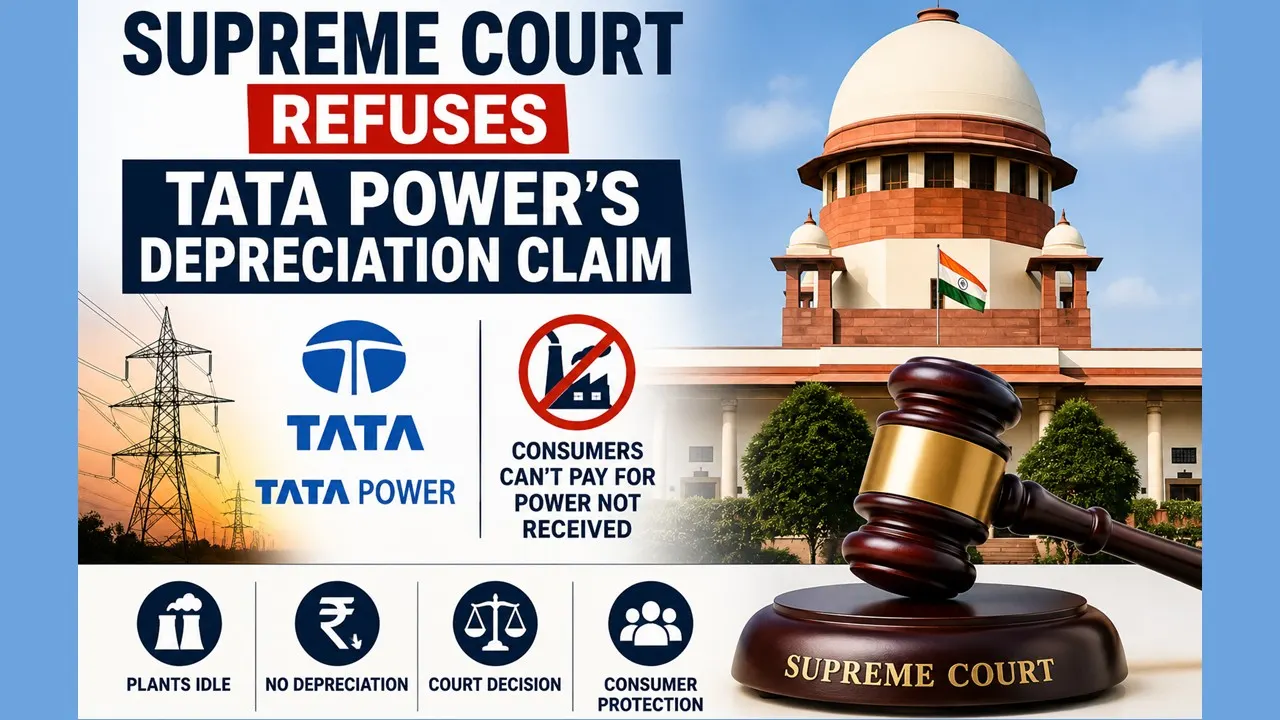
Supreme Court restores Delhi Electricity Regulatory Commission's order restricting depreciation recovery for Tata Power's Rithala Power Plant to six years.
Supreme Court restored DERC order restricting depreciation recovery period entirely
 Meetu Kumari
 May 18, 2026
The Supreme Court, in Delhi Electricity Regulatory Commission v. Tata Power Delhi Distribution Limited, delivered a significant ruling on 7 May 2026 clarifying that electricity consumers cannot be burdened with tariff recovery for a power plant that ceased supplying electricity after expiry of its approved operational period. A Bench comprising Justice Pamidighantam Sri Narasimha and Justice Alok Aradhe set aside the judgment of the Appellate Tribunal for Electricity (APTEL) and restored the Delhi Electricity Regulatory Commission’s (DERC) order restricting depreciation recovery of the Rithala Power Plant to its approved six-year operational period. The Court pointed out that:
“The consumers cannot be required to pay for a service which they no longer received.”

The dispute arose from the Rithala Combined Cycle Power Plant established by Tata Power Delhi Distribution Limited ahead of the Commonwealth Games 2010 to address Delhi’s temporary peak electricity demand. The project was conceived as a short-term arrangement with an operational tenure of five to six years, after which the land was to revert to the Delhi Development Authority. DERC had approved the plant’s operational framework only up to March 2018, although the technical useful life of the plant was assessed at fifteen years.
Subsequently, TPDDL sought recovery of the remaining depreciable capital cost beyond March 2018 through tariff mechanisms. DERC, however, restricted depreciation recovery to the actual operational period during which electricity was supplied to consumers. The Appellate Tribunal for Electricity later overturned this finding and held that the entire capital cost should be recoverable over the plant’s fifteen-year useful life under the applicable tariff regulations.

Before the Supreme Court, DERC argued that consumers could not be compelled to bear tariff charges for a plant that stopped supplying electricity after March 2018. It was also pointed out that TPDDL had the liberty to operate the plant as a merchant generator or sell power elsewhere after expiry of the approved supply arrangement.
The Supreme Court agreed with DERC and held that tariff determination is a regulatory balancing exercise requiring protection of consumer interests alongside reasonable cost recovery. The Court observed that Regulation 6.32 of the DERC Tariff Regulations, which provides for depreciation over the useful life of an asset, cannot be read in isolation and must operate harmoniously with the approved Power Purchase Agreement and Section 61(d) of the Electricity Act, 2003.
“Regulation 6.32… does not confer an absolute and unconditional right upon the generating utility to recover depreciation from the consumers even for a period when the asset is free to supply electricity.”
The Bench further held that TPDDL had accepted DERC’s 2017 order limiting the operational and tariff recovery framework to six years and could not later seek to reopen the issue during true-up proceedings. It clarified that true-up proceedings are intended to implement the existing tariff framework and not redesign it.
Thus, the Supreme Court allowed the appeal filed by DERC, set aside the APTEL judgment dated 10.02.2025, and restored DERC’s order dated 11.11.2019 restricting depreciation recovery to the six-year operational period of the plant.
To Read Full Judgment, Download PDF Given Below.
About Author


Meetu Kumari
Content Manager
 Studycafe
 Jodhpur, Rajasthan, India
 2264
2264My Recent Articles
- ITAT Condones 302-Day Delay, Restores Salary Assessment for Fresh VerificationPremium
- ITAT Condones Delay After Tax Consultant's Death, Restores Appeals for Fresh HearingPremium
- ITAT Remands Salary Addition, Says Taxability Depends on Salary Becoming Due, Not Mere ReceiptPremium
- ITAT Deletes TP Royalty Adjustment, Orders Fresh Review of Commission BenchmarkingPremium
- ITAT Quashes Reassessment Over Unsigned Section 148 Notice Issued to AssesseePremium
Loading suggestions…


Recent Posts


All Posts


Tags
Recent Posts
All Posts