Supreme Court: Section 269SS of IT Act Breach Does Not Invalidate Debt Under Section 138 of NI Act:
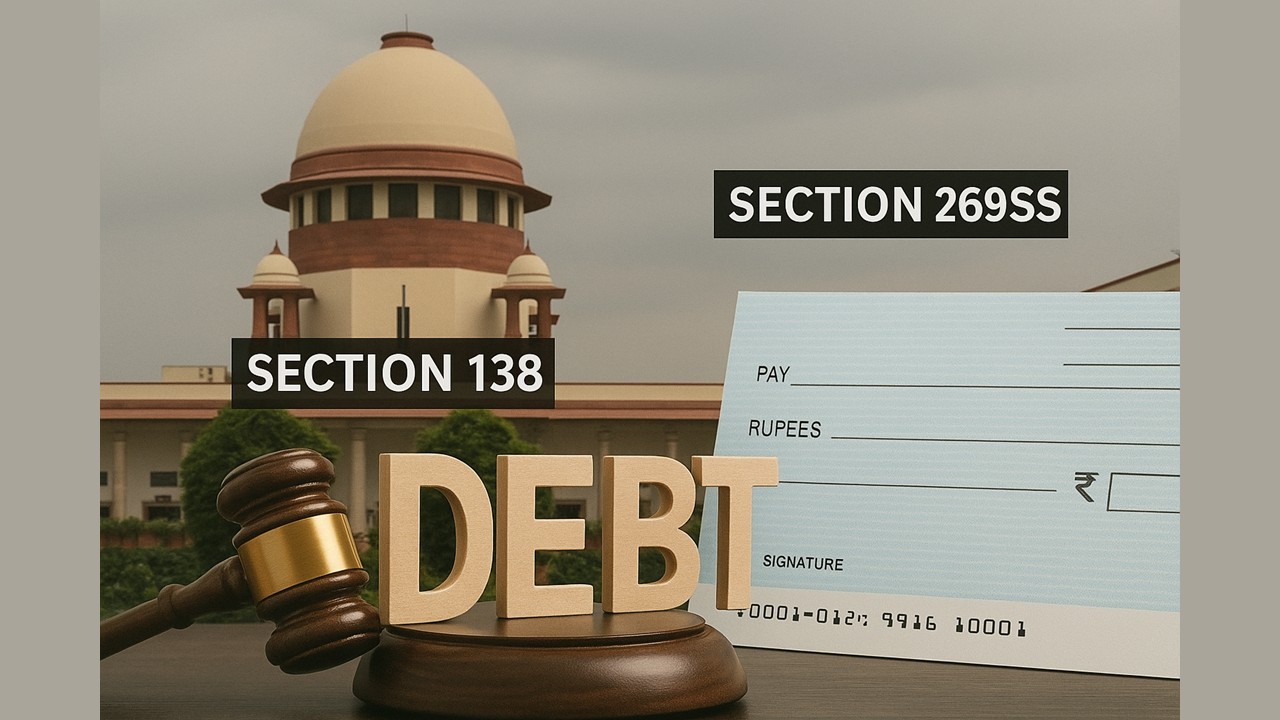
SC holds that a cash loan above Rs. 20k, in breach of Sec 269SS of IT Act, is still a 'legally enforceable debt' under Sec 138 NI Act. Issues new guidelines.
SC issues comprehensive guidelines for expeditious disposal of Section 138 cases
 Meetu Kumari
 Sep 27, 2025
Supreme Court: Section 269SS of IT Act Breach Does Not Invalidate Debt Under Section 138 of NI Act
The appeal challenged the ex-parte judgment dated 16th April 2009 passed by the High Court of Bombay at Goa, which acquitted the accused under Section 138 of the Negotiable Instruments Act, 1881 (NI Act). This order had overturned the concurrent findings of the Trial Court and Sessions Court that had convicted the accused. The dispute arose out of a dishonoured cheque issued by the accused in favour of the complainant for repayment of a friendly loan of Rs. 6,00,000/-.
Before the Trial Court and Sessions Court, the accused failed to produce any independent evidence to prove the financial incapacity of the complainant, who was earning a salary of Rs. 2,300/- per month. Instead, the accused only questioned his means and contended that a signed blank cheque was handed over for arranging a bank loan. Both lower courts rejected these defences, holding that the statutory presumptions under Sections 118 and 139 of the NI Act operated in favour of the complainant.
HC's Ruling: However, the High Court, exercising revisional jurisdiction, accepted the accused’s defence and acquitted him.
Main Issue: Whether a debt arising from a cash loan above Rs. 20,000/-, in violation of Section 269SS of the Income Tax Act, 1961, is not a 'legally enforceable debt' under Section 138 of the NI Act; and whether the High Court was justified in reversing concurrent findings of fact by the Trial Court and Sessions Court.
SC's Ruling: The Supreme Court allowed the appeal, set aside the High Court’s judgment, and restored the conviction recorded by the Trial Court and Sessions Court. It held that a breach of Section 269SS of the IT Act invites only a penalty under Section 271D and does not render the loan transaction illegal, void, or unenforceable for the purpose of Section 138 of the NI Act. Thus, the view that cash loans above Rs. 20,000/- are not legally enforceable debts was expressly rejected.
The Court affirmed that once issuance of the cheque is admitted, presumptions under Sections 118 and 139 of the NI Act arise. These presumptions were not rebutted by the accused, as mere questioning of the complainant’s financial capacity without any corroborative evidence was insufficient. The defense of having given a blank signed cheque was termed “unbelievable.” The Court also observed that a Revisional Court must not disturb concurrent factual findings unless they suffer from perversity.
Taking note of the massive backlog of cheque dishonour cases, the Court also issued detailed guidelines for their speedy disposal, which includes the following:
(i) mandatory dasti and electronic service of summons;
(ii) provision of online payment options such as QR codes/UPI links for pre-litigation settlement; (iii) standardized synopsis format for complaints; and
(iv) modified compounding cost guidelines in line with Damodar S. Prabhu.
The accused was finally directed to pay Rs. 7,50,000/- in 15 equated monthly instalments.
To Read Full Judgment, Download PDF Given Below
About Author


Meetu Kumari
Content Manager
Meetu Kumari is an Experienced Advocate and Content Writer with 4+ years of demonstrated history of working in the law practice industry. Skilled in Developing Content, Researching, and Drafting. Strong professional with a Bachelor of Science (B.Sc.) focused on Law from Gujarat National Law University.
Meetu Kumari is an Experienced Advocate and Content Writer with 4+ years of demonstrated history of working in the law practice industry. Skilled in Developing Content, Researching, and Drafting. Strong professional with a Bachelor of Science (B.Sc.) focused on Law from Gujarat National Law University.
 Studycafe
 Jodhpur, Rajasthan, India
 2264
2264My Recent Articles
- ITAT Condones 302-Day Delay, Restores Salary Assessment for Fresh VerificationPremium
- ITAT Condones Delay After Tax Consultant's Death, Restores Appeals for Fresh HearingPremium
- ITAT Remands Salary Addition, Says Taxability Depends on Salary Becoming Due, Not Mere ReceiptPremium
- ITAT Deletes TP Royalty Adjustment, Orders Fresh Review of Commission BenchmarkingPremium
- ITAT Quashes Reassessment Over Unsigned Section 148 Notice Issued to AssesseePremium
Up Next
Loading suggestions…


Recent Posts
All Posts
Tags
Recent Posts
All Posts