What is Article of Association (AOA)
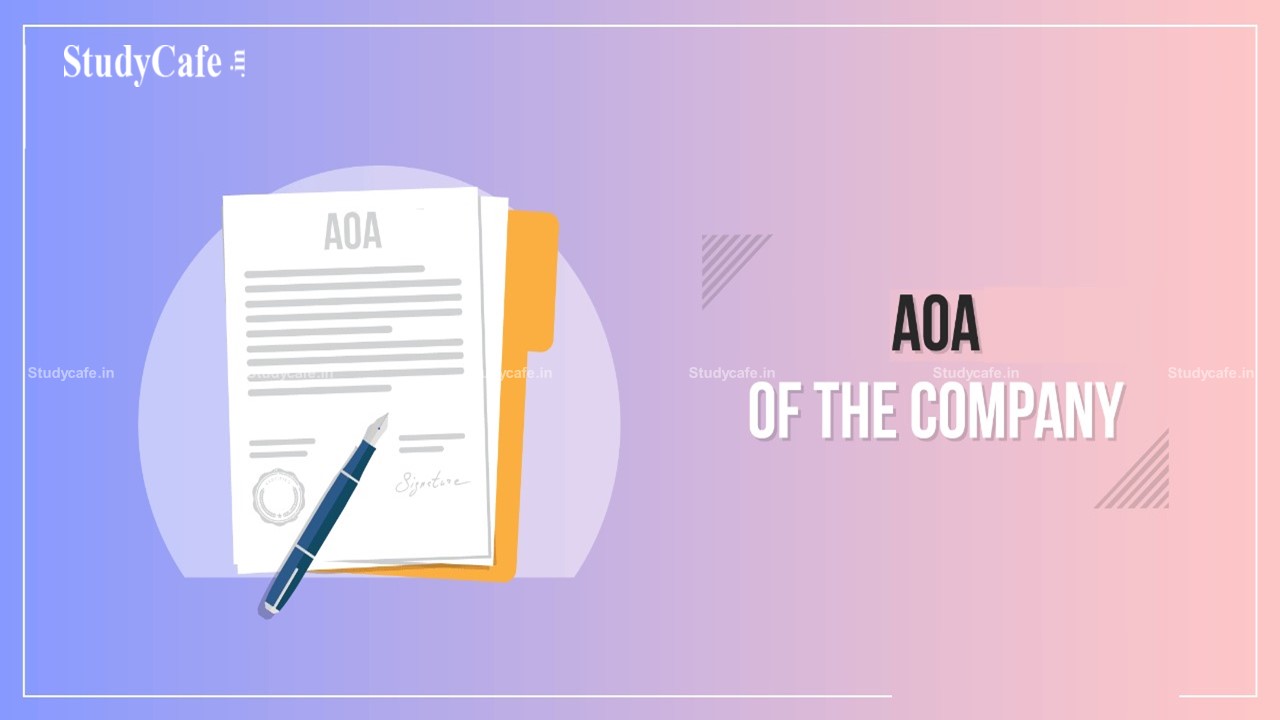
What is Article of Association (AOA) Article of Association plays a subsidiary part to the MOA. Anything done beyond the AOA will be considered to be…
 Shivani Bhati
 Feb 19, 2022
Table of Contents

What is Article of Association (AOA)
Article of Association plays a subsidiary part to the MOA. Anything done beyond the AOA will be considered to be irregular and may be ratified by the shareholders. The content of the AOA may differ from company to company as the Act has not specified any specific provisions. Flexibility is allowed to the persons who form the company to adopt the AOA within the requirements of the company law. The AOA will have to be conversant with the MOA, as they are contemporaneous documents to be read together. Any ambiguity and uncertainty in one of them may be removed by reference to the other.
Content of AOA as follows:
Share capital- No share shall be offered to the public for subscription except on the terms that the amount payable on application shall be at least 5% of the nominal amount or par value of the share, or, in the case of a share without nominal or par value, of the price of the share; and the directors shall, as regards any allotment of shares, duly comply with such of the provisions of the Companies Act as may be applicable thereto. Lien on shares- The Company shall have a lien on every share (not being a fully paid share) for all money (whether presently payable or not) called or payable at a fixed time in respect of that share, and the Company shall also have a lien on all shares standing registered in the name of a single person for all money presently payable by the person or the person’s estate to the Company; but the directors may at any time declare any share to be wholly or in part exempt from the provisions of this clause. The Company’s lien, if any, on a share shall extend to all dividends payable thereon. Calls on shares- The directors may from time to time make calls upon the members in respect of any moneys unpaid on their shares. The joint holders of a share shall be jointly and severally liable to pay all calls in respect thereof. Transfer and transmission of shares- The instrument of transfer of any shares in the Company shall be executed both by the transferor and transferee, and the transferor shall be deemed to remain the holder of the shares until the name of the transferee is entered in the register of members in respect thereof. Forfeiture of the shares- If a member fails to pay any call or installment of a call on the day appointed for the payment thereof, the directors may, at any time thereafter during such time as any part of such call or installment remains unpaid, serve a notice on the member requiring payment of so much of the call or installment as is unpaid, together with any interest which may have accrued. General meetings- The first annual general meeting shall be held within 16 months from the date on which the Company is entitled to commence business, and thereafter an annual general meeting shall be held once in every calendar year at such time, not being more than 16 months after the holding of the last preceding annual general meeting, and place as may be prescribed by the Company in general meeting, or, in default, at such time in the month following that in which the anniversary of the Company’s last annual general meeting occurs, and at such place as the directors shall appoint. In default of the meeting being so held, the meeting shall be held in the month next following, and may be convened by any 2 members in the same manner as nearly as possible as that in which meetings are to be convened by the directors. Alteration of the capital- The company may by special resolution alter the conditions of its memorandum so as to increase its authorized share capital- a. by the creation of such number of new shares of such amount, or
- b. by the creation of such number of new shares without nominal or par value if the Company is authorized to issue such shares, as the special resolution shall prescribe.
- a. of all sums of money received and disbursed by the Company and the matters in respect of which such receipt and expenditure took place,
- b. of all sales and purchases of goods by the Company,
- c. of the assets and liabilities of the Company, and
- d. all other transactions affecting the financial position of the company.
About Author


Shivani Bhati
Intern
 Studycafe
 Delhi, Delhi, India
 210
210My Recent Articles
- Important considerations when choosing an active equities mutual fund
- Ethos IPO opens today with price band fixed at Rs 836-878 per equity share: Know more about other key details
- Paradeep Phosphates IPO starts today: Learn about GMP, Price Band and other Key Details
- On the NSE, LIC shares finish 8.01 percent lower than their issue price after a dismal start
- This Mutual Funds is all set to give more than 80% of returns
Up Next
Loading suggestions…


Recent Posts
All Posts
Recent Posts
All Posts