Anisha Kumari | May 19, 2025 |
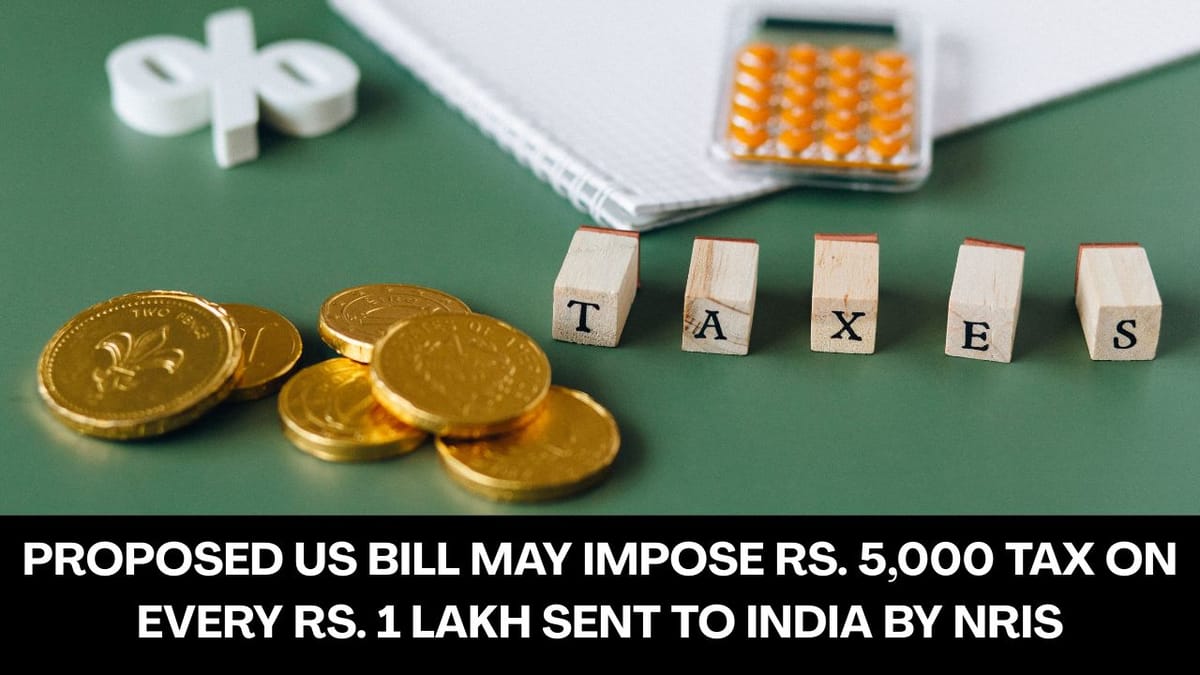

Proposed US Bill May Impose Rs. 5,000 Tax on Every Rs. 1 Lakh Sent to India by NRIs
A pending bill in America, the “Big Beautiful Bill”, is troubling Non-Resident Indians (NRIs), especially those who are remitting money to India. The draft bill, supported by the Republican party, proposes to levy a 5% duty on all foreign remittances sent by foreign nationals. If the bill is enacted, it is likely to be operational from July 4, 2025, and sending money to support families in India will be much more costly for NRIs.
A remittance of $1,160 (about Rs. 1 lakh) could be liable for a tax of Rs. 5,000 under the new rule. The tax sum would be accumulated by remittance service providers like Western Union, MoneyGram, or banks and handed over to the US government quarterly.

This suggested tax would be on people in the US on visas such as H-1B, F-1, or J-1, green card holders, and illegal immigrants. The tax also applies if the remittance is received through a provider not officially approved by the US Treasury.
Only ascertained US nationals or citizens would be exempt and even so, only if they utilize a “qualified” remittance provider that can verify their citizenship. If an unwitting US citizen is taxed, a legitimate Social Security Number (SSN) would be necessary to qualify for a refund when filing their tax returns.
Industry analysts equated the new US proposal to India’s own Tax Collected at Source (TCS) guidelines under the Liberalized Remittance Scheme (LRS), observing that this US proposal might operate in the same way as an advance tax remitted by the remitter, with credit subsequently allowed on SSN basis.
India, which was the recipient of remittances valued at $125 billion in 2023, is the global leader in foreign remittance receipts. Approximately 28% of these came from the US. With close to 4.5 million Indians living in the US of which around 3.2 million are Indians of origin India has much to lose due to any increase in tax on outward remittances sent from the US.
This extra cost on remittances would decrease inflows to India, thus affecting foreign exchange reserves and potentially putting pressure on the Indian rupee. These funds are usually critical to enable families to cover education, healthcare, and real estate investments in Indian cities like Mumbai, Hyderabad, and Kochi.
Experts pointed out that although the tax may look like a minor surcharge, its effects are broad, especially regarding trust, financial support flow, and long-term planning for NRIs.
The bill, if passed, would result in various changes for Indian immigrants in the US:
For persons who plan to return to India, this tax may seem to work out to 5% less for each dollar remitted back home. Remittance behavior change and sound financial planning may become a necessity.
The new tax might have a drastic effect on Indian families, particularly in tier-II and tier-III cities, where the remittances help meet fundamental requirements such as education, healthcare, rent, and loan EMIs. The effects might also trickle down to industries like real estate, banking, and retail, which highly value the contributions of NRIs.
Remittances are viewed neither as speculative or profit-oriented exchanges but as extremely intimate financial obligations that enable families and communities to endure over generations.
Opponents of the pending bill claim it discriminately punishes immigrants and the poor for sending earnings to their relatives. In contrast to other types of income or capital gain taxes, this pending tax would levy money already taxed both federally and at the state level in America.
The fact that it does not confer a direct service or benefit in return makes this tax seem solely extractive. It is viewed by opponents as sending the wrong message to immigrant communities and devaluing cross-border economic responsibility.
While the bill remains open for debate and needs to clear both chambers of Congress to become law, its potential to upset the financial ecosystem for NRIs and their families is already being hotly debated.

In case of any Doubt regarding Membership you can mail us at [email protected]
Join Studycafe's WhatsApp Group or Telegram Channel for Latest Updates on Government Job, Sarkari Naukri, Private Jobs, Income Tax, GST, Companies Act, Judgements and CA, CS, ICWA, and MUCH MORE!"