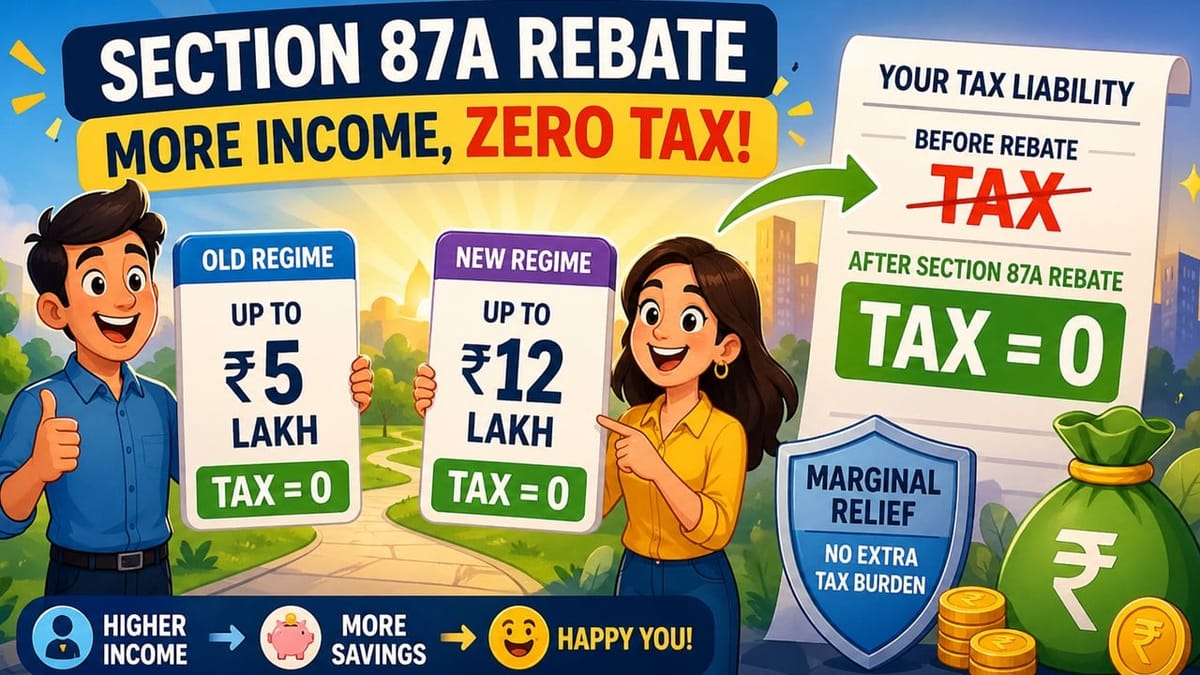
Section 87A rebate reduces tax liability for individuals. Up to Rs 5 lakh (old regime) and Rs 12 lakh (new regime) income, tax becomes zero. Marginal relief prevents excess tax burden beyond limits.
Kashish Bhardwaj | Apr 29, 2026 |

Section 87A Rebate Explained: Zero Tax up to Rs 12 Lakh & Marginal Relief Rules Simplified
It is mandatory for every taxpayer to file an Income Tax Return (ITR). Nowadays, it has become easier to do it online, but for those who file for the first time, it may seem a bit difficult. In this process, one gets a benefit that is called a “tax rebate”. This is given under Section 87A.
What is a tax rebate, and how much is it?

“Tax rebate” means a fixed amount is reduced from your total tax. This is especially to provide relief to low and middle-income people.
How does the rebate apply?
The rebate is applied to your total tax amount. This is different from deduction or exemption.

First, your entire tax is calculated. After that, the rebate is deducted from it. Then a 4% health and education cess is added to it.
How to take a rebate while filing an ITR?
To avail a rebate, you have to follow some easy steps. First, calculate your total income for the entire year. Then subtract from it whatever exemptions and deductions are available, such as exemptions related to investments or savings.
After this, your taxable income emerges. If it is within the prescribed limit, you can claim a rebate under Section 87A. This facility is available in ITR-2 and ITR-3 forms.
What is marginal relief?
In the new tax system, even if your income exceeds Rs 12 lakh, you can get relief. This is called marginal relief.
If your income is Rs 12.15 lakh, then Rs 15,000 is more than Rs 12 lakh. In such a situation, if the tax is too high, it is reduced so that it does not exceed the additional income.
For example:
This reduces your tax significantly.
In which cases is a rebate not available?
This rebate is not available in certain situations:
“Rebate” means a direct tax cut. This is available under Section 87A. Deductions reduce your taxable income, such as exemptions on investments. Exemption means not being taxed on some income.

In case of any Doubt regarding Membership you can mail us at [email protected]
Join Studycafe's WhatsApp Group or Telegram Channel for Latest Updates on Government Job, Sarkari Naukri, Private Jobs, Income Tax, GST, Companies Act, Judgements and CA, CS, ICWA, and MUCH MORE!"