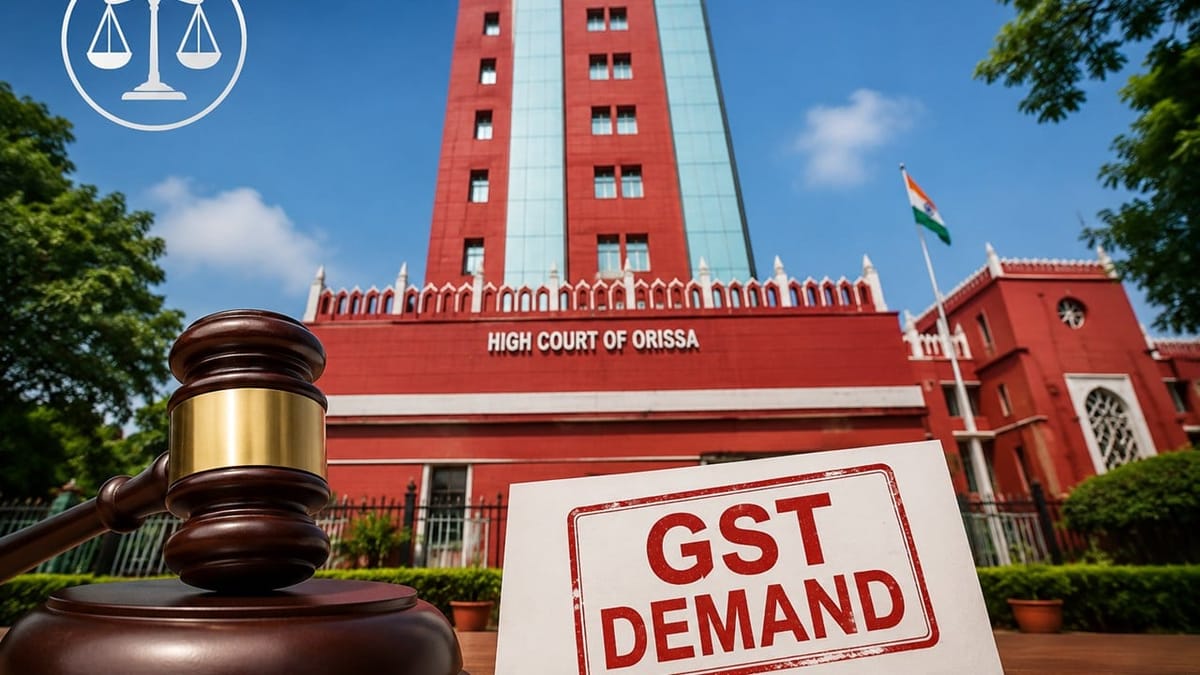
The High Court of Orissa, in the case of M/s. Nihar Ranjan Routray vs. Assistant Commissioner of State Tax (WP(C) No. 11754 of 2026), on 5 May 2026 declined to entertain a writ petition challenging a GST demand order, holding that the petitioner must first exhaust the statutory appellate remedy available under Section 107 of the GST Act. A Division Bench comprising Chief Justice Harish Tandon and Justice M.S. Raman observed that although the High Court possesses writ jurisdiction under Article 226 of the Constitution, such jurisdiction ordinarily should not be exercised when an effective alternative remedy is available under the statute.
The dispute arose after the department issued an ASMT-10 notice alleging excess claim of Input Tax Credit (ITC) in GSTR-3B returns as compared to GSTR-2A/2B for the financial year 2021-22. Subsequently, the Assistant Commissioner of State Tax, Kendrapara Circle, confirmed a demand of Rs. 2.65 lakh against the petitioner through an order dated 26 December 2025. Aggrieved by the order, the petitioner directly approached the Orissa High Court seeking interference under Article 226. The court held that:
The Bench reiterated that where a statutory mechanism for appeal is available, the writ court normally refrains from bypassing such remedy except in exceptional circumstances involving jurisdictional error, breach of natural justice, or constitutional challenge.
Relying upon settled principles laid down by the Supreme Court on exhaustion of alternate remedies, the Court held that entertaining writ petitions in tax matters despite availability of statutory appeal would defeat the legislative framework governing GST adjudication. The Bench clarified that the rule requiring exhaustion of remedies is based on “policy, convenience and discretion” and is consistently followed by constitutional courts.
The Court further observed that the petitioner had approached the High Court within the period during which a statutory appeal could still be pursued, and therefore deserved an opportunity to avail such remedy.
Thus, the High Court disposed of the writ petition with liberty to the petitioner to file an appeal under Section 107 within seven days. It further directed the appellate authority to treat the appeal as filed within limitations and decide the matter on merits subject to compliance with statutory requirements, including pre-deposit conditions.