ITAT held that Section 40A(2)(a) cannot be invoked merely for related-party share purchases shown as long-term investments, especially when no expenditure is claimed and FMV is determined without proper valuation.
Saloni Kumari | May 19, 2026 |
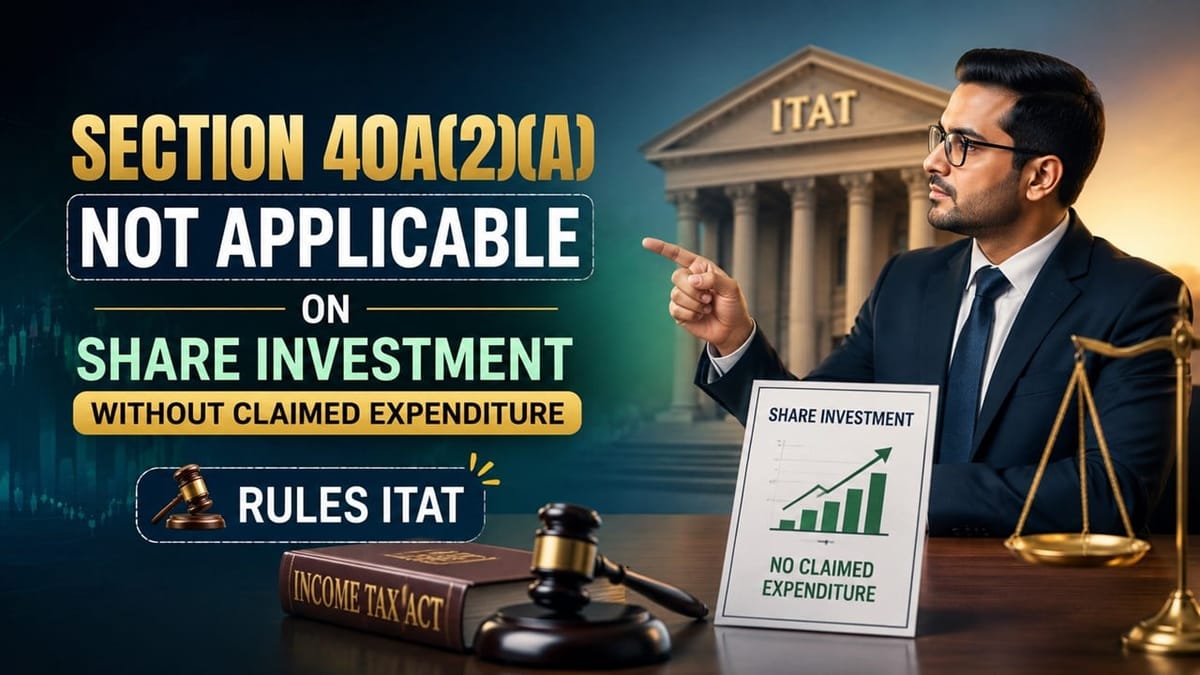

Income Tax: Section 40A(2)(a) Not Applicable on Share Investment Without Claimed Expenditure, says ITAT
ITAT Ahmedabad held that Section 40A(2)(a) could not be invoked merely because shares were purchased from an associate concern, especially when they were shown as long-term investments and no related expenditure was claimed. It also ruled that fair market value cannot be determined solely on face value without proper valuation.

The company had issued shares of Rs 1.22 crore to its related entity and, in return, purchased 67,500 shares of another private company at Rs 180 per share. The Assessing Officer argued that the face value of those shares was only Rs. 10 each and treated the excess amount paid as an unreasonable expenditure. Considering that the company had made an excessive payment to its associate concern while purchasing shares, the income tax authorities made an addition amounting to Rs 1.14 crore on the company’s income under Section 40A(2)(a) of the Income Tax Act.
Being aggrieved with the tax authorities’ action, the assessee filed an appeal before the ITAT Ahmedabad, claiming that the shares were purchased as long-term investments and were shown in the balance sheet as non-current investments. It was further claimed that no expenditure relating to the transaction had been claimed in the Profit and Loss Account, making Section 40A(2)(a) inapplicable. Further, the company pointed out that the shares had not been sold during the year and therefore no profit or loss had arisen.

When the tribunal heard the arguments from both sides, it noted that simply because the company’s business objects included dealing in shares, every purchase could not automatically be treated as stock-in-trade. The Tribunal also noted that the tax authority adopted the face value as fair market value without any proper valuation exercise or supporting evidence. Accordingly, the Tribunal set aside the matter and sent it back to the Assessing Officer for fresh examination.

In case of any Doubt regarding Membership you can mail us at [email protected]
Join Studycafe's WhatsApp Group or Telegram Channel for Latest Updates on Government Job, Sarkari Naukri, Private Jobs, Income Tax, GST, Companies Act, Judgements and CA, CS, ICWA, and MUCH MORE!"