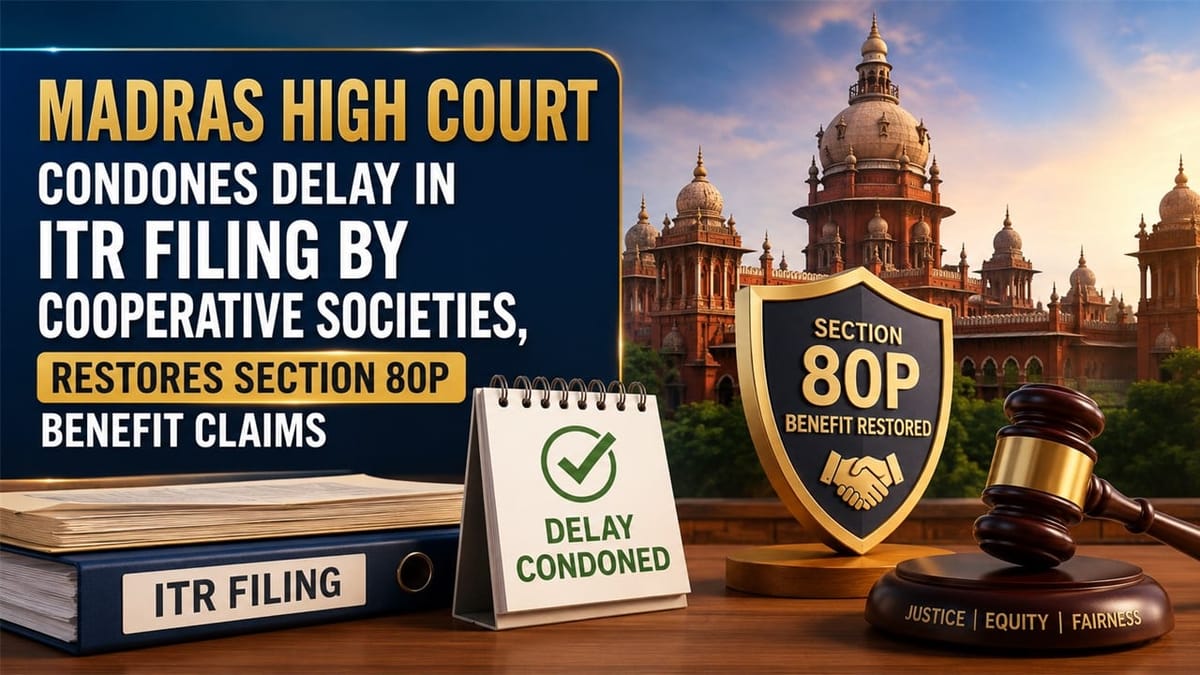
Madras High Court Condones Delay in ITR Filing by Cooperative Societies, Restores Section 80P Benefit Claims

High Court condones return filing delays and protects Section 80P deduction claims of societies.

Delayed Statutory Audits Held Sufficient Ground for Condonation Relief

Meetu Kumari | Jun 6, 2026 |

Madras High Court Condones Delay in ITR Filing by Cooperative Societies, Restores Section 80P Benefit Claims

Madras High Court Condones Delay in ITR Filing by Cooperative Societies, Restores Section 80P Benefit Claims

The Madurai Bench of the Madras High Court held that Cooperative Societies cannot be denied the benefit of deduction under Section 80P of the Income Tax Act merely on account of delay in filing income tax returns, particularly when such delay arose due to genuine hardships, including non-completion of statutory audits. Justice D. Bharatha Chakravarthy set aside the orders of the Chief Commissioners of Income Tax rejecting applications for condonation of delay and granted relief to hundreds of Cooperative Societies across Tamil Nadu.

The petitioners, comprising various Primary Agricultural Cooperative Credit Societies and other Cooperative Societies, challenged orders rejecting their applications for condonation of delay in filing income tax returns. The societies contended that although their income was eligible for deduction under Section 80P, the introduction of Section 80AC with effect from 1 April 2018 made timely filing of returns mandatory for claiming such deduction. Owing to delays in completion of statutory audits, lack of technical expertise and difficulties arising during the COVID-19 period, the returns could not be filed within the prescribed due dates.

Before the Court, the Cooperative Societies argued that the object of the CBDT circular was to alleviate genuine hardship faced by such societies and that denial of deduction solely for procedural delays would defeat the purpose of Section 80P. They also relied upon earlier judicial precedents where courts had adopted a liberal approach in matters involving condonation of delay. “The denial of the same, solely because there is a delay in filing the returns, should be considered a procedural aspect pitted against the substantive entitlement.”

The High Court observed that the activities carried on by the petitioner societies undisputedly qualified for deduction under Section 80P. It noted that the cooperative movement plays a vital role in promoting inclusive socio-economic growth, particularly in rural areas, and enjoys constitutional recognition through Article 43B. The court further held that the hardship faced by the societies in complying with the newly introduced filing requirements was genuine and had already been recognised by the CBDT through its circulars.

The court found that the tax authorities had adopted an unduly technical and restrictive interpretation of the CBDT circular by insisting on detailed explanations for every stage of delay instead of considering its beneficial object. It held that the circular was intended to provide administrative relief and should be applied in a liberal manner.

“The authority adopted a hyper-technical approach by confining the consideration of condonation strictly to the delay in filing the statutory audit report and further insisted upon an explanation for each day’s delay.”

The court also took note of an affidavit filed by the Registrar of Cooperative Societies stating that steps had been initiated to ensure timely filing of returns in future, including issuance of departmental instructions, permitting engagement of professionals, and implementation of an e-governance platform for monitoring statutory compliance.

Holding that substantial justice should prevail over procedural lapses where there was no allegation of tax evasion, the Court quashed all impugned orders rejecting condonation applications. It directed that the delay in filing returns be treated as condoned, permitted the Cooperative Societies to rely upon the returns already filed, and directed appellate and assessment authorities to proceed accordingly in accordance with law. The writ petitions were accordingly allowed.

To Read Full Judgment, Download PDF Given Below.

StudyCafe Membership

Join StudyCafe Membership. For More details about Membership Click Join Membership Button
Join Membership

In case of any Doubt regarding Membership you can mail us at [email protected]

Join Studycafe's WhatsApp Group or Telegram Channel for Latest Updates on Government Job, Sarkari Naukri, Private Jobs, Income Tax, GST, Companies Act, Judgements and CA, CS, ICWA, and MUCH MORE!"





Author Bio
My Recent Articles
HC Quashes GST Assessment Order as Personal Hearing Was Fixed Before Reply Deadline Company Clarifies Interim Market Regulator Order, Rejects Fraud Allegations ITAT Deletes Penny Stock Additions Backed Only by Suspicion Madras High Court Condones Delay in ITR Filing by Cooperative Societies, Restores Section 80P Benefit Claims HC Permits Restoration of GST Registration After Return ComplianceView All Posts