President Notifies Lakshadweep Excise Regulation, 2026, to Regulate Manufacture, Sale and Consumption of Liquor:
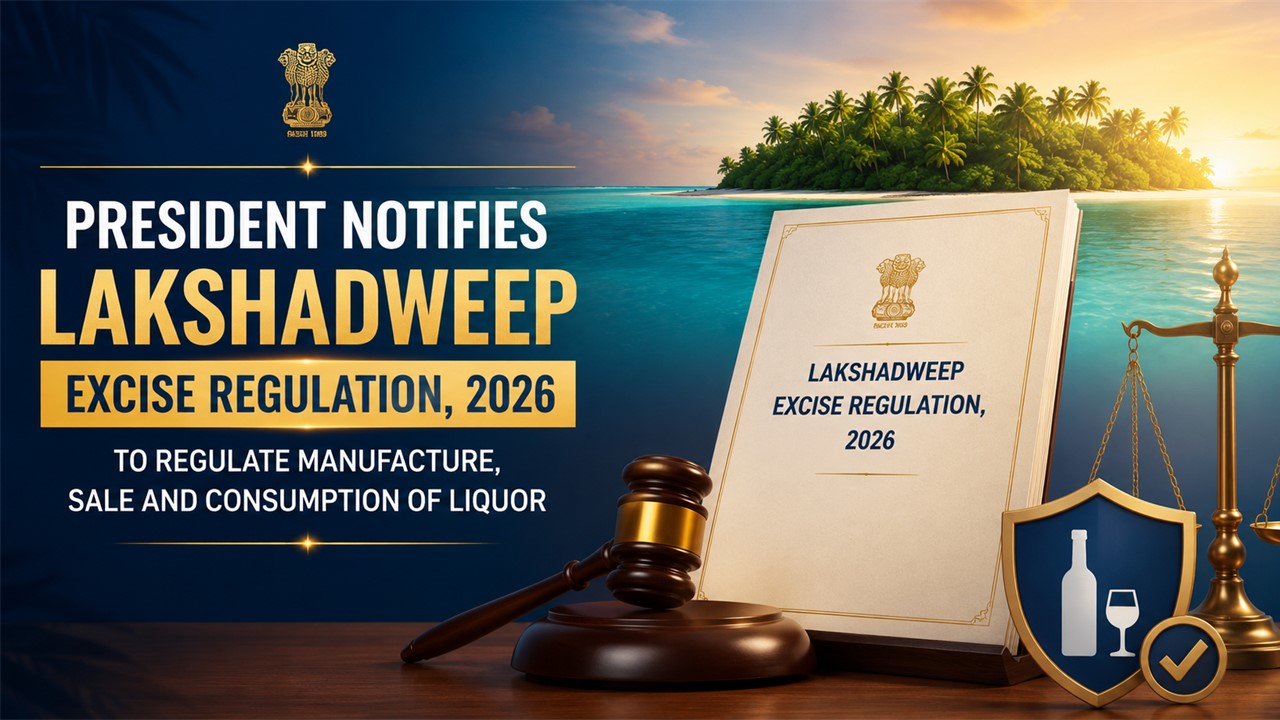
Lakshadweep Excise Regulation, 2026 establishes a comprehensive legal framework for the manufacture, possession, import, export, sale, consumption, and taxation of liquor in the Union Territory of Lakshadweep.
President Issues Lakshadweep Excise Regulation, 2026
 Saloni Kumari
 Jun 6, 2026
President Notifies Lakshadweep Excise Regulation, 2026, to Regulate Manufacture, Sale and Consumption of Liquor
The President of India, under the Legislative Department of the Ministry of Law and Justice, has issued the Lakshadweep Excise Regulation, 2026, in the seventy-seventh year of the Republic of India.
On June 05, 2026, the regulation was published in the Gazette of India Extraordinary Part II, under Article 240 of the Constitution in Extra. It is an act that regulates the manufacture, possession, import, export, transport, purchase, sale, and consumption of liquor in the Union Territory of Lakshadweep. The regulation lays down provisions relating to the levying and collection of excise duties on alcoholic products and matters incidental thereto.
The regulation includes rules for the imposition of excise duty that will be extended to the whole of the Union territory of Lakshadweep and will come into force on the date to be notified by the Administrator.
The regulation uses several words or terminology associated with the manufacture of liquor, such as alcohol, alcoholic beverage, beer, country liquor, foreign liquor, Indian liquor, brewery, distillery, winery, and process, that are defined in the regulation itself.
In accordance with this Act, 'alcohol' refers to ethyl alcohol, whereas 'liquor' denotes alcoholic beverages like whisky, brandy, rum, vodka, beer, wine, toddy, country liquor, and others. The Regulation defines the differences between Indian liquor, country liquor, and foreign liquor and sets out different classification systems that apply to the respective categories. Moreover, it describes blending, compounding, bottling, manufacturing, and other activities related to the production of liquors.
Similarly, 'administration' refers to the administrator of the union territory of Lakshadweep appointed by the president under Article 239 of the Constitution, and 'appellate authority' refers to the authority discussed under section 84.
Refer to the official PDF for the regulation for complete information.
About Author


Saloni Kumari
Content Writer
Saloni is a Content Writer with 2+ years of experience at studycafe.in. She writes legal, taxation, and finance related content including GST, Income Tax etc. Skilled in translating complex judicial pronouncements and regulatory developments into clear, and reader-friendly articles. Experienced in covering judgements of ITAT, High Court, GSTAT, and news related to Income Tax, GST, and corporate law. She can be reached at [email protected].
Saloni is a Content Writer with 2+ years of experience at studycafe.in. She writes legal, taxation, and finance related content including GST, Income Tax etc. Skilled in translating complex judicial pronouncements and regulatory developments into clear, and reader-friendly articles. Experienced in covering judgements of ITAT, High Court, GSTAT, and news related to Income Tax, GST, and corporate law. She can be reached at [email protected].
 StudyCafe
 Delhi, Delhi, India
 2889
2889My Recent Articles
- ITAT Sets Aside Rejection of Charitable Trust’s Section 12AB Registration Application, Remands Case to CIT(E) for Fresh Consideration
- Can Same-Sex Partners Claim Tax Exemption on Gifts as Spouses? Karnataka High Court to Examine
- ITAT Remits Section 80G Renewal Application to CIT(E) for Fresh Consideration in Light of CBDT Circular
- Dreamfolks Services Faces Rs 1.58 Crore IGST Demand Over ITC Availment on Invoices Issued by GST-Cancelled Supplier
- ITAT Restores Taxpayer's Appeal In Interest of Natural Justice After CIT(A)'s Failure to Decide Appeal on Merits
Up Next
Loading suggestions…


Recent Posts
All Posts
Tags
Recent Posts
All Posts